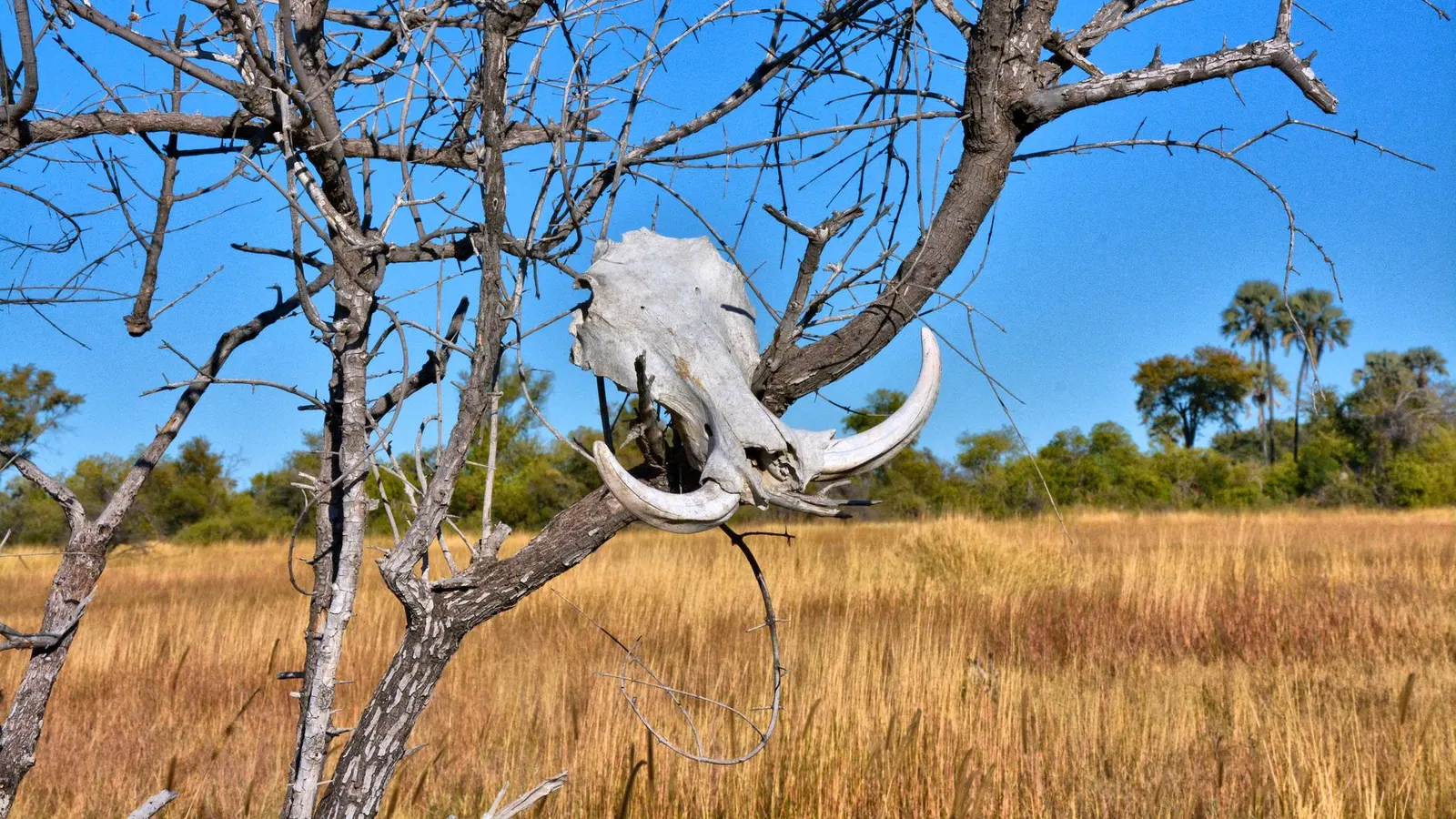
 Mark de Jong · Pexels License
Botswana
“A river that flows into a desert, and the largest elephant population on earth.”
The Okavango is a river that never reaches the sea. It flows out of Angola and spreads across the Kalahari into a delta of channels, islands and floodplain, and the flood arrives around June — six months after the rain that caused it, and at the driest point of the local year. That timing is why the delta is extraordinary: water arriving as everything else dries out, concentrating wildlife on it.
Botswana chose a high-value, low-volume tourism model decades ago, which means concession fees, small camps and prices that put a delta safari among the most expensive on the continent. Chobe in the north has the largest elephant population anywhere, and the Central Kalahari is one of the largest reserves on earth. The self-drive alternative — camping in the parks with a 4WD — is a genuinely different and far cheaper trip for people equipped to do it.
Highlights
The Okavango Delta
Channels and islands explored by mokoro dugout, motorboat and game drive, with the flood peaking around June to August. Camps are small, fly-in and expensive; the Moremi reserve within it is self-drivable.
Chobe
The largest elephant population on earth along the Chobe riverfront, best seen from a boat in the late afternoon when the herds come down to drink. Easily reached from Kasane and Victoria Falls.
The Makgadikgadi pans
Salt flats the size of Portugal, with quad biking on the crust in the dry season, meerkat habituated colonies, and a zebra migration that few people have heard of.
The Central Kalahari
One of the largest protected areas in the world — black-maned lions, Deception Valley after the rains, and a silence that is the point of going.
Entry requirements for Botswana
Checking your passport…
We don't hold entry details for this passport group yet.
Before you fly
The detail
- Passport validity
- Most destinations want validity beyond your stay, and some want six months. Check yours against the return date.
- Onward travel
- Airlines may ask for a return or onward ticket at check-in.
- Health
- Malaria prophylaxis is recommended in the north including the delta and Chobe, particularly from November to June; the Kalahari and the south are lower risk. Hepatitis A and typhoid are standard. Yellow fever certificate required if arriving from an endemic country. Healthcare is limited outside Gaborone and Francistown — evacuation cover is essential and camps normally require it. Do not drink untreated water in the bush.
- Money
- Pula. Cards work in towns and at lodges; carry cash for park fees in some cases, tips and remote areas. ATMs are in towns only. Tipping guides and camp staff is expected and camps publish guidelines. Note that camps are almost always all-inclusive, so day-to-day spending is small.
When to go
BestApr–Oct.
Drying out, mild and quiet — excellent value before the season.
The band above each month is our editorial verdict - it weighs crowds, prices and access as well as weather. The line is average daily temperature, the bars are monthly rainfall. Select a month for the figures. Climate figures: ERA5 reanalysis via Open-Meteo, 2005–2024 normals.
What it costs
A day in Botswana
Comfortable · sample day
≈ $238
Line items are real prices we track. The daily budget is an editorial estimate for this level, not their sum.
Where this sits among 244 countries we have costed
The gap between green season and peak is the largest of any country in this batch — a delta camp can be €350 in February and €1,000 in August. Park fees themselves are modest and fixed. Self-drive costs barely move seasonally, which makes the green season an exceptional value proposition for anyone equipped for mud.
Updated Aug 2026 · Editorial synthesis — DWNP park tariffs, camp and rental quotations, charter fares (2025–2026) · confidence high
Excludes international flights - they depend on where you fly from.
Regions to know
5The Okavango Delta
Channels, islands and floodplain — Moremi for self-drivers, the private concessions for fly-in camps.
Chobe & the north
The riverfront elephant herds, Savuti's predators, and Kasane on the four-country border point.
The Makgadikgadi & Nxai pans
Salt flats, baobabs, meerkats and a zebra migration between the pans and the Boteti river.
The Central Kalahari
One of the world's largest reserves — black-maned lions, Deception Valley and near-total silence.
The southeast & Tuli
Gaborone, the Tswapong hills, and the Tuli block's riverine wilderness on the Limpopo.
Practical guide
Getting there
Maun (MUB) is the delta gateway and Kasane (BBK) serves Chobe, both reached via Johannesburg or Gaborone. Many visitors arrive overland from Victoria Falls in Zimbabwe, which is 80 kilometres from Kasane. The Kazungula bridge links Zambia. Gaborone (GBE) is the capital airport and is not where safaris start.
Getting around
Light aircraft between camps is the standard, and the flights over the delta are a highlight in themselves with a strict luggage limit — usually 20 kilograms in a soft bag. Self-drivers use a 4WD and book campsites months ahead. The tarred road network between towns is good; the park tracks are deep sand and require experience.
Money & costs
Pula. Cards work in towns and at lodges; carry cash for park fees in some cases, tips and remote areas. ATMs are in towns only. Tipping guides and camp staff is expected and camps publish guidelines. Note that camps are almost always all-inclusive, so day-to-day spending is small.
Safety
Very safe from crime, with Botswana among the more stable and better-governed countries in Africa. The risks are wildlife and remoteness — camps are unfenced, elephants and hippos move through them, and the rules about not walking at night are not decorative. Self-drivers face deep sand, no phone coverage and no recovery service. Carry recovery gear and travel in convoy in the Kalahari.
Health
Malaria prophylaxis is recommended in the north including the delta and Chobe, particularly from November to June; the Kalahari and the south are lower risk. Hepatitis A and typhoid are standard. Yellow fever certificate required if arriving from an endemic country. Healthcare is limited outside Gaborone and Francistown — evacuation cover is essential and camps normally require it. Do not drink untreated water in the bush.
SIM & internet
Mascom and Orange SIMs work in towns and along main roads. Delta camps have satellite wifi that is often deliberately limited, and much of the Kalahari has nothing. Assume no coverage in the parks and tell someone your route if self-driving.
Driving
Park tracks are deep sand and demand a proper 4WD, low-range gearing and tyre-pressure management — this is not a country to learn off-road driving in. Elephants have right of way and mean it. Foot-and-mouth control gates require you to drive through disinfectant and declare meat and dairy; they are on the main routes and are not optional.
Rules change - verify with an official source before you rent.
ExplWorld VerifiedNo verified partners here yet - all 6 country seats are open.
Become ExplWorld Verified →Itineraries through this country
From the Journal
Before you go
BotswanaFrequently asked questions
Why is it so expensive?
By policy. Botswana chose a low-volume, high-value model in the 1990s: limited concessions, small camps, high fees, and no mass-market development. A delta camp runs €600–1,500 per person per night all-inclusive with light-aircraft transfers. What you get is genuine exclusivity and a conservation model that works. What you do not get is a cheap option inside the concessions.
Is there an affordable way to do it?
Yes — self-drive camping. Moremi, Chobe, Nxai Pan and the Central Kalahari all have public campsites bookable in advance, and a fully equipped 4WD with rooftop tents costs €120–180 a day. You need genuine off-road competence: deep sand, water crossings and no recovery service. It is the same wildlife for a fifth of the price and considerably more work.
When does the delta flood?
Around June to August, peaking in July, from rain that fell in the Angolan highlands the previous December. This means the delta is at its wettest in the dry season, which is why that is the best time to be there. The water level varies year to year and affects which camps have channels deep enough for mokoro.