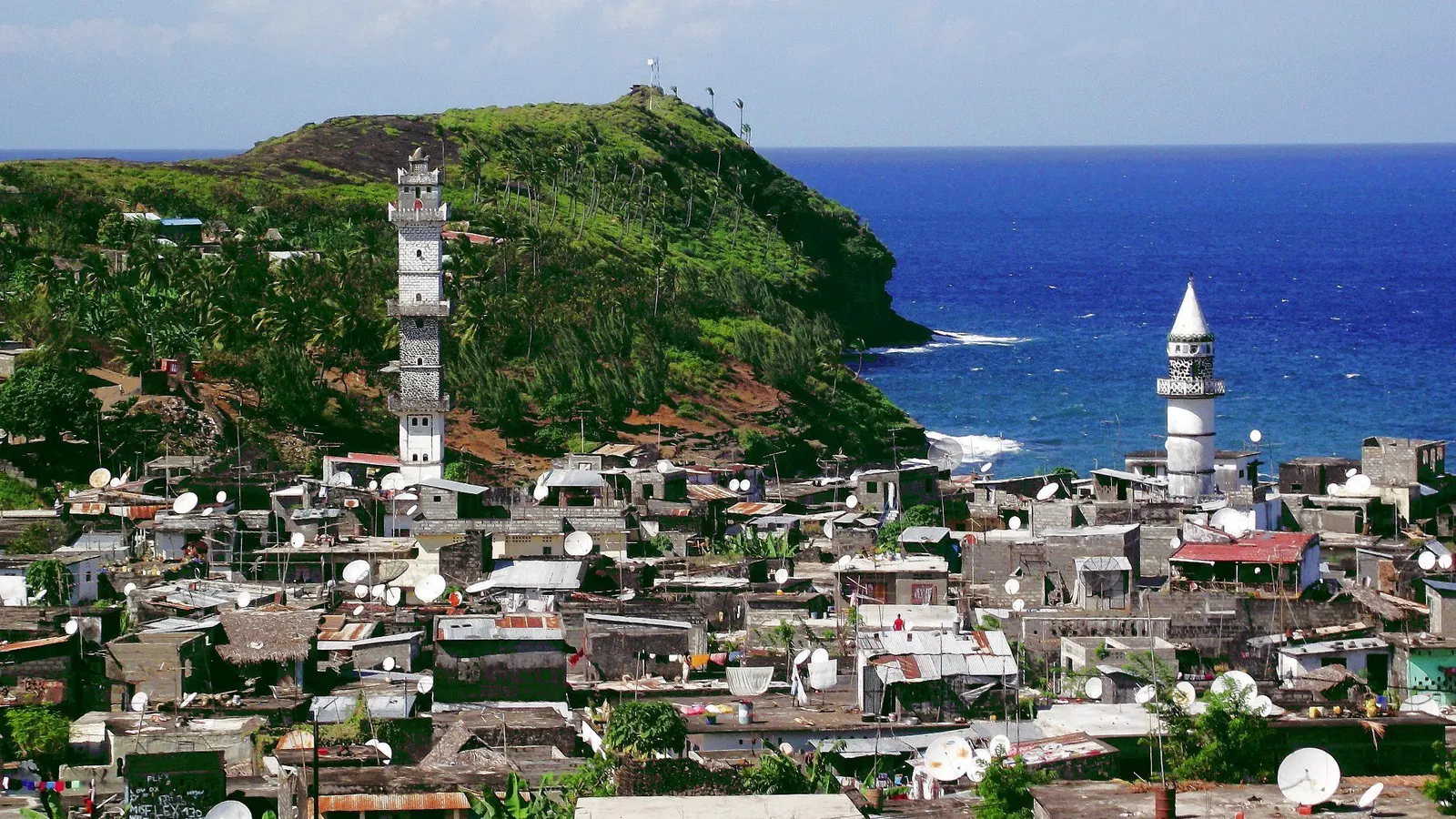
 Haryamouji · CC BY-SA 3.0
Comoros
“Three volcanic islands of ylang-ylang, coelacanths and almost no tourists.”
The Comoros produce most of the world's ylang-ylang, the flower whose oil underpins Chanel No. 5 and much of the fragrance industry, and the smell of the distilleries carries across whole valleys. The islands are volcanic, Muslim, francophone and Swahili-influenced, and receive fewer visitors than almost anywhere in the Indian Ocean. Grande Comore is dominated by Mount Karthala, one of the world's largest active craters, climbable in two hard days.
Mohéli, the smallest and least developed island, has the country's marine park — nesting green turtles most nights of the year at Itsamia, humpback whales from July to October and dugongs. Anjouan is the steepest and greenest. Politics have been unstable since independence, with a long history of coups, and Mayotte next door voted to remain French, which shapes everything about migration and money here. Infrastructure is minimal and inter-island flights are unreliable.
Highlights
Mount Karthala
One of the largest active volcanic craters in the world, three to four kilometres across, on Grande Comore. A hard two-day climb from Boboni with a guide, camping on the rim.
Mohéli marine park
Green turtles nesting at Itsamia most nights of the year, humpback whales from July to October, dugongs and reefs — the country's first protected area and its best wildlife.
Moroni and the medina
The small capital with the Old Friday Mosque on the waterfront, a coral-stone medina of narrow lanes, and Karthala rising behind the town.
Ylang-ylang and the perfume trade
Distilleries across Anjouan and Grande Comore producing the oil that anchors much of the world's fine fragrance. Visits are informal and the scent is overwhelming.
Entry requirements for Comoros
Checking your passport…
We don't hold entry details for this passport group yet.
Before you fly
The detail
- Passport validity
- Most destinations want validity beyond your stay, and some want six months. Check yours against the return date.
- Onward travel
- Airlines may ask for a return or onward ticket at check-in.
- Health
- Malaria is present, with transmission reduced but not eliminated. Yellow fever certificate required from endemic countries. Chikungunya and dengue outbreaks occur. Medical facilities are basic; serious cases go to Réunion or Mayotte.
- Money
- The Comorian franc is pegged to the euro at a fixed rate. Cash dominates; ATMs in Moroni are limited and often out of service. Cards work almost nowhere. Bring euros.
When to go
BestMay–Oct. AvoidDec–Mar.
Dry season opens — warm, calm and quiet.
The band above each month is our editorial verdict - it weighs crowds, prices and access as well as weather. The line is average daily temperature, the bars are monthly rainfall. Select a month for the figures. Climate figures: ERA5 reanalysis via Open-Meteo, 2005–2024 normals.
What it costs
A day in Comoros
Comfortable · sample day
≈ $84
Line items are real prices we track. The daily budget is an editorial estimate for this level, not their sum.
Where this sits among 244 countries we have costed
Very little seasonal variation in price — visitor numbers are too low. Diaspora arrivals over the summer fill some guesthouses.
Updated Aug 2026 · Editorial synthesis — market sampling and operator quotes (2025–2026) · confidence low
Excludes international flights - they depend on where you fly from.
Regions to know
5Grande Comore
Moroni, Mount Karthala, the lava coast at Singani and the beaches at Chomoni and Bouni.
Mohéli
The marine park, Itsamia's turtles, Nioumachoua's islets and the least developed of the three.
Anjouan
The steepest island — Mutsamudu's citadel, the Dziani Boundouni crater lake and ylang-ylang distilleries.
The Mohéli islets
A chain of small offshore islands with fruit bat colonies, reefs and almost no infrastructure.
The Karthala highlands
Cloud forest on the volcano's flanks, endemic birds and the crater trail up from Boboni.
Practical guide
Getting there
Moroni Prince Said Ibrahim is served by Kenya Airways, Ethiopian, Air Austral and Turkish, with connections via Nairobi, Addis and Réunion. Mayotte is 70 kilometres away but the connection is politically fraught.
Getting around
Shared taxis and minibuses on all three islands; the coastal roads around Grande Comore and Anjouan are mostly paved and slow. Inter-island by small aircraft or ferry, both unreliable. Guides are needed for Karthala and the marine park.
Money & costs
The Comorian franc is pegged to the euro at a fixed rate. Cash dominates; ATMs in Moroni are limited and often out of service. Cards work almost nowhere. Bring euros.
Safety
Low crime. Political instability and occasional unrest around elections. Cyclones from December to April. Strong currents on some beaches. Medical evacuation is complicated by the flight situation.
Health
Malaria is present, with transmission reduced but not eliminated. Yellow fever certificate required from endemic countries. Chikungunya and dengue outbreaks occur. Medical facilities are basic; serious cases go to Réunion or Mayotte.
SIM & internet
Comores Telecom and Telma; SIM registration requires a passport. 3G and some 4G on the main islands; coverage drops on Mohéli and in the interior.
Driving
Roads are narrow, potholed and shared with pedestrians. Anjouan's mountain routes are steep and demanding. Distances are short and journeys slow. Avoid driving at night.
Rules change - verify with an official source before you rent.
ExplWorld VerifiedNo verified partners here yet - all 6 country seats are open.
Become ExplWorld Verified →Itineraries through this country
Before you go
ComorosFrequently asked questions
How reliable are the inter-island flights?
Not very. AB Aviation and others fly Grande Comore–Anjouan–Mohéli on small aircraft with frequent cancellations. Ferries also run and are weather-dependent and sometimes rough. Always leave a buffer day before an international departure, and do not plan tight connections.
What about the coelacanth?
The Comoros is where the living coelacanth was rediscovered in the region in the 1950s, and specimens are still occasionally caught by fishermen off Grande Comore. You will not see one alive — they live at 150–700 metres — but the museum in Moroni has preserved examples and the story is central to how the islands see themselves.
Is it safe?
Crime against visitors is low. The real issues are political instability with a history of coups, poor infrastructure, limited medical care and cyclone risk from December to April. Check advisories before booking and note that consular presence is minimal.