 Justin Brinkhoff · Pexels License
Saint Kitts and Nevis
“Two islands, one nation — sugar-trail hikes, a monumental fortress and the quiet Caribbean.”
Saint Kitts and Nevis is the Caribbean at conversational volume. The smallest country in the Americas — two volcanic islands, three kilometres of channel between them — built its history on sugar, and the evidence is everywhere: ruined mills on the hillsides, a narrow-gauge cane railway circling St Kitts, and Brimstone Hill, the vast UNESCO-listed fortress the British called the Gibraltar of the West Indies.
St Kitts carries the (modest) bustle — cruise calls at Basseterre, beach bars on the Southeast Peninsula, green vervet monkeys outnumbering people by most local accounts. Take the ferry across the Narrows and Nevis slows things further still: one road around one perfect cone of a volcano, plantation-inn dinners, and hot springs in the town where Nelson married and Hamilton was born. Come for a week and hike, snorkel and do very little, exquisitely.
Highlights
Brimstone Hill Fortress
A 17th–18th-century citadel of black volcanic stone 240 m above the Caribbean — UNESCO-listed, beautifully preserved, with views across to Sint Eustatius and Saba.
Mount Liamuiga crater hike
A half-day guided climb through rainforest and elfin cloud forest to the 1,156 m rim of a dormant volcano — the best hike in the northern Leewards.
Nevis
The quieter half: Charlestown’s Georgian main street, plantation inns under Nevis Peak, hot springs, and beach bars on Pinney’s where the biggest event is sunset.
Southeast Peninsula
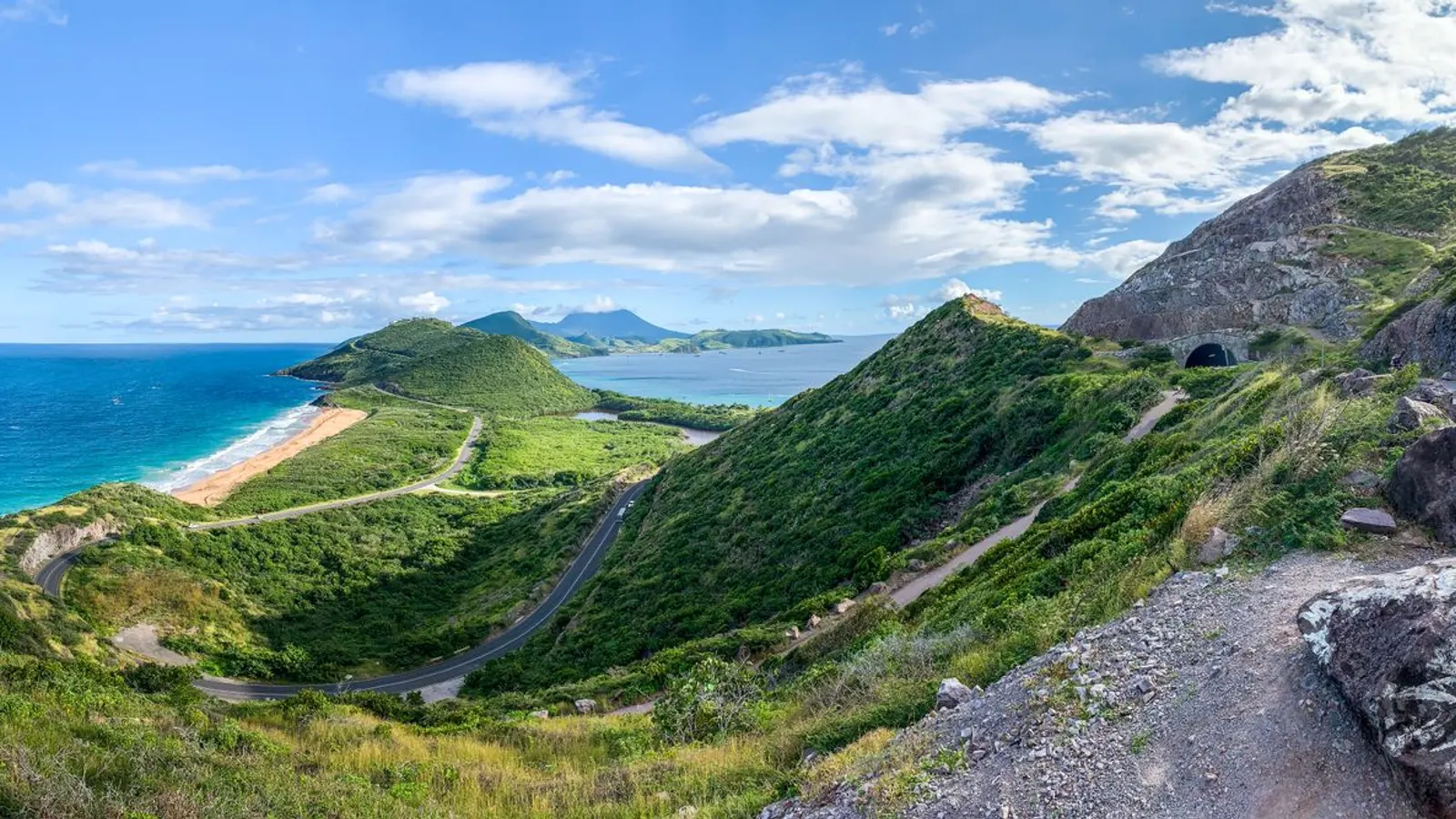
St Kitts’ wild tail — a ridge road over salt ponds to Cockleshell and South Friars beaches, monkeys on the dunes and Nevis filling the horizon across the Narrows.
Entry requirements for Saint Kitts and Nevis
Checking your passport…
We don't hold entry details for this passport group yet.
Before you fly
The detail
- Passport validity
- Most destinations want validity beyond your stay, and some want six months. Check yours against the return date.
- Onward travel
- Airlines may ask for a return or onward ticket at check-in.
- Health
- No special vaccinations required; hepatitis A and typhoid are standard advice. Tap water is treated and generally fine; bottled is universal anyway. Dengue appears periodically — repellent at dawn and dusk. The main hospital is in Basseterre with a smaller one on Nevis; anything serious means evacuation, so carry insurance with medevac cover. Manchineel trees on some beaches are toxic — don’t shelter under them in rain.
- Money
- The East Caribbean dollar is pegged at EC$2.70 to the US dollar (about EC$3.1 to the euro). US dollars are accepted nearly everywhere, but change comes in EC and the rate rounds against you — paying in EC is cleaner. Cards work at hotels, dive shops and proper restaurants; buses, beach grills and market stalls want cash. ATMs cluster in Basseterre and Charlestown.
What changed
When to go
BestDec–Apr. AvoidSep–Oct.
Dry, breezy peak season; Sugar Mas carnival ends early January.
The band above each month is our editorial verdict - it weighs crowds, prices and access as well as weather. The line is average daily temperature, the bars are monthly rainfall. Select a month for the figures. Climate figures: ERA5 reanalysis via Open-Meteo, 2005–2024 normals.
What it costs
A day in Saint Kitts and Nevis
Comfortable · sample day
≈ $157
Line items are real prices we track. The daily budget is an editorial estimate for this level, not their sum.
Where this sits among 244 countries we have costed
Mid-December to mid-April is high season, with rates 30–50 % above summer and Christmas–New Year at a hard premium; the Music Festival week in June briefly spikes Basseterre. September–October bring the lowest prices but also closures — several inns and restaurants shut for the hurricane-peak weeks, thinning the choice more than the cost.
Updated Aug 2026 · Editorial synthesis — Budget Your Trip, Eastern Caribbean cost guides, hotel-rate surveys (2025–2026) · confidence medium
Excludes international flights - they depend on where you fly from.
Regions to know
4Basseterre & the sugar belt
The small Georgian-Victorian capital and the cane-field ring around the island — Romney Manor’s batik workshop, the old sugar railway and village rum shops.
Mount Liamuiga & the north
Rainforest slopes, the crater-rim hike and Brimstone Hill Fortress rising over the leeward coast — the wild, green end of St Kitts.
Southeast Peninsula
Salt ponds, dunes and the country’s best beaches — Cockleshell and South Friars — with beach bars facing Nevis across the Narrows.
Nevis
A single volcanic cone ringed by one road: Charlestown’s Georgian main street, plantation inns, hot springs and Pinney’s Beach. The unhurried half of the federation.
Practical guide
Getting there
Robert L. Bradshaw airport (SKB) outside Basseterre has a nonstop British Airways link from London plus US service from Miami, New York and Charlotte (several routes seasonal); regional hops connect via Antigua and Sint Maarten. From Central Europe count on two legs, usually via London or a US hub (ESTA needed even in transit). Nevis has its own airstrip (NEV) for island-hoppers, but most visitors cross by ferry.
Getting around
Shared minibuses run the main road around St Kitts cheaply and cheerfully but don’t serve the Southeast Peninsula — taxis or a rental car cover that. The passenger ferry between Basseterre and Charlestown takes about 45 minutes and runs several times daily; a water taxi from Cockleshell crosses the Narrows to Nevis in ten. On Nevis one road circles the island; a car for a day or two covers everything. Drive on the left, and buy the local visitor’s permit with your rental.
Money & costs
The East Caribbean dollar is pegged at EC$2.70 to the US dollar (about EC$3.1 to the euro). US dollars are accepted nearly everywhere, but change comes in EC and the rate rounds against you — paying in EC is cleaner. Cards work at hotels, dive shops and proper restaurants; buses, beach grills and market stalls want cash. ATMs cluster in Basseterre and Charlestown.
Safety
Low-key by regional standards. Take the usual measures: nothing visible in parked cars, valuables off the beach when you swim, licensed taxis late at night in Basseterre. Monkeys are bolder thieves than people — don’t feed them. The sea deserves respect on the Atlantic side, where currents are stronger and beaches unpatrolled.
Health
No special vaccinations required; hepatitis A and typhoid are standard advice. Tap water is treated and generally fine; bottled is universal anyway. Dengue appears periodically — repellent at dawn and dusk. The main hospital is in Basseterre with a smaller one on Nevis; anything serious means evacuation, so carry insurance with medevac cover. Manchineel trees on some beaches are toxic — don’t shelter under them in rain.
SIM & internet
Digicel and Flow both cover the two islands well; a visitor SIM or eSIM with 10 GB or so runs €15–20. LTE reaches everywhere except the deepest rainforest; hotel wifi is standard. If you day-trip to Nevis your SIM works identically — one country, one network footprint.
Driving
Drive on the left. One main road rings each island; limits are low, rarely posted and largely self-enforcing given the bends. Goats and monkeys on the road are the real hazard, and fuel stations close early on Nevis.
Rules change - verify with an official source before you rent.
ExplWorld VerifiedNo verified partners here yet - all 6 country seats are open.
Become ExplWorld Verified →Itineraries through this country
From the Journal
Before you go
Saint Kitts and NevisFrequently asked questions
Is Saint Kitts and Nevis safe?
Yes — it is among the safer corners of the Caribbean, and Nevis especially so. Violent crime rarely touches visitors; petty theft from cars and beaches is the realistic risk, so lock vehicles and don’t leave valuables unattended. Normal night-time common sense applies in Basseterre. Hurricanes are the more meaningful hazard — watch forecasts June to November.
When is the best time to visit?
December to April: dry, breezy and at its liveliest, with the Sugar Mas carnival running from mid-December into early January. June brings the St Kitts Music Festival. September and October sit at the peak of hurricane season — several hotels and restaurants close for the quietest weeks.
How much does a day cost?
Around €145 (≈ $155) a day mid-range: this is the pricier end of the Caribbean, with small inns from €120 a night and restaurant mains at resort-adjacent prices. Determined budget travellers can hold €70 (≈ $75) using guesthouses, local buses and EC-dollar lunch spots. The Basseterre–Nevis ferry keeps two-island trips affordable.