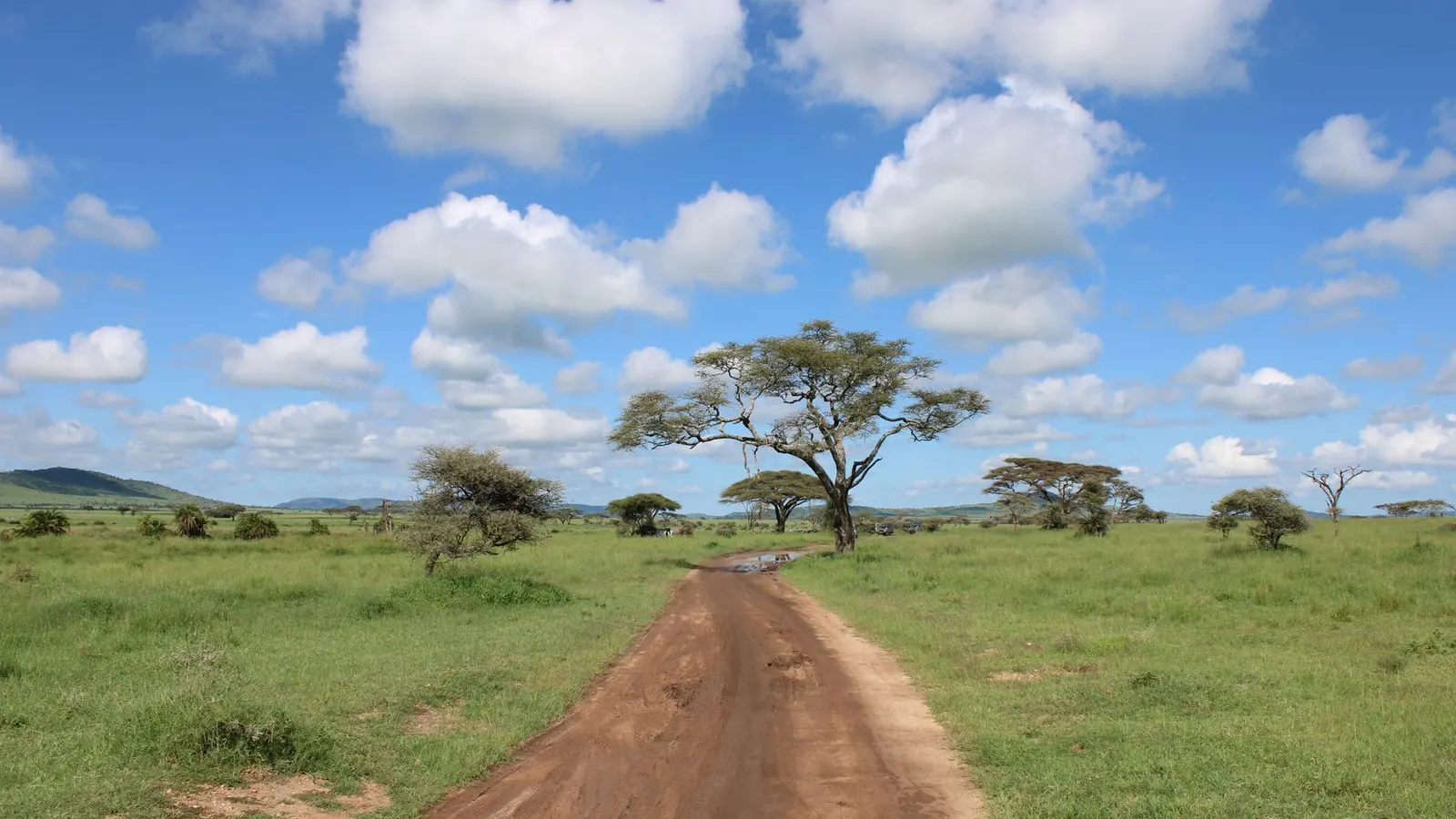
 Ana Kenk · Pexels License
Tanzania
“The Serengeti, Ngorongoro, Kilimanjaro and Zanzibar in one country.”
Tanzania holds an improbable set of headline attractions. The Serengeti carries the wildebeest migration for most of the year; the Ngorongoro Crater is a collapsed caldera holding a resident population of most of the big five in twenty kilometres of grassland; Kilimanjaro rises to 5,895 metres and is climbable without technical skill; and Zanzibar sits an hour offshore with Stone Town and white-sand beaches.
The southern and western parks — Ruaha, Nyerere, Katavi, Mahale with its chimpanzees — are larger, wilder and receive a fraction of the visitors. The country is more expensive than most travellers expect: park fees are among the highest in Africa, and the mountain and the migration both carry premiums. Two weeks buys a northern circuit plus Zanzibar; three lets you go south instead of north and see almost nobody.
Highlights
The Serengeti
Fifteen thousand square kilometres carrying the migration through most of the year — calving in the southern plains in January and February, the Grumeti and Mara crossings from June onward.
The Ngorongoro Crater
A 260-square-kilometre caldera floor with a resident population including black rhino, in an area where Maasai still graze cattle. Extraordinary, expensive and busy — go at the gate opening.
Kilimanjaro
Africa's highest point at 5,895 metres, a walk rather than a climb, and a serious altitude undertaking — success rates rise sharply on seven- and eight-day routes over the five-day ones.
Zanzibar
Stone Town's UNESCO-listed coral-rag lanes and carved doors, spice farms inland, and the beaches and reefs of the east and north coasts.
Entry requirements for Tanzania
Checking your passport…
We don't hold entry details for this passport group yet.
Before you fly
The detail
- Passport validity
- Most destinations want validity beyond your stay, and some want six months. Check yours against the return date.
- Onward travel
- Airlines may ask for a return or onward ticket at check-in.
- Arrival form
- E-visa applied for online in advance, or visa on arrival for many nationalities. Note Zanzibar requires separate compulsory travel insurance.
- Health
- Yellow fever certificate required if arriving from an endemic country, including a transit over twelve hours. Malaria prophylaxis is recommended for almost the whole country including Zanzibar; the crater rim and high altitude are lower risk. Hepatitis A, typhoid and rabies are standard. Healthcare outside Dar es Salaam and Arusha is limited and evacuation cover is essential, particularly for Kilimanjaro. Do not drink tap water.
- Money
- Shilling, though park fees and most tourism is priced and often paid in US dollars — bring clean notes issued after 2009, which is enforced. Cards work in lodges and larger hotels and increasingly at park gates. M-Pesa and Tigo Pesa dominate locally. Tipping guides, drivers and porters is expected and significant; Kilimanjaro crews in particular depend on it, and operators publish guideline amounts.
When to go
BestJun–Oct, Dec–Feb. AvoidApr–May.
Calving season in the southern Serengeti — predator action at its most concentrated.
The band above each month is our editorial verdict - it weighs crowds, prices and access as well as weather. The line is average daily temperature, the bars are monthly rainfall. Select a month for the figures. Climate figures: ERA5 reanalysis via Open-Meteo, 2005–2024 normals.
What it costs
A day in Tanzania
Comfortable · sample day
≈ $162
Line items are real prices we track. The daily budget is an editorial estimate for this level, not their sum.
Where this sits among 244 countries we have costed
Northern-circuit camps roughly double between the green season and the July-to-October peak, and the Christmas fortnight spikes again. Park fees are set officially and are charged per person per twenty-four hours, which makes them the dominant and unavoidable line. Zanzibar peaks in July and August and again at New Year. Kilimanjaro pricing is set by route length and operator standard rather than season.
Updated Aug 2026 · Editorial synthesis — TANAPA and NCAA published tariffs, operator quotations, ferry fares (2025–2026) · confidence high
Excludes international flights - they depend on where you fly from.
Regions to know
5The northern circuit
Serengeti, Ngorongoro, Tarangire and Lake Manyara — the famous wildlife, reached from Arusha.
Kilimanjaro & Arusha
The mountain and Mount Meru beside it, plus Arusha as the base for every northern trip.
The southern parks
Ruaha and Nyerere — vast, wild and quiet, with strong predator populations and a fraction of the vehicles.
The west
Mahale and Gombe on Lake Tanganyika for chimpanzees, and Katavi, which may be the emptiest good park in Africa.
Zanzibar & the coast
Stone Town, spice farms, the east-coast beaches and Mnemba's reefs, plus Pemba further north.
Practical guide
Getting there
Kilimanjaro (JRO) is the northern-circuit gateway with direct European and Gulf flights; Dar es Salaam (DAR) serves the south and Zanzibar (ZNZ) takes direct charters and regional flights. Land borders with Kenya at Namanga and with the other five neighbours are open.
Entry formalities
E-visa applied for online in advance, or visa on arrival for many nationalities. Note Zanzibar requires separate compulsory travel insurance.
Getting around
Light aircraft link the parks and Zanzibar and are how most safari itineraries move — road transfers between northern parks are long and rough. Safari vehicles come with driver-guides. Ferries connect Dar es Salaam and Zanzibar in two hours. Buses cover the main roads. Self-driving is uncommon and only sensible with a 4WD and experience.
Money & costs
Shilling, though park fees and most tourism is priced and often paid in US dollars — bring clean notes issued after 2009, which is enforced. Cards work in lodges and larger hotels and increasingly at park gates. M-Pesa and Tigo Pesa dominate locally. Tipping guides, drivers and porters is expected and significant; Kilimanjaro crews in particular depend on it, and operators publish guideline amounts.
Safety
Broadly safe on the tourist circuit. Petty theft in Dar es Salaam, Arusha and Stone Town is the everyday risk, along with the usual overcharging. Foreign ministries advise caution in parts of the far southeast near the Mozambican border. Wildlife is not tame — camp rules exist because people are killed. Road accidents are the largest practical danger. Altitude illness on Kilimanjaro is the most likely serious medical problem.
Health
Yellow fever certificate required if arriving from an endemic country, including a transit over twelve hours. Malaria prophylaxis is recommended for almost the whole country including Zanzibar; the crater rim and high altitude are lower risk. Hepatitis A, typhoid and rabies are standard. Healthcare outside Dar es Salaam and Arusha is limited and evacuation cover is essential, particularly for Kilimanjaro. Do not drink tap water.
SIM & internet
Vodacom and Airtel SIMs are cheap with passport registration. Coverage is good in towns and along main roads, present in much of the northern circuit and absent in the remote southern parks. Lodge wifi is often satellite and slow. Zanzibar has good coverage.
Driving
Park roads require high clearance and 4WD in the wet season, and the transfer roads between northern parks are corrugated and slow. Most visitors travel with a driver-guide, which is both the norm and much the better experience. Night driving between towns is dangerous.
Rules change - verify with an official source before you rent.
ExplWorld VerifiedNo verified partners here yet - all 6 country seats are open.
Become ExplWorld Verified →Itineraries through this country
Before you go
TanzaniaFrequently asked questions
Which Kilimanjaro route should I take?
Longer is better, and it is not close. Summit success rates on the five-day Marangu route are far lower than on the seven- or eight-day Lemosho and Northern Circuit, because acclimatisation is the whole game. Paying for two extra days is the single highest-return decision in the whole trip. All routes require a licensed operator, guides and porters.
North or south?
The northern circuit — Serengeti, Ngorongoro, Tarangire, Manyara — has the famous wildlife and the crowds and vehicles that come with it. Ruaha and Nyerere in the south are bigger, wilder and much quieter, with excellent predator populations, and reached by light aircraft. If it is your first safari, go north; if it is your third, go south.
Why is it so expensive?
Park fees. The Serengeti and Ngorongoro charge among the highest entry rates in Africa, with concession fees, crater service fees and vehicle charges on top, and they are levied per person per day. A mid-range northern circuit safari runs €300–450 per person per day all in. Zanzibar and the cities are inexpensive by comparison.