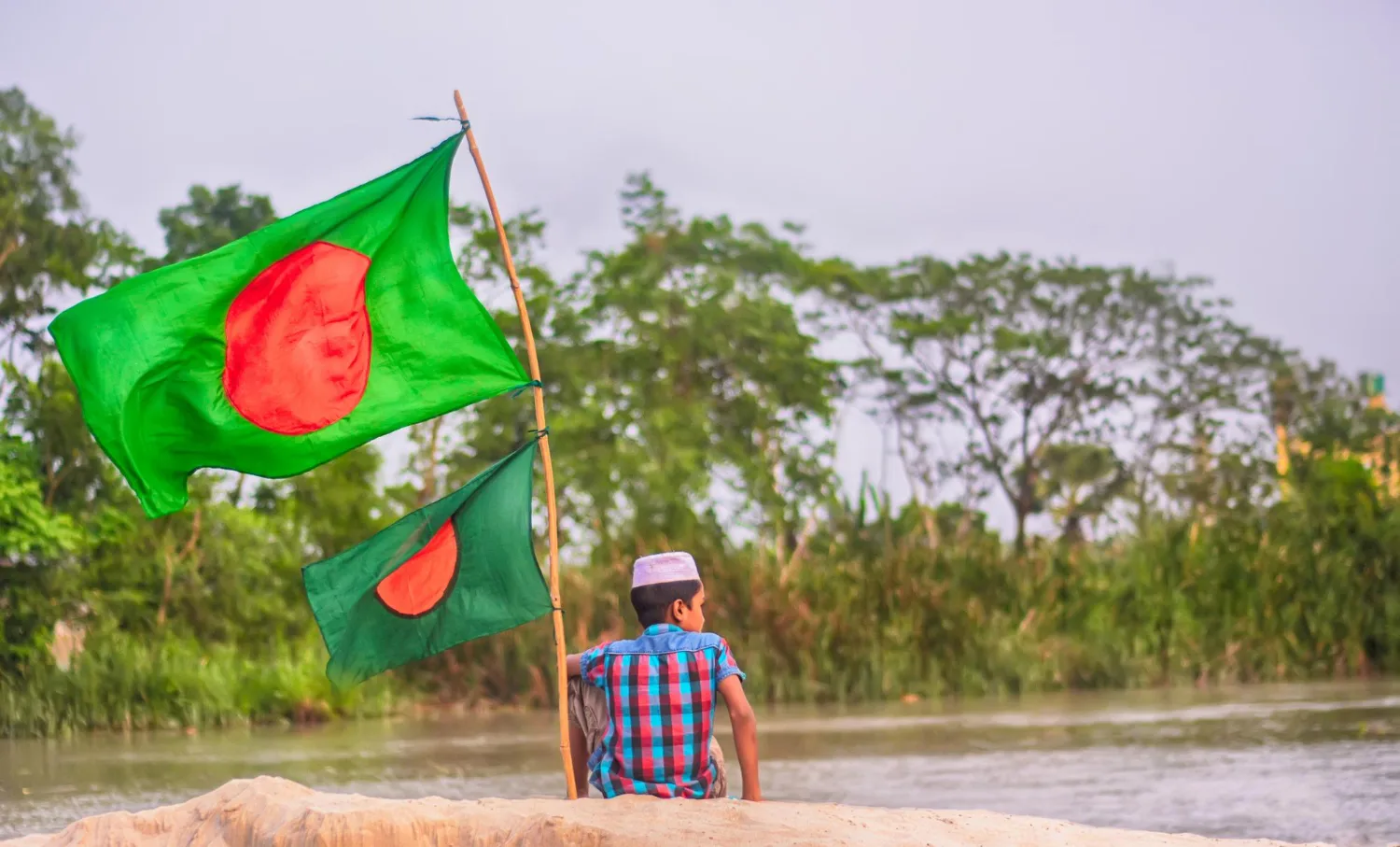
The delta has no quarry in it. Everything monumental in Bangladesh that is not modern concrete was made out of the ground it stands on — fired clay, moulded and carved before firing. Fourteen days up the dry western side of the country to the largest Buddhist monastery south of the Himalaya and a temple sheathed in terracotta, then south to a fifteenth-century mosque city and into the mangroves the whole delta drains through.
Old Dhaka
Start at the river. Sadarghat is still the busiest inland passenger terminal in the country even after the Padma Bridge took most of the southern launch traffic away in 2022, and an hour on the pontoons explains more about Bangladesh than any museum. Then Ahsan Manzil, the pink nawab's palace of 1872; Lalbagh Fort, begun by the Mughal prince Muhammad Azam in 1678, carried on by the governor Shaista Khan after the prince was recalled to Delhi, and abandoned unfinished in 1684 when Shaista Khan's daughter Pari Bibi died on the site and he decided the place was unlucky — her tomb is one of the three parts that were ever finished; and the Armenian church of 1781 in Armanitola, which has a caretaker and almost no congregation left.
Kahn's parliament
Louis Kahn was hired in 1962 to build a national assembly for what was then East Pakistan. He died in 1974; the building opened in 1982, in a country that had become a different one in 1971. It is concrete with marble inlaid in the shuttering lines, a circular chamber inside a ring of vast geometric openings, sitting in an artificial lake. The public cannot go in without arrangement, but the grounds are walkable and the outside is the point. Afterwards the Liberation War Museum at Agargaon.
Panam City
Thirty kilometres south-east at Sonargaon, a single street of about fifty merchants' houses built from the 1890s by Hindu cloth traders and left standing empty. Most of the owners went to India in 1947 and after the riots of 1964; the buildings were never demolished and never repaired, and stucco is coming off brick along the whole length of it. The folk art museum in the Bara Sardar Bari nearby is the government's better-kept half of the same site.
North-west to Mahasthangarh
Out of Dhaka over the Jamuna bridge, which opened in 1998 at 4.8 kilometres and was the first fixed crossing of the river anyone had managed. Mahasthangarh, north of Bogura, is the oldest urban site excavated in Bangladesh: the citadel of Pundranagar, occupied from around the third century BC, with a rampart of brick you can walk the length of and a Mauryan-period inscribed stone plaque found on it.
Paharpur
Somapura Mahavihara was built by the Pala king Dharmapala around the turn of the ninth century and is the largest Buddhist monastery south of the Himalaya — a quadrangle nearly 300 metres on each side with 177 monastic cells facing inward and a cruciform temple rising in the middle of the courtyard. Terracotta plaques by the thousand are still set into the base. UNESCO listed it in 1985. Kusumba Mosque, an hour south, is the exception that proves the rule: brick faced in dark stone, imported and reused, and it looks like nothing else in the country.
Kantajew Temple
North to Dinajpur and then twenty kilometres beyond it to Kantanagar, where a temple begun in 1704 and finished in 1752 is covered — walls, cornices, piers, every surface facing outward — in small terracotta plaques showing the Ramayana, the Mahabharata and a great deal of ordinary eighteenth-century Bengali life. It was built in the nine-spired navaratna form. The earthquake of 1897 brought all nine down and they were never rebuilt, so the roof you see is flat and wrong and nobody minds.
Puthia and Rajshahi
South again, breaking the drive at Puthia, which holds the densest cluster of Hindu temples left in Bangladesh — the Shiva temple of 1823 in stone-cut style and the Govinda temple behind it, whose entire facade is terracotta panels of the Krishna story. Rajshahi itself is a low, green, unhurried city on the Padma with the Varendra Research Museum in it, founded in 1910 and the oldest museum in the country.
Gaur
West to the Bangladeshi remnant of Gaur, the capital of the Bengal sultanate, most of which lies over the Indian border. Choto Sona Masjid — the Small Golden Mosque, gilded once — was built in the reign of Alauddin Husain Shah in the years around 1500, brick faced with stone, fifteen domes, and standing in a field with a keeper and a ticket book. The Tahkhana complex and Darasbari mosque are within a few kilometres of it.
Kushtia
Over the Padma on the Lalon Shah road bridge, beside the Hardinge rail bridge of 1915 that carried the line to Calcutta. At Cheuriya is the shrine of Lalon, the Baul poet who died in 1890 having refused, in every account of him, to state a religion or a caste; his songs are the closest thing Bengal has to a common scripture and singers still live around the tomb. Twenty kilometres away at Shilaidaha stands the Kuthibari, the house where Tagore ran the family estates from 1890 and lived on and off until 1901, writing the river-and-village Bengali that made his name; he came back to it in 1912 and began there the English translation of Gitanjali that won him the Nobel the following year.
South to Khulna
A transfer day through Jhenaidah and Jessore into the delta proper, where the land stops being fields with rivers through it and becomes water with fields on it. Khulna is a working river port with a shipyard, a shrimp trade and no sights to speak of, which is fine — it is the base for the next three days.
Bagerhat
Khan Jahan Ali cleared mangrove here in the fifteenth century and built a city with a mosque quarter, roads and a system of freshwater tanks; he died in 1459 and the place was swallowed back by forest until it was cleared again in the twentieth century. The Sixty Dome Mosque is the survivor — seventy-seven domes carried on sixty free-standing pillars, which is almost certainly where the name came from: shait khamba, sixty pillars, misheard down the centuries as shat gambuj, sixty domes. Fifty-five of those pillars are stone, hauled in from outside a delta that has none of its own; the other five and every wall around them are brick, thick enough to be mistaken for a fort. UNESCO listed the mosque city in 1985. Transfer to Mongla in the afternoon for the boat.
Into the Sundarbans
Board at Mongla and sail south into the largest mangrove forest on earth, about 6,000 square kilometres of it on the Bangladeshi side alone. The permit is the Forest Department's, the operator arranges it, and an armed forest guard comes aboard because vessels are not allowed in without one. The first afternoon is Harbaria and the narrow creeks off it, by dinghy, at the speed the tide allows.
Kotka
The full day, deep in the east of the forest. Walk the boardwalk at Kotka out to the grasslands, cross to Jamtola beach on the Bay of Bengal, and go up the creeks at dawn and again at dusk, which is when anything moves. The 2024 camera-trap census put 125 tigers in the Bangladeshi Sundarbans — up from 114 in 2018 — and you will not see one; spotted deer, monitor lizards, kingfishers and the tracks are the realistic list.
Out
The boat is back at Mongla by late morning and Khulna an hour and a quarter after that. The Jahanabad Express runs Khulna to Dhaka over the Padma Bridge in under four hours — 06:00 out, 09:45 in — so the sensible end to this is a last night in Khulna and the train at dawn. Check the day first: it does not run on Mondays, when the set goes in for maintenance. The road, if you would rather not, takes six to seven hours over the same bridge.
Good to know
Get the visa before you fly. Bangladesh does issue a visa on arrival at Dhaka to a list of nationalities, single entry and thirty days, paid in cash US dollars, but every mission that publishes advice on it says the same thing: it is at the immigration officer's discretion and it is not a right, and being turned back at Dhaka is an expensive way to learn that. The Sundarbans closes completely to tourists, fishermen and honey collectors from 1 June to 31 August for the breeding season — an annual closure since 2021, moved to the 1 June start in 2022, and enforced — so a summer trip loses the last third of this route entirely; November to February is the season for the whole country, March and April are brutally hot, and the monsoon runs June to September with cyclone risk concentrated in April–May and October–November. Trains are far better than buses and sell out days ahead — book on the Bangladesh Railway e-ticket site, where a foreigner registers with a passport number, and carry that passport, because names are printed on tickets and checked. Reckon on hiring a car with a driver for the north-west legs: Paharpur, Kusumba, Kantanagar and Gaur are all rural sites reached down lanes with no useful bus. The Chittagong Hill Tracts are not part of this route and are not a casual add-on: since a Home Ministry circular of 2015 foreigners need permission for Rangamati, Khagrachhari and Bandarban, applied for through an enlisted operator at the relevant deputy commissioner's office at least ten working days ahead, and the upazilas of Ruma, Thanchi and Alikadam have been closed outright for stretches. The refugee camps at Ukhia and Kutupalong are not a place to visit; access needs authorisation and there is no version of turning up that is defensible. Friday and Saturday are the weekend and offices open on Sunday. Alcohol is restricted to licensed hotel bars and is not worth the effort. Drink bottled or properly filtered water everywhere — the reason is in the story below, and it is not stomach bugs.
Shorter or longer?
Four more days at the start: the train east from Dhaka to Srimangal for the estates, the Khasia betel-leaf villages and Lawachara forest, then Sylhet for the shrine of Shah Jalal and the swamp forest at Ratargul, and back to Dhaka before heading north-west.
Dhaka for two days, then straight down to Khulna by train, Bagerhat, and three days on the boat. Keeps the mosque city and the mangroves, drops every one of the long north-western road days.