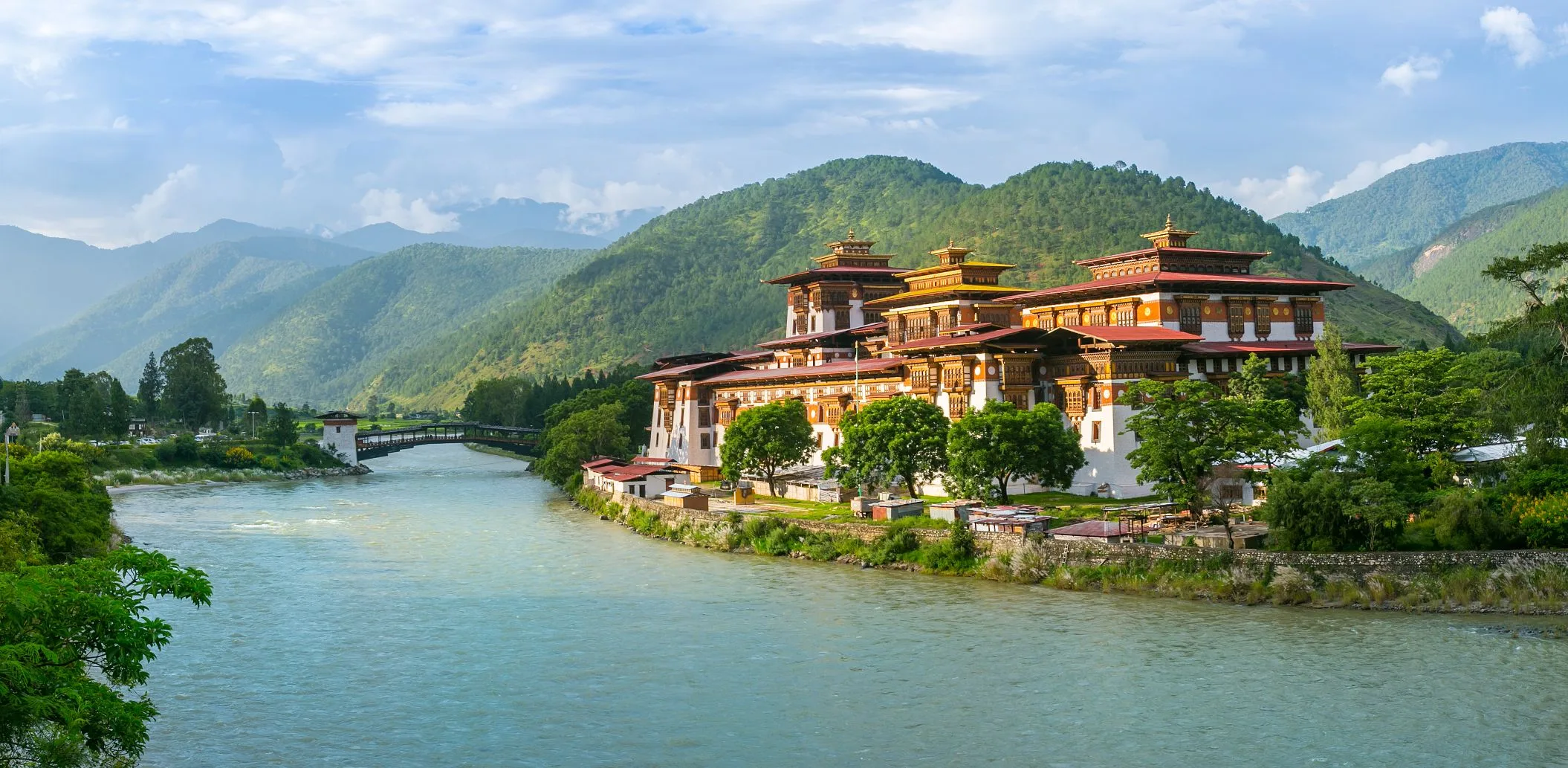
The single east–west road across the Black Mountains, from the airport valley to the four valleys Bhutanese Buddhism came from, and back by air. A country you cannot travel independently once you leave Thimphu and Paro, and cannot travel cheaply anywhere: the government fee is US$100 a night before you have paid for a bed, and understanding what it buys is most of the trip.
Paro
Land at the only international airport in the country, at 2,235 metres, on an approach into a valley that a short list of certified pilots is cleared to fly. Nothing strenuous on the first day: Rinpung Dzong, the National Museum in the round watchtower above it, and Kyichu Lhakhang, which Bhutan dates to the seventh century.
Chele La and the Haa valley
Up to 3,988 metres on the highest road in the country, then down the other side into Haa, which was closed to foreign visitors until 2002 and still has a fraction of Paro's beds. Back over the pass in the afternoon. The pass is the best acclimatisation available before the walk tomorrow.
Taktsang
The climb to the Tiger's Nest is roughly 900 metres of ascent and two to three hours up, with a cafeteria at the halfway viewpoint; horses go that far and no further. What stands on the cliff is a reconstruction — the monastery burned in April 1998 and was rebuilt over the following years. Phones and cameras go into lockers at the gate.
To Thimphu
Ninety minutes down the Paro Chhu and up the Wang Chhu. The capital has no traffic lights — a set was installed and taken out again — and a policeman still directs the main junction from a painted booth. Buddha Dordenma, 51.5 metres of bronze consecrated in 2015, sits above the city; the weekend vegetable market is the better hour if the dates fall right.
The head of the Thimphu valley
North past the last houses to Cheri Goemba, founded in 1620 by the Zhabdrung Ngawang Namgyal, who unified the country and gave it the dzong architecture every later fortress copies. It is a steep hour up from the bridge. Tango monastery is on the other side of the same valley for anyone with legs left.
Over Dochula to Punakha
The pass at about 3,100 metres carries 108 chortens built in 2004 and 2005 for the soldiers killed clearing militant camps in the southern jungle in December 2003; on a clear winter morning the eastern Himalaya stands up behind them. Then 2,000 metres down into rice country and Punakha Dzong, built in 1637 where two rivers meet and damaged repeatedly by fire, by earthquake and, in 1994, by a glacial lake bursting upstream.
Khamsum Yulley and the dam road
An hour up through paddy to the Khamsum Yulley Namgyal Chorten, nine years in the building and finished at the turn of the 2000s, then down the Punatsangchhu past the two hydropower projects this valley has been living beside since 2008 — the camps, the spoil heaps and the anchored hillside are the largest thing anyone has built in Bhutan. Wangdue Phodrang Dzong on the ridge above the confluence burned to the ground in June 2012 and has been rebuilt from the foundations.
To Phobjikha
East up the Dang Chhu to the turning at Nobding, three kilometres short of the Pele La, then over the Lawa La at about 3,250 metres and down into a glacial valley with a flat marshy floor, where black-necked cranes winter from late October to the middle of February. The transmission lines here were put underground so the birds would not fly into them, which is the most Bhutanese engineering decision in the country. Gangtey Goenpa sits on the spur above the marsh.
Trongsa
Back out of the valley to the highway and over the Pele La at 3,420 metres, the divide between western and central Bhutan. The dzong at Trongsa sat across the only east–west route in the country, and whoever held it held Bhutan; the first two kings ruled from it before the capital existed. The watchtower above became the Tower of Trongsa museum in 2008 and explains the monarchy better than anything else on this road.
Into Bumthang
Over the Yotong La at about 3,425 metres to the four valleys Bhutanese Buddhism came from. Jambay Lhakhang is one of the temples tradition attributes to the seventh-century Tibetan king Songtsen Gampo; Kurjey Lhakhang is built around a cave where Guru Rinpoche is said to have meditated. There is also a cheese dairy and a brewery, both the work of one Swiss settler who arrived with a development project in the late 1960s — the cheese from that era, the Red Panda wheat beer added decades later — and both entirely serious.
Ura
The highest of the Bumthang valleys at around 3,100 metres, ninety minutes east, with a tight village of stone houses under one temple and a wool economy still visible in what people are wearing. This is where the road stops being a tourist road. Back to Jakar in the evening.
Fly out west
Bathpalathang airstrip to Paro in half an hour, back over everything the road took four days to cross. Drukair flies it five times a week rather than daily, so it sets the shape of the last three days, not the other way round; and it is cancelled for weather often enough that the sensible plan is a night in Paro before an international departure rather than a same-day connection. That night is the twelfth the fee is charged on.
Good to know
There is no independent version of this trip. Since 2022 you may book yourself through the government portal rather than through a licensed operator, and you may walk around Thimphu and Paro unaccompanied — but a licensed guide is compulsory for every dzong, temple and national park, and for every district beyond those two towns, which is ten of the twelve days here. The operator or portal also files the route permit that lets you leave the Thimphu–Paro corridor at all; it names the districts you may enter, so a detour invented on the road is generally not available. Every visitor except Indian, Bangladeshi and Maldivian nationals needs a visa: US$40 once, around five working days after the money lands, issued for the exact dates booked, so changing them means reapplying. On top of that sits the Sustainable Development Fee, US$100 per adult per night, half for children aged 6 to 12 and nothing under 6. Read the history before calling that cheap or expensive. Until 2022 the fee was US$65 a night, but it sat inside a compulsory minimum package of US$200 to US$250 a day that already covered hotel, food, guide and transport. The Tourism Levy Act passed in June 2022 abolished the package and set the fee alone at US$200 a night, effective when the border reopened on 23 September that year; arrivals collapsed, and the fee was halved to US$100 from 1 September 2023. That rate is confirmed to 31 August 2027 and nobody outside the government knows what happens after it, so confirm the figure before budgeting dates beyond that. Flights into Paro are visual-approach only and daylight only, which is why they leave early and why weather delays cascade; the same applies to the domestic legs from Bathpalathang and Gelephu, which run a few times a week rather than daily, and neither should be the last thing between you and an international flight. Festival dates follow the lunar calendar and move every year — Paro Tshechu in spring and Thimphu Tshechu in autumn fill the good hotels in those two towns months ahead, and an operator will quote higher for those weeks. June to August is the monsoon: the mountains are behind cloud and the eastern road slips. The cranes in Phobjikha are only there from late October to mid-February. Cash is easier than it looks — the ngultrum is pegged to the Indian rupee and rupees circulate — but ATMs in the towns regularly refuse foreign cards, so carry enough for the trip and change it locally. Drink-driving is zero tolerance, tobacco import is limited and taxed, and drug offences are prosecuted hard.
Shorter or longer?
Carry on from Bumthang over the Thrumshing La at 3,780 metres to Mongar and Trashigang, and exit overland at Samdrup Jongkhar into Assam. Five or six more days on the worst road in the country, almost no other visitors, and an Indian-side onward plan that has to be arranged in advance.
Paro, Thimphu and Punakha only, flying home from Paro. Cuts the four driving days across the Black Mountains and the domestic flight — and since the fee is charged per night, cutting nights is the only lever on the cost that exists.