Prague gets two days and the rest of the country gets twelve. The Czech rail and bus network is one of the densest in Europe and among the cheapest to use, and it reaches the sandstone gorges on the German border, the Ore Mountains town that named the dollar and then mined uranium with prisoners, the brewery that invented pale lager, Český Krumlov, and the wine country in the south-east — almost none of it needing a car.
Prague, off the axis
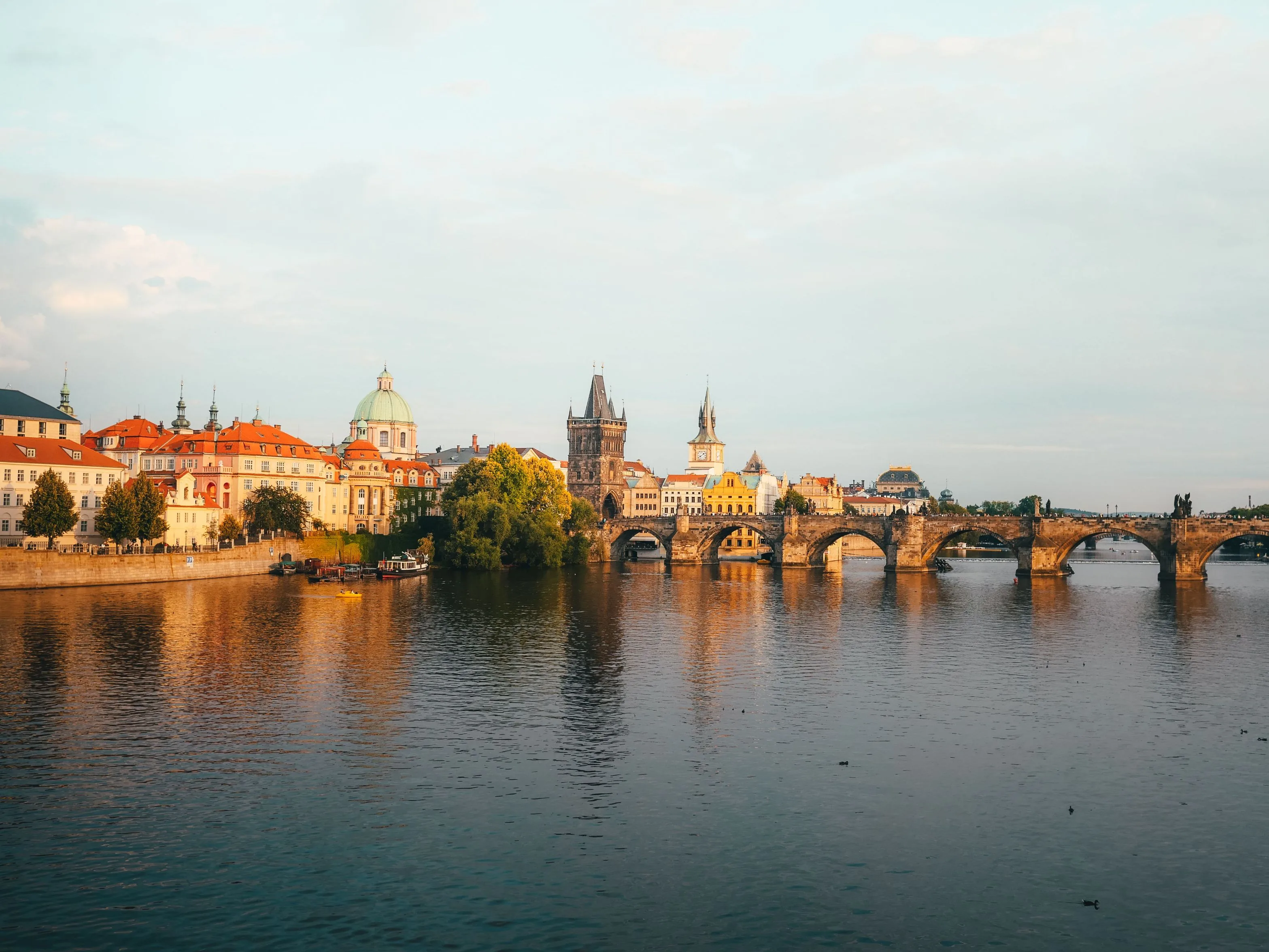
The medieval core came through the twentieth century almost untouched, which in this part of Europe is rarer than it looks, and between ten and six it is full to the point of shuffling. Cross Charles Bridge at dawn, do Vyšehrad in the afternoon when the coaches are on the other side of the river, and sleep four tram stops out where people live.
Kutná Hora
Silver from these hills paid for fourteenth-century Bohemia, and the mint at the Italian Court struck the Prague groschen that circulated across central Europe. St Barbara's is the cathedral that money built, and it was left unfinished when the money stopped. The ossuary at Sedlec now runs timed tickets and bans photography, which has improved the experience considerably.
Terezín and Litoměřice
A garrison town laid out by Joseph II in the 1780s, used by the Gestapo as a prison from 1940 and by the SS as a ghetto and transit camp from November 1941. The Small Fortress and the Ghetto Museum are separate sites twenty minutes apart and both are needed. Sleep three kilometres on in Litoměřice, which is an ordinary Elbe wine town and a relief.
Down the Elbe to Hřensko
The line follows the river north through Ústí nad Labem to Děčín, cliffs on both sides, and it is the scenic route by accident rather than design. Hřensko is one street in a ravine at the lowest point in the country, and it exists to be walked out of.
Bohemian Switzerland
Pravčická brána is the largest natural sandstone arch in Europe and has been closed to walkers since 1982, because the traffic was eating it. Below it, punted boats work the Kamenice gorge. The fire that started here in July 2022 burned roughly a thousand hectares and trails reopened in stages over the following two years; a good part of the walk is still through standing dead pine, which is worth understanding rather than avoiding.
West to Karlovy Vary
A slow cross-country transfer under the Ore Mountains. Karlovy Vary is thirteen hot springs, a colonnade, and the porcelain cups with the spout in the handle that everyone carries and nobody explains; the Vřídlo spring comes out at about 72°C and throws water twelve metres up. It is a handsome town and a shallow one, and it is the base rather than the point.
Jáchymov
Twenty kilometres uphill and five centuries deep. Silver founded the town in 1516 and named a coin that became the dollar; the black rock the silver miners threw away gave Marie Curie her radium; the Soviet weapons programme came for the same rock after 1945 and staffed the mines with political prisoners. The Royal Mint House is the museum, the Svornost shaft can be descended by arrangement, and the camp memorials above the spa hotels are signposted and almost entirely unvisited.
Plzeň
The city's burghers dumped their bad beer in the street in 1838 and hired a Bavarian to fix it; what Josef Groll brewed in 1842 is the reason the overwhelming majority of the beer drunk on earth is pale lager. The brewery tour ends in the sandstone cellars with unfiltered, unpasteurised beer straight from an oak lager barrel, which is the only place it exists. Then the Great Synagogue, one of the largest in the world, and the medieval tunnels under the old town.
South to Český Krumlov
Down through České Budějovice, which is where Budweiser gets its name and where the argument about that name has been running in the courts for over a century. Krumlov is a town wrapped in a bend of the Vltava under a castle, listed by UNESCO in 1992, and day-tripped from Prague in coach loads. Staying two nights buys you the mornings and the evenings, which is the whole difference.
The upper Vltava
The Cistercian monastery at Vyšší Brod was founded in 1259 and its library is the reason to go. From the same village the Vltava runs down to Rožmberk in canoes and rubber rafts, which is a national summer institution and less genteel than it sounds. Back in Krumlov, the castle's baroque theatre of 1766 still has its original stage machinery — one of a handful anywhere that does — and tours are few and short.
East to Telč
A long day of buses across the south to a square of arcaded Renaissance houses with the gables painted in different colours and a chateau at one end. Telč has been on the UNESCO list since 1992 and is emptied out by six in the evening, because nearly everyone comes for two hours. Stay, and it is yours.
Brno
The second city, and the one that argues with the first. Villa Tugendhat — Mies van der Rohe, finished 1930, listed by UNESCO in 2001 — must be booked weeks ahead and is worth the diary management. Gregor Mendel ran his pea experiments at the Augustinian abbey in Old Brno between 1856 and 1863 and the museum there is honest about how long nobody noticed. Underneath St James's church is an ossuary holding the remains of tens of thousands, found in 2001.
The Moravian Karst
The Punkva caves end in a boat ride along an underground river and at the bottom of the Macocha abyss, a collapsed sinkhole 138 metres deep. Tickets are timed, and the slots released online are gone weeks ahead in summer; the ticket office at the cave sells what is left of the day's other tours, which in July is often nothing. Above ground the plateau is walkable and free, and the Balcarka and Kateřinská caves take the overflow.
Mikulov and the Liechtenstein landscape
Wine country against the Austrian border, under the limestone ridge of the Pálava. Mikulov was the seat of Moravia's chief rabbi for three centuries and the Jewish quarter and hillside cemetery are what remain of that. East of it, the Liechtensteins spent two hundred years turning three hundred square kilometres of farmland into a designed landscape of chateaux, follies and avenues — Lednice, Valtice and a sixty-metre minaret built in 1802 — listed by UNESCO in 1996. Out from Břeclav for Vienna, Bratislava or back to Prague.
Good to know
The seasonal calendar decides more of this trip than the weather does: almost every state-run castle and chateau in the country — Telč, Lednice, Valtice, the Krumlov interiors — shuts completely from November to March and opens weekends only in April and October, and interiors are seen on a timed guided tour or not at all, with foreign-language circuits either booked ahead or surcharged. Book the Punkva caves, Villa Tugendhat and the Krumlov baroque theatre online the moment your dates are fixed; all three sell out weeks in advance in summer, and Villa Tugendhat is the strict one — interior tickets are released two months ahead, go within days, and there is no walk-in ticket for the inside at all, only the garden. IDOS is the timetable aggregator that actually works for the whole network; České dráhy runs the trains, with RegioJet and Leo Express competing on the Prague–Brno–Ostrava axis at better value and requiring seat reservations, while regional trains take no reservation at all and are bought at the counter or on board. Rural bus timetables are the trap: a great many services carry the note jede jen ve dnech školního vyučování, meaning school days only, so they vanish at weekends and through July and August, which is exactly when visitors want them. The currency is the koruna and not the euro; cards work almost everywhere, the exchange booths in central Prague and the Euronet ATMs are among the worst value in Europe, and dynamic currency conversion should always be declined. In a pub you sit where there is space, the waiter marks a paper tally, and fresh beer keeps arriving until you put a coaster on top of the glass. The Kamenice gorge boats in Bohemian Switzerland run roughly April to October and not otherwise.
Shorter or longer?
Four days on from Mikulov: Olomouc, which has the second-largest historic reserve in the country and a fraction of the visitors, then the Jeseníky mountains behind it for walking. Trains cover both.
Prague, Kutná Hora, Terezín, Bohemian Switzerland, Karlovy Vary and Jáchymov, Plzeň, Český Krumlov. Cuts both long bus days and all of Moravia, and it is the stronger half if you only have a week.