The country end to end without a car — chalk cliffs and a dark-sky park on Møn, an island crossed by bike, the largest all-electric ferry in the world when it launched, a seabed road to Mandø that is only a road twice a day, and the sandspit at the top where two seas meet in visible water.
Copenhagen
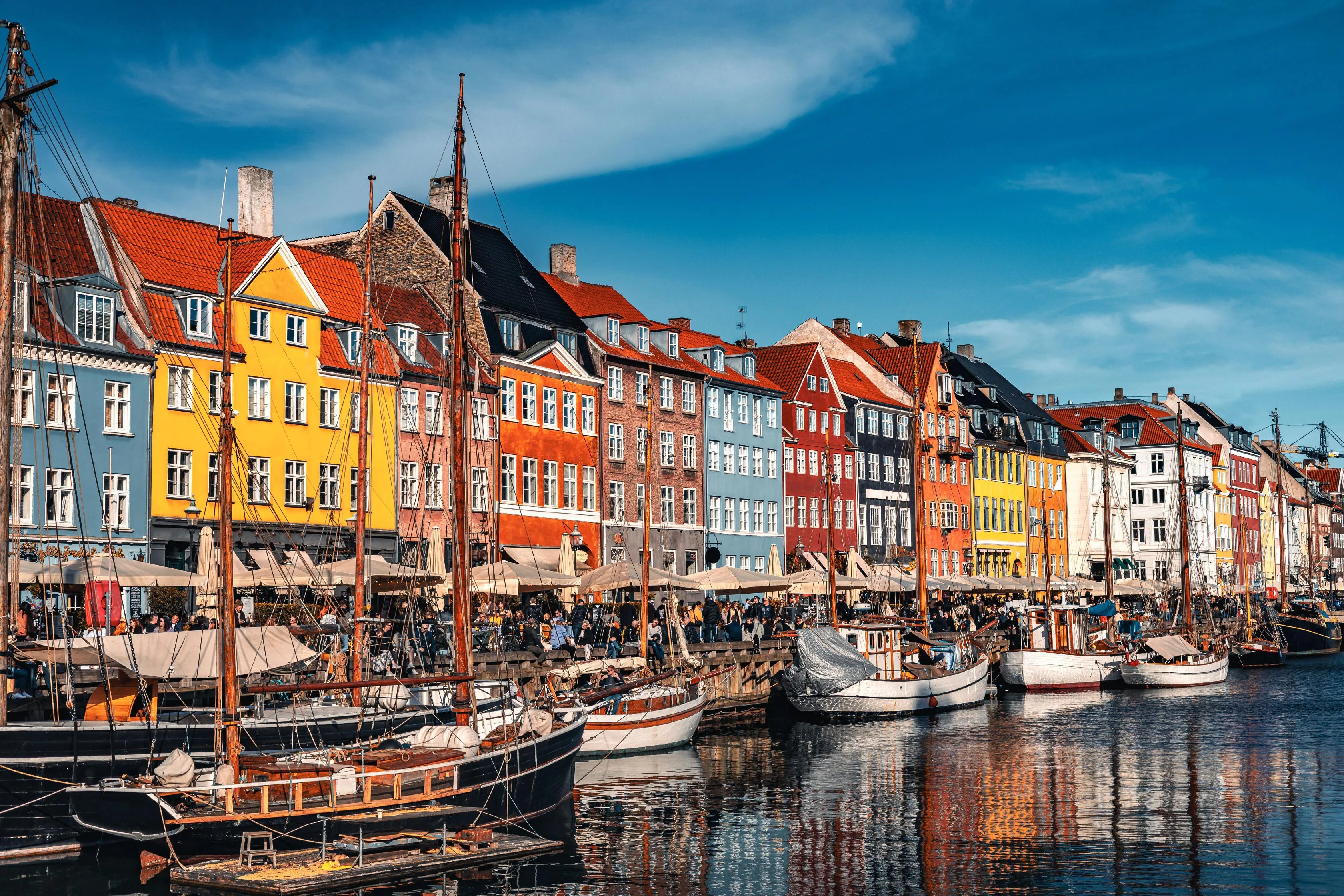
Start on foot and on a bike. The city has more of the second than it has residents, and the separated lanes are not a leisure amenity — they are the road, with their own signals and their own rush hour. Ride the harbour ring, look at Christiansborg because the parliament, the supreme court and the royal reception rooms share one building, and eat somewhere that is not on Nyhavn.
The harbour and Amager
The water in the middle of Copenhagen was too dirty to swim in until the sewers were rebuilt in the 1990s; the harbour baths at Islands Brygge are what that project bought. Then the harbour bus out to Refshaleøen, and up Amager Bakke, which is a working waste incinerator with a dry ski slope on the roof and a very good argument inside it.
Roskilde
Twenty-five minutes west. The cathedral is the first Gothic brick church in Scandinavia and the burial place of about forty Danish monarchs, stacked in chapels added over eight centuries. Down at the fjord, five ships scuttled around 1070 to block the channel were raised in 1962. The Norwegian ship burials had already shown what an elite hull looked like; Skuldelev showed the working fleet — a deep-sea trader, a coaster, two warships and a fishing boat, all built to different rules.
South to Møn
Train to Vordingborg, then the bus over the bridges. Møns Klint is chalk, up to 128 m of it, dropped straight into turquoise water because the sea is full of the same chalk in suspension. The stair down to the beach is 500-odd steps and the cliff face loses pieces of itself every winter, so read the signs about where not to stand.
Nyord and the dark sky
Møn and Nyord were designated a dark-sky park and community in 2017, the first in Scandinavia, which in a country this flat and this built-up took some doing — street lighting was replaced parish by parish. Nyord itself is a single village of thatched houses with a bird-watching marsh behind it. The astronomy only works when there is night: at this latitude in June there effectively is not one.
West to Odense
A transfer day across Zealand and over the Great Belt. Odense is the third city and it spent most of the 2010s digging out the four-lane road driven through its medieval centre in the 1960s — closed to cars in 2014, built over, and since 2022 carrying a tram line instead, which tells you what Danish urban politics is mostly about. The Hans Christian Andersen museum, rebuilt by Kengo Kuma in 2021, is better than the subject usually gets.
Svendborg and across to Ærø
Forty-five minutes down to the south coast of Funen, then an hour and a quarter on the ferry through the archipelago. Ærøskøbing kept its street plan and most of its timber houses because the island got poor at the right moment and nobody could afford to knock anything down. Bring a bike or hire one at the harbour.
Ærø by bike
Thirty kilometres end to end, no hill worth the name, and a beach at Ærøskøbing lined with painted bathing huts that are individually owned and individually argued about. Ride east to Marstal for the maritime museum and the field of solar collectors behind the town, which has been heating the place since the 1990s and was a demonstration project when almost nobody else was doing it.
Ellen to Jutland, then Ribe
Bus across to Søby and out on Ellen, which entered service in 2019 as the largest all-electric ferry in the world and still crosses to Als on a battery topped up at the Søby quay between sailings. Then buses and trains west and south to Ribe, which was a trading town in the 700s and is the oldest in the country.
Mandø, between tides
The Wadden Sea is the largest unbroken system of intertidal sand and mud flats on earth and it is UNESCO-listed across three countries. Mandø sits in it, and the track out to the island is under the sea for most of the day. The tractor bus leaves Vester Vedsted at whatever time the water allows, which is a different time every day. Back in Ribe, the night watchman still walks the town in the evening from spring to autumn.
North to Aarhus
Three hours across Jutland. Aarhus is a university city that behaves like one: ARoS with Olafur Eliasson's circular glass walkway on the roof, Den Gamle By, which is an open-air museum of relocated buildings organised by year — 1864, 1927, 1974 — rather than by century, and Moesgaard out at the edge of town, where Grauballe Man has been lying since somebody cut his throat around 290 BC.
The top of the country
Up the east coast to Frederikshavn and onto the Skagensbanen for the last stretch. Grenen in the evening: walk out along the spit until the sand ends and two seas meet at an angle you can see, the Skagerrak running one way and the Kattegat the other. Do not swim there — the current is exactly what it looks like.
The sand
Råbjerg Mile is four million cubic metres of dune walking north-east at roughly 15 m a year, the last of the sand drift that buried farms along this coast for two centuries. Then the tower of the church it took: the congregation gave up in 1795 and the nave was demolished, leaving a whitewashed tower standing in heath. The Skagen painters came for the light in the 1870s and the museum in town shows why they stayed.
Good to know
DSB releases a limited quota of Orange and Orange Fri tickets about two months before departure, tied to one specific train and much cheaper than the flexible fare — book the long legs (Odense, Ribe, Aarhus, Skagen) the day they open and let the short ones look after themselves. Everything else runs on regional operators with different names on each island, but Rejseplanen plans across all of them and a single app ticket covers most journeys; bikes ride free on Copenhagen's S-trains and need a cheap bike ticket on long-distance services. The Mandø road is not a road with a tide problem, it is a seabed with a published window: the tractor bus departure moves with the water every day, and walking or driving out at the wrong hour is how people get lifted off by helicopter. Søby–Fynshav is a small route with a handful of sailings, so check it before you build a day around it. Season matters more than the flat map suggests — Skagen in July is a Danish holiday town at full price, Roskilde is unbookable during the festival at the start of that month, and the starling murmurations south of Ribe are a March-to-April and September-to-October event only. Cards work everywhere and a fair number of places no longer take cash at all.
Shorter or longer?
From Copenhagen, the through train across Sweden to Ystad and the fast ferry to Rønne — about three hours in total. Give the island four days for the round churches, the smokehouses and Hammershus, and rejoin at the end rather than the middle.
Copenhagen, Roskilde, Møn, Odense, Ærø and out. Drops Jutland entirely along with both of the long transfer days, and keeps the two best islands.