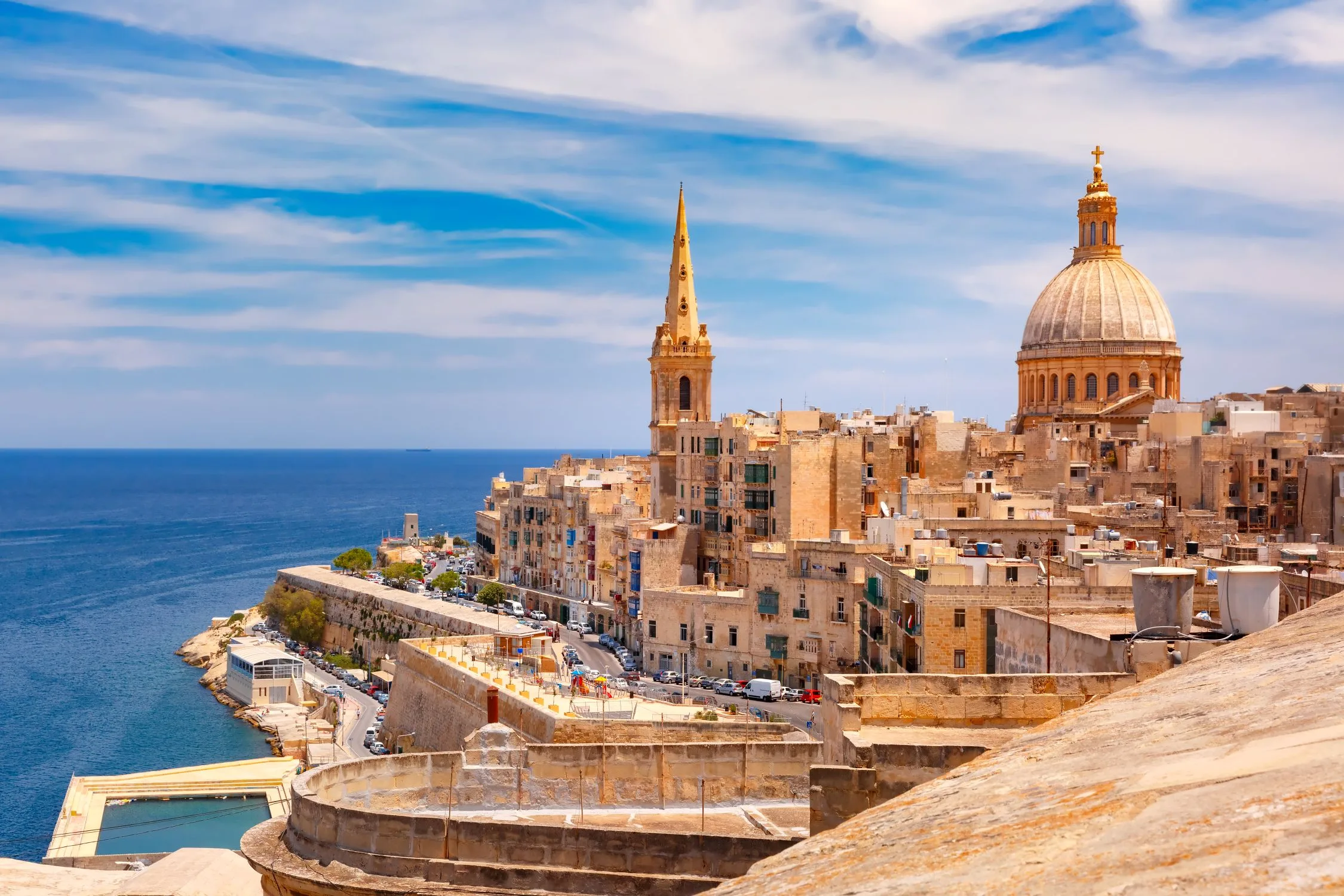
Malta is twenty-seven kilometres end to end and holds free-standing stone temples older than the pyramids at Giza, a capital laid out in one go by a military order, and a harbour that has been fought over since the Phoenicians. Eight days on public buses and the Gozo ferry — with the Hypogeum booked before the flights, because it takes ten people an hour and nothing else on this route bends.
Valletta
The Order of St John began the city on 28 March 1566, six months after surviving the Ottoman siege, on a grid drawn by Francesco Laparelli, the papal military engineer. St John's Co-Cathedral is plain outside and unreasonable inside: a floor of some four hundred inlaid marble tombstones, Mattia Preti's vault, and in the oratory the largest canvas Caravaggio ever painted and the only one he signed — in the blood running from the saint's throat.
The Three Cities
All three are older than Valletta, but only Birgu by centuries. Birgu was the harbour town the Order took over in 1530 and ran from for forty-one years, until the convent finally crossed to the new city in 1571; Senglea began as Fort St Michael on the point in 1552, and Grand Master Claude de la Sengle walled the rest of the peninsula and gave it his name two years after that; Cospicua stayed an open village behind both until the Santa Margherita lines were begun round it in 1638 and the far larger Cottonera lines went outside those from 1670. All three took the worst of both sieges. Fort St Angelo at the tip of Birgu was the Order's headquarters through 1565; the Inquisitor's Palace behind it is one of very few anywhere still standing and open, tribunal room and cells included. The war museum in the Couvre Porte leads down into shelters cut by hand through the rock in the 1940s.
The Hypogeum and Marsaxlokk
Workmen cutting cisterns for a housing block found the Hypogeum in 1902 and kept quiet about it for months. Three levels, carved with stone tools to imitate the built temples above ground, holding the scattered remains of thousands of people. Tarxien is ten minutes' walk away and above ground, which makes the comparison the whole point. Marsaxlokk in the afternoon for the luzzus, each with an eye painted on the prow.
Ħaġar Qim, Mnajdra and the Blue Grotto
Two temple complexes five hundred metres apart on a slope above the sea, under protective canopies since 2009. Mnajdra's lower temple is the one that matters: at the equinoxes the sunrise runs the length of the central corridor, at the solstices it strikes the edges of megaliths either side. Filfla sits offshore, shelled and bombed as a target range by the British services until 1971, made a bird sanctuary in 1980 and a nature reserve in 1988 — landing is prohibited. Then walk the coast road east to Wied iż-Żurrieq, twenty-five minutes, for the Blue Grotto boats: twenty minutes in an open launch, and only when the sea is flat.
Mdina, Rabat and Mosta
Mdina was the capital until the Order moved down to the harbour, and the walls you walk through were rebuilt after the 1693 Sicilian earthquake shook the old ones apart. About three hundred people still live inside. Below the gate, St Paul's Catacombs are Roman-period burial complexes with stone tables cut for funeral meals. Mosta on the way back: on 9 April 1942 a German bomb came through the dome during a service and did not go off.
Across to Gozo
Bus north to Ċirkewwa, then the Gozo Channel ferry into Mġarr under Fort Chambray. Victoria's Cittadella is the reason the island has a history it does not much enjoy retelling: in July 1551 an Ottoman force took it and carried off nearly the entire population of Gozo into slavery. The fortifications you climb are the rebuild that followed. Xlendi for the evening.
Ġgantija and the west of Gozo
Two temples inside one enclosing wall at Xagħra, begun around 3600 BC and among the oldest free-standing structures anywhere. Ta' Kola windmill next door is from 1725 and still has its machinery. West to Dwejra, where the Azure Window fell into the sea in a storm on 8 March 2017 and the Inland Sea and Fungus Rock did not. Finish on the Ta' Ċenċ cliffs above Sannat.
Comino, and out
The passenger boat from Mġarr crosses to Comino in about fifteen minutes — Gozo is the closer side, whatever the Ċirkewwa touts say. Fewer than half a dozen people live on the island; the Blue Lagoon is the reason everyone else comes, and in August that is several thousand of them a day. Walk twenty minutes inland to Santa Marija Tower, built in 1618 under Grand Master Wignacourt to stop the island being used as a corsair base, and the crowd disappears. Second boat across to Ċirkewwa and the bus south.
Good to know
Book the Hypogeum first and build the week around the slot you get: admission is ten people an hour, eight slots a day, and Heritage Malta releases them months ahead online. A small number of last-minute tickets go over the counter the day before the visit at a markedly higher price — Fort St Elmo and the Gozo Museum of Archaeology until midday, the National Museum of Archaeology in Valletta and the Hypogeum itself after it — which is a fallback rather than a plan. Buses are cheap and go everywhere, but the network radiates from Valletta, so two villages ten kilometres apart on the same coast can mean going in and back out again; the seven-day Explore card covers it, evening services thin out badly, and in July the bus is standing room. The Gozo Channel fare is collected only on the return leg at Mġarr — you board free at Ċirkewwa and pay to leave the island — while the fast passenger ferries from Valletta take about 45 minutes and carry no cars. July and August average around 31°C and go past 35°C in a heatwave, and the temple canopies are the only shade at any of these sites; September holds August's sea temperature with a fraction of the coaches, and October is still swimming weather. Boats to the Blue Grotto and around Comino cancel outright in wind, so check on the morning rather than the night before. Malta's hunting seasons put shotguns in the garrigue from September to January and again under a spring derogation in April — the walled enclosures and stone hides off the paths are private, so stay on marked routes. Churches want shoulders and knees covered, and St John's Co-Cathedral turns away stiletto heels, because the floor is four hundred marble tombstones and they are the exhibit.
Shorter or longer?
The catamaran from Valletta to Pozzallo takes about an hour and three quarters and runs most days. Four or five more days gets you Ragusa, Modica and Syracuse, and the baroque rebuilt after the same 1693 earthquake that cracked Mdina.
Valletta, the Three Cities, the Hypogeum, the southern temples and Mdina. Drops Gozo and Comino, and with them both ferry days — the trade is that you never see the country from the water.