Advisory - travel not recommended · checked 5 Aug 2026
North Korea
Foreign ministries advise against ALL travel to North Korea. Independent travel does not exist, detentions have been arbitrary and prolonged, and some passports are barred from entry outright. Standard scores are suspended while this alert is active.
Official advisory →Read the advisory first: foreign ministries advise against ALL travel to North Korea, independent travel does not exist in any form, detentions have been arbitrary and prolonged, and United States passports have been invalid for travel to the country since September 2017. The borders were sealed in January 2020 and the country has stayed shut to almost every foreign visitor since, with only brief and partial exceptions. This route is published for the day that changes rather than as an invitation for now. It follows the circuit that tour groups genuinely ran in the years before 2020 — Pyongyang, Kaesong and the northern side of Panmunjom, the West Sea Barrage at Nampho, Myohyangsan, the east coast at Wonsan and Hamhung, and a flight north to Mount Paektu — accompanied every day by two state guides, because that is the only arrangement under which the country can be seen at all.
Pyongyang
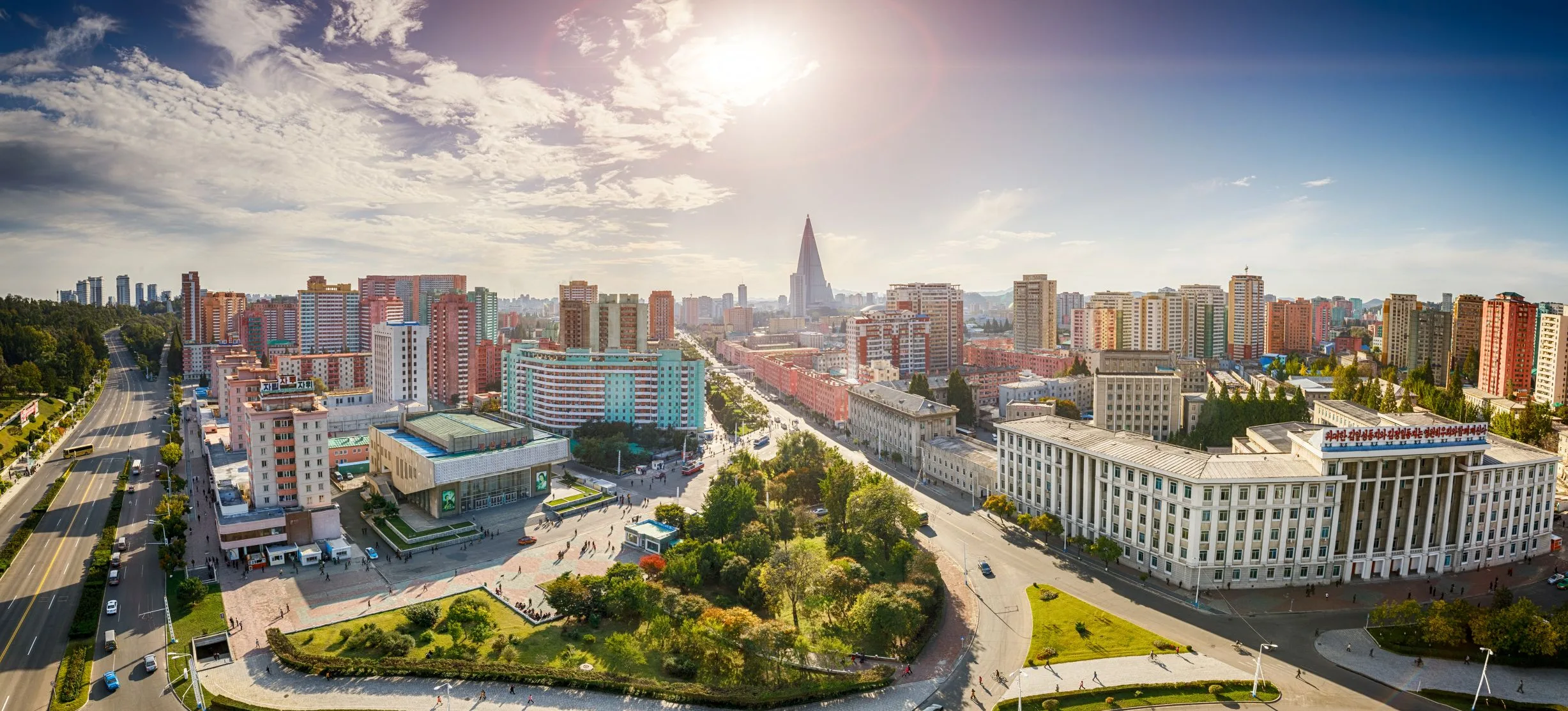
Air Koryo lands at Sunan and the itinerary you agreed weeks ago begins there — two guides meet the group at arrivals and stay with it until departure. The first afternoon is usually Kim Il Sung Square, a granite parade ground with the numbered marker dots for rank formations still painted on it, and the view across the Taedong to the Juche Tower on the far bank. The city was flattened in the Korean War and rebuilt from nothing on a Soviet plan, which is why the boulevards are wide enough to land an aircraft on and why almost nothing standing predates 1953.
The metro and the monuments
The Chollima Line is given at about a hundred metres (330 ft) down — an operator figure nobody outside has ever surveyed — and the escalator takes roughly three minutes; for decades visitors saw two stations of it and no more, Puhung and Yonggwang, and full-line rides became normal on tours from around 2014. Above ground the standard round is Mansu Hill, where the bronzes of Kim Il Sung and Kim Jong Il stand and where flowers are laid before photographs are permitted, then the Arch of Triumph of 1982 and the Victorious Fatherland Liberation War Museum, which tells the war from the other end and is worth the hours precisely for that.
South to Kaesong
The Reunification Highway runs about 170 km (106 mi) south with almost no traffic on it and concrete anti-tank blocks standing over the carriageway at intervals, ready to be dropped. Kaesong was the Koryo capital from 918 and is the one city in the country that was not levelled between 1950 and 1953, so it still has a quarter of tiled single-storey courtyard houses. The Koryo Museum occupies the old Confucian academy, and the tombs of King Kongmin sit a few kilometres out in open hills.
Panmunjom, then north
The Joint Security Area is eight kilometres (5 mi) from Kaesong and the briefing comes from a Korean People's Army officer before anyone gets out of the coach. The armistice was signed on 27 July 1953 and no peace treaty has followed it, which is the fact the whole site is arranged around. You see the same blue huts that visitors from the southern side see, from the opposite doorway. Then back north, breaking at Sariwon, where a mock-historic folk street was built in the 2000s and the hill above it gives the only wide view of a provincial city the itinerary allows.
Nampho and the West Sea Barrage
West down the Youth Hero Motorway to the estuary, where a dam roughly eight kilometres (5 mi) long with three lock chambers was built across the mouth of the Taedong between 1981 and 1986 to hold back the sea and secure irrigation water upstream. It is the single largest piece of civil engineering the country will show you and the presentation film is a period piece in its own right. On the way back, the Chongsan-ri cooperative farm, which has been the standard agricultural stop for fifty years.
East to Wonsan
The Pyongyang–Wonsan motorway crosses the peninsula over the Ahobiryong pass, and the drive is the best look at ordinary country the route offers: ox carts on the hard shoulder, terraced maize to the ridgelines, whole hillsides worked by hand. Wonsan is a working port on the Sea of Japan — the East Sea, in both Koreas — with a long beach, a fishing fleet and, since July 2025, a large state-built resort strip along Kalma spit that took a few Russian groups in its opening weeks, stopped accepting foreign visitors within a month of that, and has otherwise held domestic holidaymakers.
Hamhung
North up the coast to the second city, an industrial centre rebuilt after the war largely by East German engineers — the DAG Hamhung reconstruction team worked here from 1955 to 1962 and the housing they laid out is still standing and still occupied. The Hungnam fertiliser complex is the reason the city exists, the Tongbong cooperative farm is the usual stop, and Majon beach is where Hamhung swims. This is as far north-east as the standard circuit goes.
Back across the country
A long road day returning to Pyongyang, and an honest one — the interior between the coast and the capital is farmland and small towns and the coach does not stop in them. Use it. You will see more of how the country actually works through a window on this leg than on any organised visit, and the guides generally let the camera stay in your lap so long as it stays out of the direction of soldiers, checkpoints and anything under construction.
Myohyangsan
North into the mountains to the International Friendship Exhibition, a complex burrowed into the rock to hold the gifts sent to Kim Il Sung and Kim Jong Il by foreign states and parties — bear skins, armoured railway carriages, a stuffed crocodile holding a tray of drinks. You surrender your camera and put on shoe covers at the bronze doors. Pohyon Temple stands a few minutes away, founded in the 1040s, burned in the war and rebuilt around what survived — with Kaesong it is one of only two points on the route where anything is nine hundred years older than the state showing it to you.
Ryongmun cave and the road back
A limestone cave system in Kujang county, opened to visitors in the 1960s, with a couple of kilometres of walkable passage lit in colours no geologist chose. It is the closest thing to an ordinary day out the route contains, and Korean school groups are usually in it, which makes it one of the few stops where the other visitors are not a delegation. Then the road south to Pyongyang and a last evening in the city.
North to Samjiyon and Paektu
A domestic Air Koryo flight to Samjiyon, on the plateau below the mountain at around 1,400 m (4,600 ft), where the temperature drops hard even in August. Mount Paektu is 2,744 m (9,003 ft) and the crater lake in its summit sits at about 2,190 m (7,190 ft) — a stratovolcano that produced one of the largest eruptions of the last two thousand years, around AD 946, and is claimed by the state as the birthplace of Kim Jong Il, which the historical record does not support. The road up is open roughly late June to September and closes with the first serious snow.
Rimyongsu and out
The falls at Rimyongsu come out of the side of a lava field rather than over a lip, because the water is running underground through basalt and emerges at the contact — which is why they do not freeze solid in a place that spends the winter well below zero. Then the flight back to Pyongyang and the departure formalities, which include a phone and camera check that is thorough and is not a formality. Delete nothing on the spot; guides would rather advise you before you reach the desk.
Good to know
Start with the advisory and with the fact that the door is shut. Foreign ministries advise against all travel to North Korea. The country closed its borders in January 2020 and has not reopened them to general tourism since: small Russian groups have been admitted from February 2024, a handful of Western groups reached the Rason special economic zone in the north-east in February 2025 before that opening was withdrawn within weeks, and foreign amateur runners were let in for the Pyongyang marathon in April 2025. None of that adds up to a country you can currently book. Treat everything below as the shape of a trip for whenever it reopens, and check your own foreign ministry the week you would travel.
There is no independent travel. Not restricted, not difficult — none. Every visit is booked through a state-approved operator, the itinerary is agreed and stamped in advance, and you are accompanied throughout by two Korean guides plus a driver. You do not leave the hotel alone, you do not change the plan on the day, and the guides carry personal responsibility to the state for what their group does. That last point is worth holding onto, because the consequences of a stunt fall on them long after you have flown home.
Know what the trip is and who is paid for it. The tour price is hard currency to a state whose human rights record a United Nations commission of inquiry, reporting in February 2014, found to involve crimes against humanity. What you are shown is chosen as carefully as what you pay: the itinerary is agreed in advance, the stops are the stops every group gets, and the country outside them is not on offer. Neither of those settles the argument by itself, and neither is something to work out after you have paid.
Some passports cannot go at all. United States passports have been invalid for travel to, in or through North Korea since 1 September 2017, imposed after the death of Otto Warmbier — detained at Pyongyang airport in January 2016, accused of taking a propaganda banner from the Yanggakdo hotel on an account no one outside the state has been able to verify, sentenced to fifteen years' hard labour, returned to the United States in a coma in June 2017 and dead within days of landing — and the restriction has been renewed every year since. A special-validation passport exists for journalists and humanitarian workers and is granted rarely. South Korean nationals cannot travel there under their own law. Other nationalities have faced bans at various points, so verify your own position rather than assuming.
The visa is issued as a separate paper tourist card rather than a stamp in the passport, arranged by the operator and usually collected at the embassy in Beijing or handed over on arrival. The practical entry points are Air Koryo from Beijing or Vladivostok; the Beijing–Pyongyang through train, which carried most groups before 2020, has not run for foreign passengers since.
Money is cash and nothing else. Sanctions mean no international card network functions anywhere in the country, there are no ATMs you can use, and the won is not a currency tourists are meant to hold. Euros, Chinese yuan and US dollars are all accepted in the shops and hotels foreigners use, and change comes back in a mixture of all three. Bring more clean small notes than you think you need. Note also that carrying North Korean goods home can breach your own country's sanctions regime.
Phones come in and are inspected on both entry and exit. A Koryolink tourist SIM gives international calls and expensive data with no access to anything domestic; there is no roaming and there is no ordinary internet. Photography rules are real and enforced: no soldiers, no checkpoints, no construction sites, and images of the leaders' statues must show the whole figure. Material described as propaganda, and religious material, should not be in your luggage.
Insurance is the line most people miss. Ordinary travel insurance is void in a country under an against-all-travel advisory, so the cover you already hold will not respond. Specialist high-risk policies exist and cost several hundred euros for a fortnight, and even they generally exclude detention and exclude any evacuation the state itself will not permit. There is no commercial medical evacuation from North Korea and consular assistance for most nationalities is routed through a third country's embassy. Price the policy before you price the tour, because it changes the arithmetic.
Season decides the north. The Paektu road is a summer proposition, roughly late June to September; outside that window the mountain leg is cut and the route ends at ten days. Pyongyang is hot and wet in July and August and reliably below freezing from December to February, and the shoulder months are the ones the tours were built around.
Shorter or longer?
Four or five more days for Chongjin, the Kyongsong hot springs and Rason, the special economic zone on the Russian and Chinese border that runs on its own rules and its own currency exchange. Rason was the one part of the country briefly opened to Western groups in February 2025, and it is reached overland from Yanji in China rather than through Pyongyang.
Pyongyang, Kaesong and Panmunjom, with the metro and the West Sea Barrage. This was the standard first visit before 2020, it is what most groups actually did, and it cuts every long road transfer and the Paektu flight.