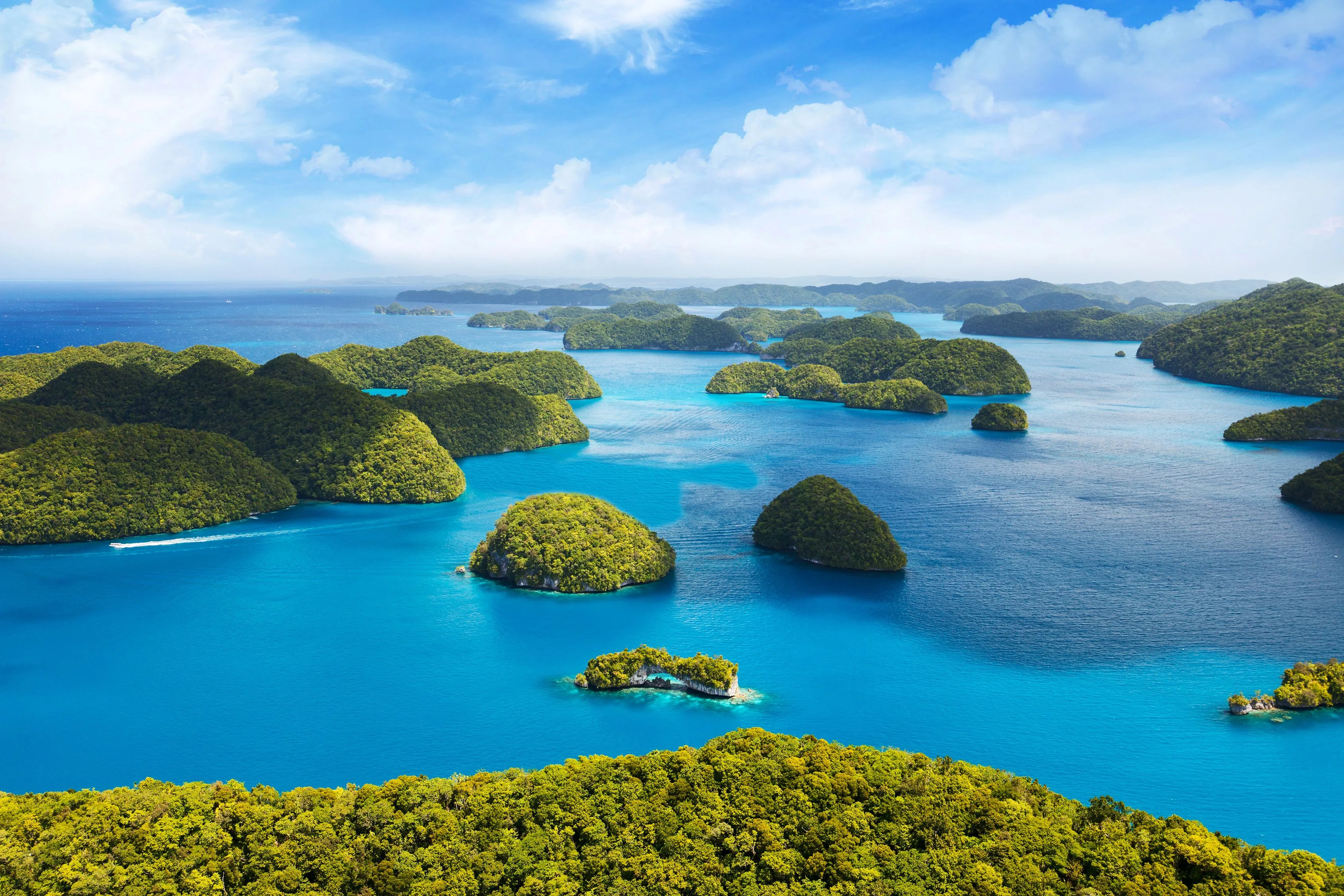
Palau is 459 square kilometres (177 sq mi) of land and about 604,000 square kilometres (233,000 sq mi) of sea, and almost everything worth the flight is in the water or reached across it. Seven days out of Koror on dive boats and one hire car — the limestone islands and the marine lake, the current-swept reef corners the country is known for, a night on the battlefield island, and the one day of the week spent on tarmac.
Koror
The only town in the country and the base for everything that follows. Buy the Koror State Rock Islands permit before you book a boat — US$100 for ten days with Jellyfish Lake, US$50 without, and rangers do check it on the water. The Belau National Museum is the oldest museum in Micronesia, founded in 1955, and the reconstructed bai in its grounds is the fastest way to understand what you will be looking at for the rest of the week; the Etpison Museum across town is the better collection of Palauan and outer-island material and has the honest labels about where objects came from. Then a dive shop, a briefing, and a straight conversation about your logged experience, because the sites here are not forgiving of an exaggeration.
The Rock Islands and the marine lake
Several hundred undercut limestone knobs in a lagoon, World Heritage since 2012 as a mixed cultural and natural site, and the cultural half is not decoration: the islands were inhabited for around two thousand years and the abandoned villages, burial caves and rock art are the reason the inscription reads the way it does. Ongeim'l Tketau on Mecherchar holds golden jellyfish that have been cut off from the open sea long enough to lose an effective sting. Snorkelling only — scuba is prohibited, and not for sentiment, because below about fifteen metres the lake is anoxic and full of hydrogen sulphide. Koror State closed the lake after a drought collapsed the population in 2016 and did not reopen it until December 2018.
Blue Corner and Blue Holes
The reef plateau off Ngemelis is the site the country is sold on and it earns it on a running tide. You drop into the blue, swim to the wall, put a reef hook into dead rock at the lip and hang there while the current does the work — grey reef sharks stacked into it, jacks, barracuda, napoleon wrasse that come to look at you. It is a drift dive with a real current and a plateau that shelves away on both sides, and operators will refuse people who cannot demonstrate the experience. Blue Holes next door is four vertical shafts through the reef top opening into one cathedral chamber at about thirty metres, and it exits onto the same corner.
German Channel and Ulong
The channel is a cut blasted through the barrier reef by the German administration before the First World War so that phosphate barges from Angaur could reach Koror without going round the south of the archipelago. A hundred years on it is a manta cleaning station: the animals queue over coral heads on the sand while wrasse work them over, usually on the incoming tide, and the wait is done kneeling on sand at fifteen metres. Ulong Channel in the afternoon is the other kind of dive here — a fast drift through a cut in the reef with a lettuce coral garden at the mouth. Ulong island above it is where the Antelope was wrecked in 1783, which is how Britain first heard of Palau.
Peleliu
An hour and a half south by boat to an island of about five hundred people that the United States assaulted on 15 September 1944 in an operation planned for four days and finished after more than two months. Bloody Nose Ridge is a coral spine honeycombed with caves the Japanese garrison had spent months preparing, and the path up it passes gun positions, a Sherman on its side and the concrete shell of the headquarters building. Nothing has been landscaped. The Peleliu World War II Memorial Museum in the old power station is run locally and is where you hire the guide you should be walking with, because the island has never been fully cleared and unexploded ordnance is in the ground either side of the tracks.
Peleliu Corner, and back north
The reef off the southern tip is the least dived good water in the country because it is a long way from where the boats sleep, and staying the night on Peleliu is the only way to reach it early. Peleliu Express and Peleliu Corner run current on the same scale as Blue Corner with a fraction of the boats on them, and the wall drops into open ocean rather than a lagoon. In the shallows off Orange Beach there is landing craft wreckage from the assault, sitting in five metres of water. Then the run back to Koror in the afternoon.
Babeldaob by road
The one day out of the water. Babeldaob is the second-largest island in Micronesia and has almost nobody on it: the Compact Road, an 85-kilometre (53 mi) ring finished with American money in 2007, runs round it past savannah, taro patches and villages of a few hundred people. Ngerulmud is the capital — a domed capitol complex opened in 2006, built with borrowed money and standing on a hill in Melekeok state with no town attached to it, because the constitution required the seat of government to leave Koror for Babeldaob and the ministries moved without anything else following them. Ngardmau falls take a hot walk down and a hotter one back. Finish at Badrulchau in Ngarchelong, where thirty-odd basalt monoliths stand on a grass slope above the sea, quarried and raised by people who left no written record — Palauan tradition holds they were the footings of a bai built for the gods — and where an entry fee is collected on site by whoever holds the land.
Good to know
Most nationalities are admitted visa-free for thirty days on arrival with a passport valid six months and an onward ticket; United States citizens may live and work here indefinitely under the Compact of Free Association. Every arrival signs the Palau Pledge, which is printed in the passport and stamped at immigration — it is a legal undertaking to behave, not a souvenir, and it is addressed to the children of Palau because they wrote it. The sunscreen ban is the part visitors get wrong: since 1 January 2020 sunscreens containing oxybenzone, octinoxate, octocrylene, triclosan, parabens and several other listed ingredients have been prohibited under the Responsible Tourism Education Act, they are taken off you at the airport, and the only reliable answer is a non-nano zinc oxide cream bought before you fly or in Koror. Costs are the other thing people underestimate. A hundred-dollar Pristine Paradise Environmental Fee has been collected inside the air ticket since 2018, so it is paid before you arrive and does not appear in the budget below; the Koror State Rock Islands permit is a separate US$100 for ten days including Jellyfish Lake, or US$50 without it, and Peleliu, Ngardmau and Badrulchau each charge their own state or landowner fee on top. A week here costs more than a month in South-East Asia and there is no budget end of the market to retreat to. The currency is the US dollar. Cards work at hotels and dive shops in Koror and almost nowhere else, ATMs exist only in Koror, and small notes matter on Peleliu. Flights are thin — Koror is served from Taipei, Manila, Seoul and Guam a few times a week rather than daily, so a cancellation costs days rather than hours and there is no second carrier behind it. Keep a spare day in front of the international flight and do not dive on the day you fly. Diving here is not entry-level: Blue Corner, Peleliu Corner and Ulong all run genuine current, a reef hook is standard equipment, and operators are entitled to turn you away. There is a recompression chamber in Koror — confirm it is operating before you commit to depth, because the alternative is an evacuation to Guam or Manila — and insurance with chamber and evacuation cover is not optional. On Peleliu, walk with a local guide and stay on the tracks: the island has never been fully cleared and the ordnance in the ground is live. Saltwater crocodiles are present in the mangroves and estuaries and are treated seriously by people who live here. The dry season runs roughly November to April and holds the best visibility of the year; June to October is wetter, cheaper and still perfectly diveable, with squalls rather than washouts. Palau sits at the southern edge of the typhoon belt and is usually missed, but Bopha in 2012 and Haiyan in 2013 both crossed the country — Haiyan flattened Kayangel — which is the kind of event that ends a trip rather than delays it. Sunday is quiet, church is where people are, and boat schedules thin accordingly.
Shorter or longer?
Three or four more days at the two ends of the country. Kayangel is a true atoll off the north tip of Babeldaob with a population in the dozens, reached by an open boat crossing that is regularly cancelled by swell and arranged through the state office rather than a tour desk. Angaur, south of Peleliu, was mined for phosphate under three administrations, has macaques descended from animals released by the Germans, and is served by a small state boat and an airstrip that sees almost nothing. Both need flexible dates and a tolerance for being stuck.
Koror, the Rock Islands and Jellyfish Lake, Blue Corner and Blue Holes, German Channel and Ulong. Keeps every dive the country is famous for and the marine lake, and drops Peleliu and Babeldaob — which means dropping the war, the monoliths and the only day you would have spent on land.