The length of the country on trains and buses, west to east. A capital that borders two other states, the mining town that built sixty reservoirs to keep its shafts dry, a timber church seating eleven hundred people that was forbidden a tower, the smallest high-alpine range in the world, and a run of Gothic towns in the east that were preserved by going broke.
Bratislava
The only national capital that borders two other countries, and a city that spent 267 years as the coronation seat of the Kingdom of Hungary — eleven monarchs and eight consorts crowned in St Martin's between 1563 and 1830, with brass crowns set into the pavement marking the route. Note what the 1972 motorway bridge cost: its approach road took most of the old Jewish quarter, and the Neolog synagogue below the castle came down in 1969.
Devín and the border
Bus 29 out to the confluence of the Morava and the Danube, where a Great Moravian fortress recorded in the Frankish annals for 864 sits on a rock that Napoleon's troops blew up in 1809. From 1948 to 1989 the water below was the Iron Curtain; the Gate of Freedom memorial at the foot of the crag carries the names of people who died trying to cross it. Ride back along the riverside cycle path if the weather holds.
East to Banská Štiavnica
A slow cross-country train to Hronská Dúbrava, then a branch line that climbs twenty kilometres into a collapsed volcanic caldera. Banská Štiavnica held 23,192 people in 1782, which made it the third largest town in the Kingdom of Hungary; about ten thousand live there now, and the gap between those two numbers is why the eighteenth century is still standing.
The tajchy
The mines flooded, so the town built a water system to pump them: roughly sixty reservoirs fed by more than a hundred kilometres of hand-cut channel, about two dozen of the lakes still holding water. Walk the jarky between Počúvadlo and Vindšachta and swim in a pond dug to drive a pumping engine. Jozef Karol Hell built a water-column engine here in 1749; the first steam engine on the European mainland had gone in at Nová Baňa, half an hour away, in 1722.
Banská Bystrica and Hronsek
The Slovak National Uprising began here on 29 August 1944 and the city held out until 27 October; the museum that commemorates it, a split concrete shell by Dušan Kuzma opened in 1969, is the best building of its decade in the country. Twelve kilometres south at Hronsek stands a timber church of 1725 on oak piles, seating about 1,100, with no tower and its door turned away from the road — every one of those features a legal requirement rather than a choice.
Over Donovaly to Vlkolínec
North over the pass into Liptov. Vlkolínec is 45 log buildings on a hillside above Ružomberok, UNESCO-listed since 1993, and about eighteen people live there permanently — which is the difference between this and an open-air museum. Go late in the afternoon when the coaches have gone and the smoke from the chimneys means something.
Orava
Oravský hrad stands on a limestone cliff 112 metres above the river, first recorded in 1267, and Murnau filmed Nosferatu on it in 1921. Down the valley at Leštiny is another of the articular churches, built 1688 and reachable only by asking for the key. If there is time, the open-air museum at Zuberec collects the Orava buildings that were not going to survive where they stood.
Into the High Tatras
East to Poprad, then up. From Štrba a rack railway opened in 1896 climbs to Štrbské Pleso at 1,346 metres, and the electric line strung along the southern slope since 1912 connects the three resort villages. Arrive, walk the lake circuit and up to Popradské pleso, and let the legs find out what altitude they are at.
Skalnaté pleso and Lomnický štít
The cable car from Tatranská Lomnica reaches the tarn at 1,751 m, where the observatory has been reading the sky since 1943; the second stage, running since 1940, goes to the summit of Lomnický štít at 2,634 m. That top section is a timed ticket with a fixed fifty minutes at the summit, and in July it is gone days ahead. Note the even-aged forest below the line, all of it younger than 2004.
Zelené pleso
The walk into the eastern valleys from Biela voda — about two and a half hours up to the hut at 1,551 metres under the north face of Malý Kežmarský štít, the biggest wall in the range, and the same back. It is the best value day in the range: no cable car, no queue, and the granite does all the work. Marked trails only unless you have hired a licensed guide, which is the law here rather than advice.
Kežmarok
Down out of the mountains to a Spiš town with two Protestant churches side by side: the wooden one of 1717, seating around 1,500 and built under the same restrictions as Hronsek, and the Byzantine-styled replacement of 1894 by Theophil Hansen, who also built the Vienna parliament. Imre Thököly, whose revolt is part of why the wooden one exists at all, is buried in the newer one.
Slovenský raj
A plateau cut by gorges that are climbed rather than walked, on ladders and chains bolted beside the waterfalls. Suchá Belá from Podlesok is the standard introduction, roughly two hours up; the ladder routes are one-way uphill and there is a small daily fee at the gate. Prielom Hornádu is the flatter alternative when the queue at the first ladder is long.
Spišský hrad and Levoča
Over four hectares of castle on a travertine hill, burned out in 1780 and left as the ruin that makes it the biggest thing of its kind in central Europe. Then Levoča, where the altar Master Pavol finished in 1517 stands 18.62 metres inside St James's and is the tallest wooden Gothic altar anywhere. Both went on the UNESCO list because the Spiš towns lost their trade and never had the money to rebuild.
Bardejov and Hervartov
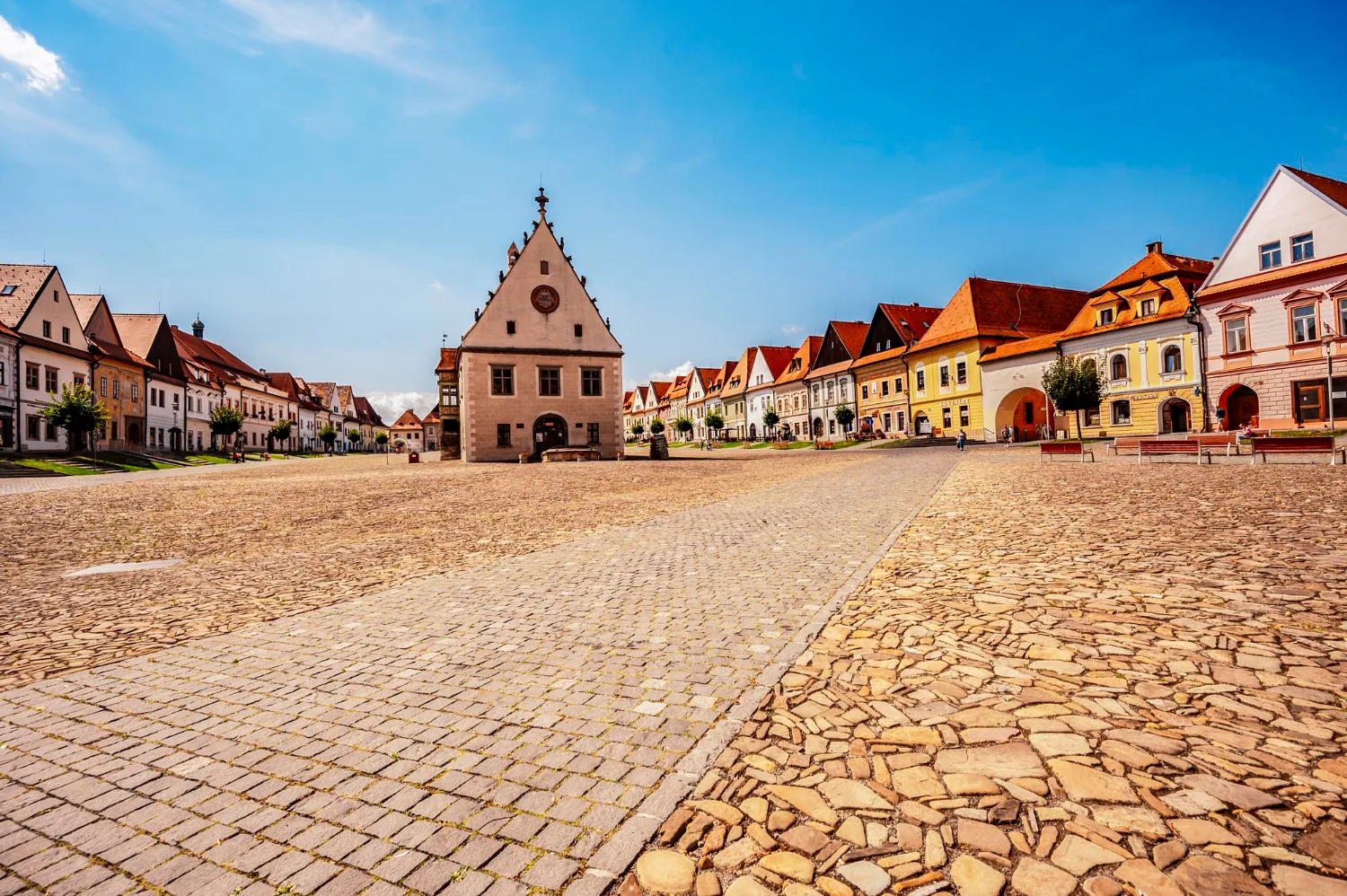
The last long bus, north-east to a square of burgher houses and a town hall of 1505 that was the first Renaissance building in the kingdom. Below it is the Jewish suburb laid out in the 1830s — synagogue, ritual bath and study house still standing together, which is rare. Ten kilometres out at Hervartov is the oldest wooden church in Slovakia, built around 1500. Košice, and the flights, are an hour and three quarters south.
Good to know
The Tatra trail closure is a date, not a forecast: everything above the huts shuts from 1 November to 15 June regardless of conditions, it is enforced with on-the-spot fines, and no amount of good weather in late May changes it. Mountain rescue is charged to the person rescued under the 2002 law that created the Horská záchranná služba, so insurance that explicitly covers mountain walking matters here in a way it does not in Austria; the HZS emergency number is 18 300. Book Tatra huts direct by email months ahead and take cash — none of them are on a booking platform, and Chata pod Rysmi is still supplied by porters carrying loads up on their backs. Lomnický štít sells timed slots with a fixed fifty-minute stay at the top and sells out in high summer. Off marked trails you are legally required to be with a licensed guide, which is why Gerlachovský štít, the highest peak in the Carpathians, cannot be climbed alone. On the flat, cp.sk is the timetable aggregator that covers trains and buses together; note that rural services marked "premáva v pracovných dňoch" do not run at weekends, which is exactly when visitors want them. ZSSK's free-travel scheme on state trains is open to EU and EEA citizens in the student and pensioner categories once you register at a ticket counter with a passport, and most visitors who qualify never find out. Slovakia uses the euro; card acceptance is near-universal in towns and absent in mountain huts. Driving is a separate calculation: an electronic vignette registered to the plate, headlights on all year, and a blood alcohol limit of absolutely zero.
Shorter or longer?
Four or five days on from Bardejov: the Greek Catholic wooden churches at Bodružal and Ladomirová on the Polish border, then south to Košice, the caves of the Slovak Karst at Domica and Ochtinská, and the Tokaj vineyards on the Hungarian line. Buses are thin and a car earns its keep here.
Bratislava, Banská Štiavnica, the High Tatras for three days, Slovenský raj, Spišský hrad and Levoča. Cuts Orava, Liptov and the whole north-east, which is the quiet half, but keeps every day under two hours of travel.