Iron Bottom Sound to the Western Province
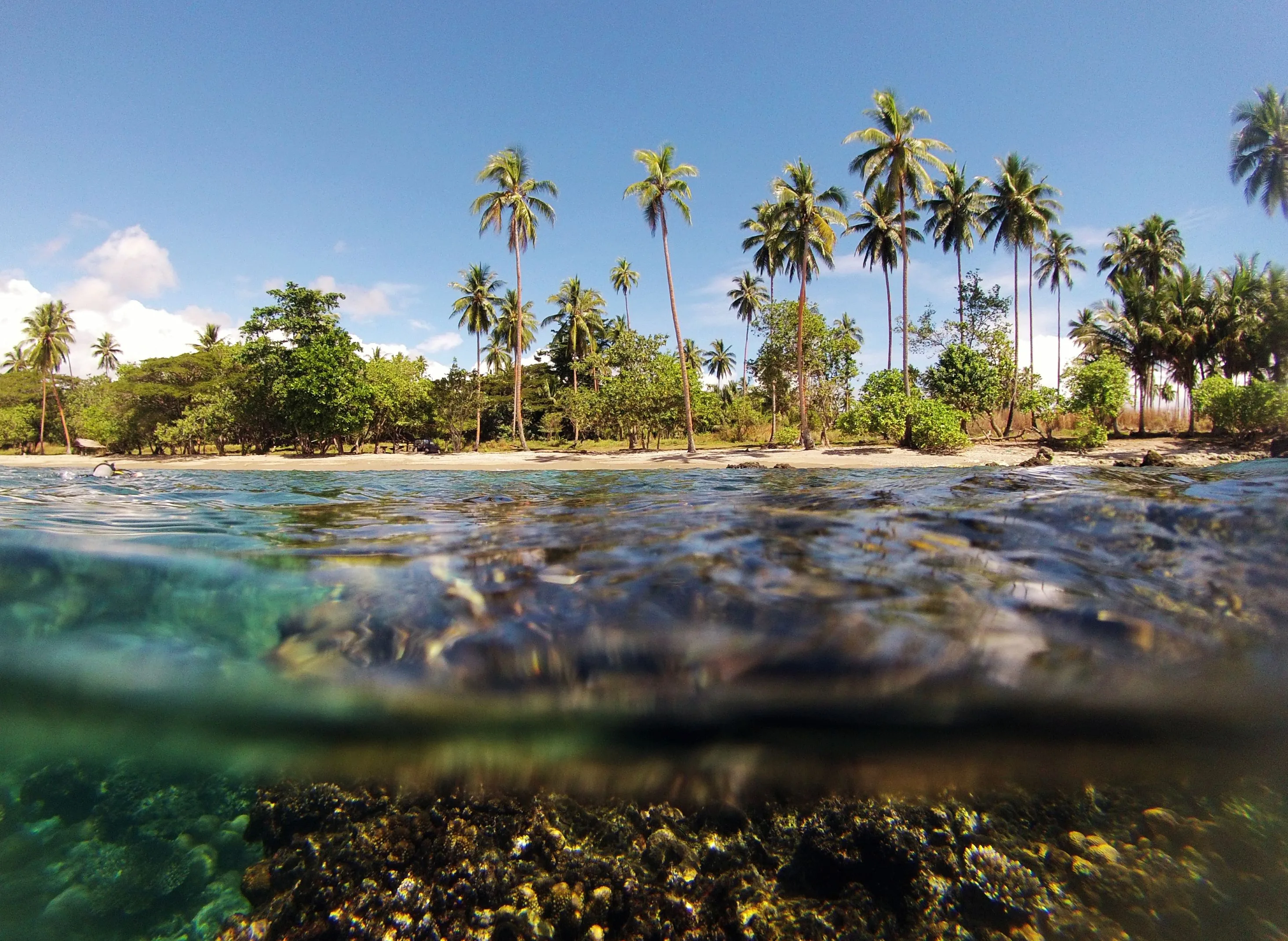
Twelve days across two provinces, moving by three domestic flights and a great deal of open boat — the Guadalcanal battlefields and the transports beached at Bonegi, the largest saltwater lagoon on earth, an airfield the Japanese built under the coconut palms without cutting them down, and the island where a future American president swam ashore and two Solomon Islanders found him. Nothing here runs to a timetable you can rely on, and the route is built with that in it rather than around it.
Honiara
The capital is a single coastal strip with the sea on one side and steep bush on the other, and it exists because the Americans built a base here rather than because anyone chose to found a town. The National Museum on Mendana Avenue is two rooms and a yard of carvings and canoe prows, and it keeps unreliable hours. The Central Market at the western end is the cheapest and best food in the country — kingfish, ngali nut, cassava pudding, betel nut by the pile — and it empties by mid-afternoon. Walk the Mataniko river mouth and the Chinatown beyond it, burned in the riots of April 2006 and burned again in November 2021, and rebuilt both times. Buy a SIM at Our Telekom with your passport, draw cash, and confirm every onward flight in person at the Solomon Airlines office rather than trusting a booking email.
The Guadalcanal battlefields
American marines landed on 7 August 1942 and took the half-finished Japanese airstrip the next day; it became Henderson Field, named for a marine major killed at Midway, and the international airport sits on it now. Bloody Ridge, a few kilometres inland, is a bare spine of kunai grass where Merritt Edson's raiders held off Kiyotake Kawaguchi's brigade over the nights of 12 to 14 September 1942 — there is a small marker, a lot of wind and almost nobody else. Mount Austen above it was the Gifu strongpoint and now carries the Japanese memorial; the American memorial on Skyline Ridge was dedicated on 7 August 1992, fifty years to the day after the landings, and reads out the campaign on stone panels. Twenty-five kilometres west, the Vilu open-air museum is a private collection of aircraft wrecks dragged out of the bush by the landowning family, who charge to walk round it. Ordnance is still in the ground everywhere on this island: in September 2020 two explosive-disposal technicians working for a Norwegian clearance charity were killed in a Honiara compound. Stay on paths and pick nothing up.
Bonegi and Iron Bottom Sound
The strait north of Guadalcanal took so many ships in six months of 1942 that the sailors renamed it. Most of what is down there is unreachable — the cruisers lost at Savo Island on 9 August 1942 lie past seven hundred metres and have only ever been visited by submersible. What you can dive is the shallow end, and the best of it is at Bonegi, twelve kilometres west of town — the same coast road as the battlefield day, stopped short of Vilu — where two transports of the convoy that came down on 14 and 15 November 1942 were run onto the beach and burned. Hirokawa Maru at Bonegi I starts about five metres under the sand and drops away past fifty; Kinugawa Maru at Bonegi II is shallower and can be snorkelled from the shore. Both sit on customary land and a family collects an access fee at the beach, which is normal here and not a shakedown. The wrecks are war graves — nothing comes off them, and the rule is enforced by the people who live above them.
Fly west to Seghe
An hour in a Dash 8 or a Twin Otter over the whole length of the New Georgia group. Seghe's airstrip was cut by American Seabees who landed at the end of June 1943 and had aircraft on it in about ten days, on ground held for the Allies through the previous year by the coastwatcher Donald Kennedy and a force of local scouts operating out of Segi Point — the reason the campaign for New Georgia began where it did. The strip is grass at the mouth of Marovo Lagoon, and a boat from your lodge meets the aircraft, because there is no road out of it. Spend the afternoon on the water: Marovo is the largest saltwater lagoon in the world, a double barrier reef with hundreds of islands inside it, and the scale only registers once you are an hour into it and still inside.
The carving villages and the barrier islands
Marovo has sat on the World Heritage tentative list since the 1980s and has never been inscribed, in large part because nobody could establish who would sign for land held by clans rather than by a state — the same fact that has kept the lagoon from being developed and has not kept it from being logged. Barges and log ponds are part of the view. The villages along the lagoon carve for a living: nguzunguzu canoe prow figures, sharks and dolphins in kerosene wood and ebony, sold from the beach or brought out to your boat by canoe, and the quality gap between one village and the next is large and worth paying attention to. Much of the Western Province is Seventh-day Adventist, so the sabbath here falls on Saturday and boats do not move on it — check which day your lodge keeps before you plan anything. Crocodiles live in the mangrove channels; ask locally before swimming anywhere that is not open reef.
Across to Munda
Two hours or so in an open fibreglass boat up the coast and through Blanche Channel, weather permitting, which is the standing condition on every crossing in this country. Munda is the main settlement on New Georgia — smaller than Gizo, which is the provincial capital, but the most straightforward base in the province. The airfield was built by the Japanese in late 1942 with the palm crowns wired back into place above the strip so that reconnaissance photographs showed unbroken plantation; American analysts worked out what was underneath from the shadows. It fell on 5 August 1943 after five weeks of fighting inland. The Peter Joseph WWII Museum is a private collection in a shed and a garden — helmets, bottles, aircraft parts, a great deal of it dug up locally — and the owner walks you round it himself.
Skull Island and Vonavona Lagoon
Half an hour west by boat, a coral shrine on a small island in Vonavona Lagoon holds the skulls of Roviana chiefs in one structure and, separately, the skulls of men taken in raids. Roviana ran a headhunting polity across this part of the archipelago through the nineteenth century, built on iron trade and fast war canoes; a Royal Navy punitive expedition attacked its settlements in 1891 and the British protectorate over the southern Solomons was declared in 1893. The custodian family takes you across, tells the story and charges for it, and you ask before photographing anything. Nusa Roviana, the fortified island off Munda, has the old hilltop shrines and terraces and is the other half of the same history — steep, overgrown and guided only.
Diving off Munda
The reason people who dive keep coming back to this country and the reason almost nobody else does. Munda's sites run from the drop-offs and shark passes on the outer barrier to aircraft in shallow lagoon water — a Corsair sitting upright on sand within snorkelling depth, and Japanese and American airframes that people can still name. Visibility is best from May to October. There is no recompression chamber anywhere in Solomon Islands: the nearest are in Australia and Papua New Guinea, an evacuation flight away, so dive conservatively, keep the profiles shallow and make sure the insurance says chamber treatment and repatriation in writing.
Tetepare
An hour and a half south across Blanche Channel to an island of about a hundred and twenty square kilometres with nobody living on it — the largest uninhabited island in the South Pacific, abandoned in the middle of the nineteenth century for reasons the descendants explain variously as raiding, disease and a decision to leave. In 2002 those descendants, scattered across several islands, organised themselves as the Tetepare Descendants' Association and refused the logging licences that took most of the forest on every island around them. The association runs a leaf-house lodge on the north-east coast, monitors nesting leatherback and hawksbill turtles, and employs rangers from its own membership. The forest is intact in a way nothing else on this route is, the rivers have crocodiles in them, and the accommodation is basic, shared and dependent on a generator. Nothing about this day is walk-up: the island is private, the beds are few, and the stay and the boat both have to be arranged with the association weeks ahead — email, then confirm through a Munda operator once you are in the country, because the reply may not come.
Back through Munda and on to Gizo
Return across the channel in the morning and take the Gizo leg — twenty minutes in the air, or about two hours by fast boat if the flight is not running, which happens. Gizo is the second town of the country, built along one street on the water, and it was hit hard by the tsunami of 2 April 2007 after a magnitude 8.1 earthquake offshore; much of the waterfront and several villages on Simbo and Ranongga were destroyed, and parts of Ranongga were lifted several metres clear of the sea, leaving reef standing dry. In the afternoon, fifteen minutes out to Kasolo — Kennedy Island on the charts now. The crew of PT-109 swam here after a Japanese destroyer cut the boat in half on 2 August 1943, moved on to Olasana and Naru, and were found by two Solomon Islander scouts, Biuku Gasa and Eroni Kumana, who carried a message scratched into a green coconut through Japanese-held water to Rendova. The island is a hundred metres across and there is nothing on it, which is the point.
The Toa Maru and Njari
The Toa Maru is a Japanese transport lying on her side off the southern shore of Kolombangara, about forty minutes from town, running from roughly eight metres down past thirty-five — holds with trucks, sake bottles and a motorcycle still in them, and a wreck substantial enough to spend two dives on. Njari, to the north-west, is the other kind of diving entirely: a submerged reef with one of the highest fish counts recorded anywhere in the region, dived as a drift and good enough to snorkel. Kolombangara itself is a near-perfect volcanic cone rising to about seventeen hundred and seventy metres at Mount Veve, climbable over two hard days from Ringgi with a guide arranged in advance through the landowners — a decision for a different trip, but you will look at it all day.
Nusatupe, and the day the route keeps spare
Gizo's airstrip is on Nusatupe, a small island five minutes across the water from town, and the flight back to Honiara takes a little over an hour direct or considerably longer if it routes through Munda. This is the day the route exists to absorb: if any leg in the previous fortnight has slipped, it slips into here. Never plan the Gizo–Honiara flight for the same day as an international departure. Assuming it runs, an afternoon in Honiara is enough for the market, the carvings at the museum shop and the ridge above town at dusk, and international flights to Brisbane, Nadi and Port Moresby leave at hours that make an airport hotel sensible.
Good to know
Entry is easy and the rest is not. EU and EEA, UK, US, Canadian, Australian, New Zealand and most Commonwealth passports get a visitor permit on arrival for up to ninety days at no charge, on a passport valid six months with an onward ticket and an address; a yellow fever certificate is asked for only if you are arriving from a country with transmission risk. The currency is the Solomon Islands dollar and it is a cash economy. There are ATMs in Honiara and a small number in Gizo, Munda, Noro and Auki, they run out, and cards are accepted at perhaps a dozen hotels and dive operations in the whole country — draw the entire outer-island budget before you leave Honiara, in small notes, because a village has no change for a hundred. Malaria is endemic and among the highest-risk in the Pacific: take prophylaxis, use the net, and treat any fever within three months of getting home as malaria until a test says otherwise. Dengue circulates in outbreaks. Medicine is thin outside the capital — provincial hospitals at Gizo and Munda deal with the routine, the National Referral Hospital in Honiara handles what it can, and anything serious means an evacuation flight to Australia, so insurance must name repatriation, and if you are diving it must also name chamber treatment, because there is no recompression chamber in the country. Flights are the fragile part. Solomon Airlines runs the domestic network on Dash 8 and Twin Otter aircraft to grass and coral strips, checked baggage on the small aircraft is limited — commonly around sixteen kilos — and cancellations and reschedules are routine rather than exceptional. Confirm in person at a Solomon Airlines counter, keep a spare day before the international departure and never book a domestic leg on the day you fly out. Munda's runway was rebuilt and sealed with New Zealand funding and has at times taken direct flights from Brisbane; if that service is running when you travel it removes two domestic legs and is worth restructuring the trip around. Boats between islands are open fibreglass hulls with outboards, the cost is fuel and fuel in the provinces is expensive, crossings are exposed, and life jackets are not standard — ask for them and ask what the plan is if the engine stops. Around eighty-seven per cent of land is under customary ownership, and that includes reefs, beaches, wrecks, waterfalls and walking routes: access is arranged through a lodge or a guide and a fee is paid to the landholding family. This is the normal way the country works, not an imposition on visitors, and the corollary is that nothing here is public by default. The Second World War is still physically present — unexploded ordnance is turned up regularly on Guadalcanal and in the New Georgia group, clearance work is ongoing and has killed people, and every wreck in Iron Bottom Sound is a war grave from which nothing may be removed. Saltwater crocodiles are in the mangroves and river mouths of Marovo, Tetepare and much of the Western Province; ask before you swim and never at dusk. The dry season runs roughly May to October and is when the diving and the boats work; November to April is the wet season and the cyclone season, February is the wettest month, and boats cancel for days. Honiara has a real history of unrest — riots burned parts of the town in 2006 and again in November 2021 — so avoid political gatherings and do not walk at night; the provinces are calm. Sunday is observed strictly in most of the country and Saturday in the Seventh-day Adventist areas of the Western Province, which covers a good deal of Marovo, and on the sabbath nothing moves. Dress modestly away from a resort beach: shoulders covered, and knees covered for women, including when swimming in a village. Ask before photographing people, shrines or skull houses, and expect the answer sometimes to be no.
Shorter or longer?
Add three days from Honiara: half an hour in the air to Auki, or about three hours on the fast boat, then out into Langa Langa Lagoon, where families built islands out of stacked coral rubble in shallow water and have lived on them for generations. The lagoon is also where shell money is made — Spondylus and other shells cut, drilled, strung and ground down into the strands still used across the country for bride price and compensation payments, a currency the state has never replaced. Malaita is the province at the centre of the tensions of 1998 to 2003 and of most arguments in national politics since, and it is worth going to for that reason as much as any other.
Honiara, the battlefields, Bonegi, then fly straight to Munda for four nights — the airfield, Skull Island, Vonavona Lagoon and two days of diving — and fly back. Drops Marovo, Tetepare and Gizo, and with them three boat crossings and the two legs most likely to be cancelled. It is the version to take if the trip has a hard end date.