Gaziantep to Van by bus and dolmuş, across the part of Türkiye that most itineraries stop short of — the oldest monumental buildings anyone has found, a Commagene king's tomb sanctuary at 2,134 metres, the Syriac monasteries of the Tur Abdin, a town moved uphill ahead of a reservoir, and the Urartian fortresses above Lake Van.
Gaziantep
Start at the Zeugma Mosaic Museum, which holds floors lifted out of the Roman city of Belkıs before the Birecik reservoir covered it in 2000 — an entire salvage operation displayed as a museum, and a useful thing to see before the rest of this route. Then the coppersmiths' bazaar, and baklava, which the city treats as a serious industry. The castle was badly damaged in the February 2023 earthquake and parts of the old quarter are still being repaired.
Halfeti and Rumkale
A day trip east to the Euphrates. Half of Halfeti went under the Birecik dam in 2000; boats leave from the waterfront and pass the half-submerged minaret at Savaşan before running up to Rumkale, a fortress on a rock spur where the Euphrates meets the Merzimen. The same argument you will meet at Hasankeyf, rehearsed twenty years earlier and on a smaller town.
Nemrut Dağı
North to Adıyaman, then a dolmuş up to Kâhta and Karadut for the last climb. Antiochus I of Commagene had a tumulus of crushed stone piled on the summit around 62 BC with terraces of colossal seated gods on either side, and earthquakes have since put all of their heads on the ground, which is why the photographs look the way they do. Go up for sunset, sleep in the village, or go up again at dawn. Adıyaman was among the worst-hit cities in 2023 and is still rebuilding.
Şanlıurfa
Down to Urfa. The archaeology museum is the reason to arrive with time: it holds the Balıklıgöl statue, a life-size human figure carved around 9000 BC and the oldest known, and a full-scale reconstruction of Göbekli Tepe's Enclosure D that lets you stand inside something you can only look into on site. Afterwards the carp pools at Balıklıgöl and the covered bazaar.
Göbekli Tepe and Karahan Tepe
Eighteen kilometres out to Göbekli Tepe, where Klaus Schmidt began digging in 1995 and found T-shaped limestone pillars up to five and a half metres tall, carved with foxes, boars, cranes and scorpions, raised between roughly 9500 and 8000 BC by people with no pottery and no farming. Then some fifty kilometres south-east to Karahan Tepe, opened to visitors only recently, where excavation started in 2019 and the chamber of pillars cut from the bedrock is the single most startling thing in the region.
Harran
Forty-five kilometres south on the plain. The mud-brick beehive houses are the postcard and are largely a maintained demonstration; the ruins behind them are not. Harran had the last surviving temple of the Sabian moon cult, an Abbasid-era translation school, and the square minaret and shattered arcades of a great mosque of the eighth century. Read the current advisories before committing to this day — see the notes below.
Mardin
East to a town built in tiers of honey-coloured limestone down a ridge, with the Mesopotamian plain flat to the horizon below it. The Zinciriye and Kasımiye medreses, the Syriac Orthodox churches in the lanes, and a single main street that everything else hangs off. Nothing here is level; pack for stairs.
Dara and Deyrulzafaran
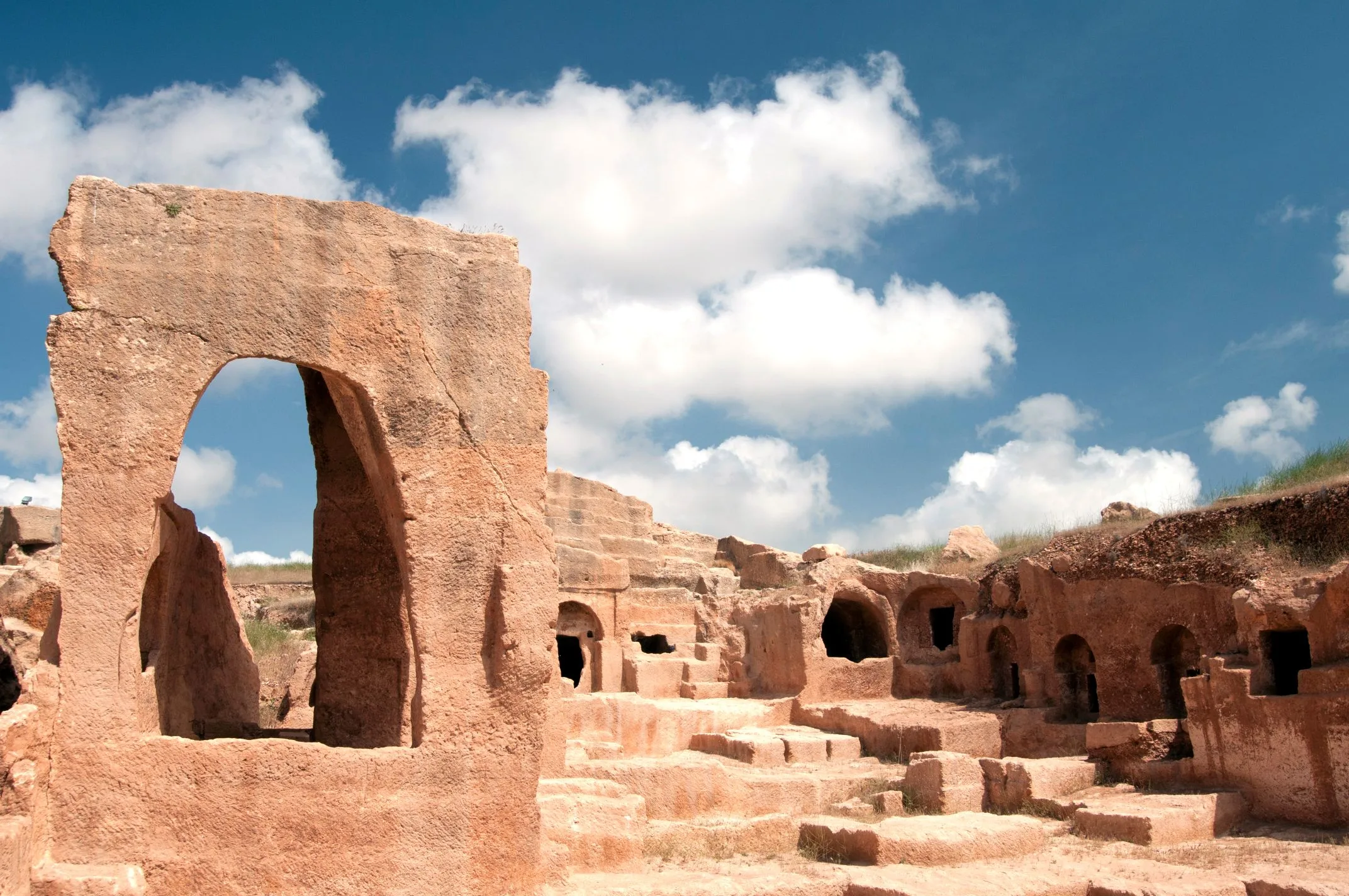
Thirty kilometres out to Dara, a fortress city the emperor Anastasius founded between 505 and 507 to hold the Persian frontier, with a rock-cut cistern the size of a church and a necropolis cut into the hillside above the village. Back via Deyrulzafaran, a Syriac Orthodox monastery founded in 493 that was the seat of the patriarchate from 1160 until 1932 and is still a working house.
Midyat, Mor Gabriel and on to Hasankeyf
Through the Tur Abdin, the limestone plateau that is the heartland of Syriac Christianity. Mor Gabriel was founded in 397 and is the oldest Syriac Orthodox monastery still in use; Aramaic is the liturgical language and a spoken one in a handful of villages around it. Midyat's old quarter is stone-carved and largely empty. Then north to the new town of Hasankeyf.
Hasankeyf, then Diyarbakır
The culture park below the new town holds the eight monuments lifted out of the old one ahead of the Ilısu reservoir, the Zeynel Bey tomb of 1475 among them. Walk out to the viewpoint: the citadel rock still stands clear of the water because it always stood high above the river, and the bazaar, the houses and the piers of the twelfth-century bridge are under it. Then west along the Tigris.
Diyarbakır
Nearly six kilometres of black basalt wall around the old city, listed by UNESCO in 2015 together with the Hevsel gardens on the river terrace below. The Ulu Cami of 1091 reuses Roman columns in its courtyard. Sur, the walled quarter, was fought over in 2015 and 2016 and large parts of it were demolished and rebuilt afterwards; the Armenian church of Surp Giragos, restored in 2011, was damaged then and reopened in 2022. The city does not hide any of this and you should not skirt it.
East to Van
The long day. Bus east across the plateau, climbing most of the way, with the black basalt of the Diyarbakır plain giving out into the limestone of the Bitlis mountains and then into volcanic country, and the temperature dropping as it goes. Arrive in Van, which sits on a lake at 1,640 metres that is six and a half times the size of Lake Geneva and is too alkaline to drink or to hold ordinary fish.
Akdamar and the Rock of Van
A boat from Gevaş out to Akdamar island and the Armenian church of the Holy Cross, built between 915 and 921, whose exterior is carved end to end with Old Testament figures, hunts and vines. Restored in 2007 and open as a museum, with a liturgy permitted once a year. Back in the afternoon for the Rock of Van, the Urartian citadel of Tushpa, where Xerxes had a trilingual inscription cut into a sheer cliff face.
Çavuştepe and Hoşap
South-east on the Hakkari road as far as two castles. Çavuştepe was built by the Urartian king Sarduri II in the eighth century BC and has cuneiform inscriptions and basalt masonry polished smooth enough to reflect. Hoşap, thirty kilometres further, is a Kurdish bey's fortress of 1643 on a rock above a village. Back to Van and fly out.
Good to know
Entry is simple: many nationalities are visa-free and the rest use the official e-Visa at evisa.gov.tr, which issues in minutes — buy it there and nowhere else, because the look-alike sites charge several times the fee. Read the travel advisories by province rather than by country. The British and American ministries both draw a no-travel line within ten kilometres of the Syrian border and advise against all but essential travel to Hakkari and Şırnak; this route enters none of that, but Harran sits under twenty kilometres from the frontier and is the one day here that needs checking against current advice before you commit to it. Jandarma checkpoints are routine on the roads south and east of Şanlıurfa and again on the Hakkari road out of Van: keep your passport somewhere you can reach it rather than in a bag in the luggage hold, expect to be waved through in under a minute, and do not photograph the post or the soldiers. The earthquakes of 6 February 2023 killed more than fifty thousand people across this region — Gaziantep was badly hit and Adıyaman far worse, and hotel stock, roads and museum hours in both are still not what a pre-2023 guidebook says. Season decides the trip: the Nemrut summit road is under snow from roughly November into April and the site closes with it, the plateau around Van stays cold into May, and the southeast routinely passes forty degrees in July and August, which makes Göbekli Tepe and Dara a bad idea after ten in the morning. Late April to early June and mid-September to late October are the windows. Intercity buses are the backbone and they are good — book at the bus company's town office rather than at the otogar, and use the free servis minibus every firm runs between the two, which is included in your fare and which nobody mentions unless asked. Foreign-visitor admission at the major sites has been repriced in euros since 2024 and the Museum Pass Türkiye now runs around €165 for fifteen days, so do the sum against the sites you will actually enter rather than buying it on principle. Cards work in the cities and ATMs dispense lira everywhere; carry cash east of Mardin, and decline dynamic currency conversion every time it is offered.
Shorter or longer?
From Van carry on north past Ishak Pasha Palace and under Ararat to Kars, and out to Ani, the ruined Armenian capital standing on a gorge that is the closed border. Four or five more days, colder weather, and the Doğu Ekspresi back to Ankara if you want the train.
Fly into Şanlıurfa and out of Diyarbakır: Göbekli Tepe, Karahan Tepe, Harran, Mardin, Dara, the Tur Abdin and Hasankeyf. Drops Gaziantep, Nemrut and the whole of Lake Van, and removes the two longest bus days.