The Forest With No Children
The dragon's blood trees on Socotra's Firmihin plateau are the densest stand left of a species that grows nowhere else, and almost every one of them is an adult. The reason there are no young ones is not the climate, or not yet — it is a goat, and that makes it a question about the island's economy rather than its weather.
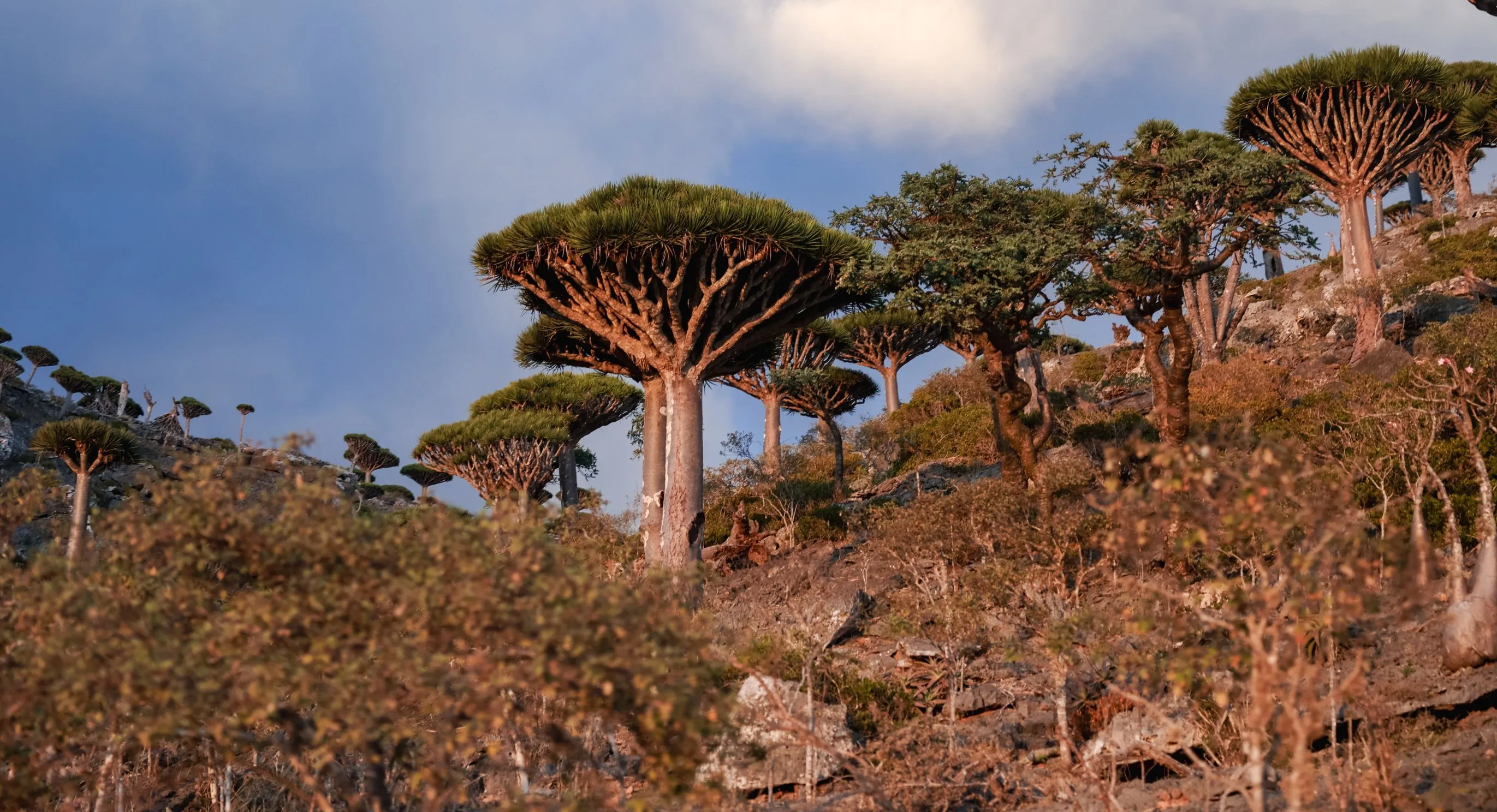
The Firmihin plateau on Socotra carries the largest surviving stand of Dracaena cinnabari, the dragon's blood tree, and the first thing you notice from the track is how uniform it is. The trees stand apart on thin limestone soil, each with the same inverted-umbrella crown of stiff leaves held out on branches that fork and fork again, and they are all roughly the same height. What is missing takes longer to register. There are no small ones. No knee-high seedlings between the adults, no thickets of saplings on the edges of the grove — nothing, in most of it, below the browse line of an animal standing on its hind legs.
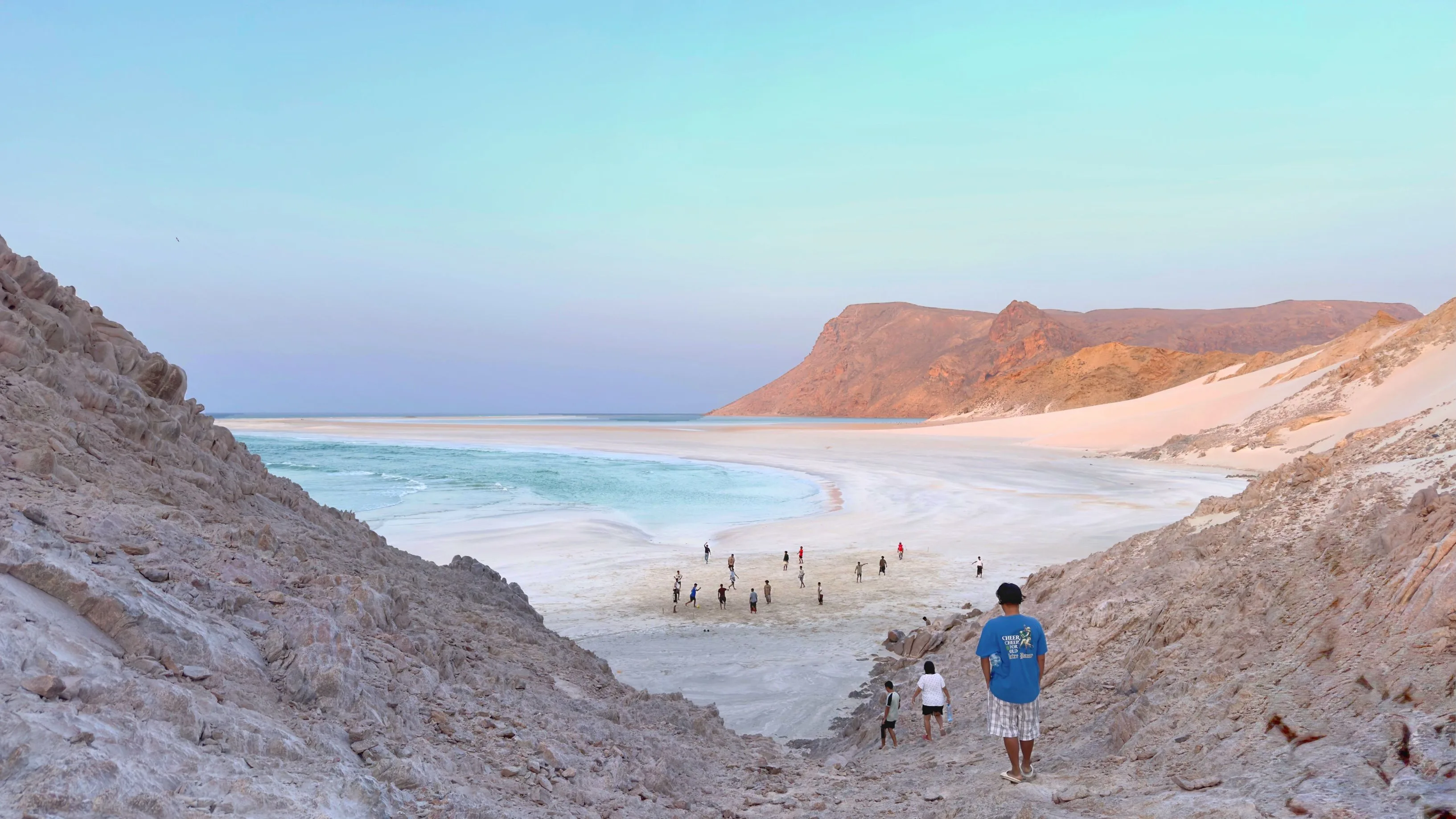
Socotra was inscribed on the World Heritage list in 2008 for exactly this kind of isolation. Of roughly 825 plant species on the archipelago, more than a third grow nowhere else on earth, the product of a fragment of Gondwana that separated from the Arabian mainland long enough ago for its flora to go its own way. The dragon's blood tree is the emblem of all of it, printed on the tourist permits and the airline tail. It is also listed as vulnerable, and the mechanism behind that listing is not fire, logging or disease. It is that the population has stopped replacing itself.
What the resin was worth
The tree is named for what comes out of it. Cut the bark and it bleeds a dark red resin that hardens into brittle lumps, and that resin was a serious commodity in the ancient Indian Ocean trade. The Periplus of the Erythraean Sea, a Greek merchant's handbook of the first century AD, lists the island it calls Dioscorida as a source of what it terms Indian cinnabar, alongside tortoiseshell and aloes. The resin travelled as a dye, a varnish and a medicine, and it has long been claimed as an ingredient in the varnish of Italian violin makers, on evidence thinner than the claim usually admits. That trade is essentially gone — synthetic dyes and cheaper substitutes took it — and what is harvested now is sold in small quantities on the island and to visitors. The tree that made Socotra known outside itself is no longer worth cutting, which has removed one threat and removed one reason to protect it.
A crown that makes its own rain
The shape is not decorative. Socotra gets little rain but a great deal of mist off the monsoon, and the dense flat canopy intercepts fog droplets that run down the leaves and the branches to the base of the trunk. The tree waters itself, and in doing so it waters what grows beneath it, which on this island includes a set of endemic herbs and shrubs that occur in the shade of these crowns and effectively nowhere else. The canopy also cools and shades the ground enough for a seedling to survive its first dry season. Take out the adults and you do not simply lose the trees; you lose the microclimate that the rest of the plateau vegetation is built on, and the ground beneath goes from woodland floor to bare karst.
A forest can look intact and be finished. Every tree on Firmihin is an adult, and an adult-only population is a population with a date on it.
The goats are the mechanism
Where regeneration does happen, it happens in the places a goat cannot get to: cliff ledges, crevices between boulders, the middle of a thorn bush. Botanists have been recording that pattern for decades and it is about as clean a natural experiment as ecology offers. Livestock browsing, not rainfall, is the immediate limit on new dragon's blood trees across most of the accessible plateau. Goats have been on Socotra for a very long time and they are not an invasive species in the usual sense — they are the island's working capital. A Socotri family's herd is its savings account, its meat and its milk, in a place where the alternatives are dates, fish and, more recently, whatever the visitor season brings. Any answer that begins by removing goats is asking herders to liquidate their assets so that a tree can have grandchildren.
Two cyclones in eight days
Then there is the weather, which has stopped behaving. In November 2015 Socotra was hit twice inside eight days: Chapala passed the island on the first of the month and Megh went directly across it on the eighth, an unprecedented pairing in a basin where storms of that strength had barely reached Yemen at all in the modern record. Cyclone Mekunu came through in May 2018. Mature dragon's blood trees are shallow-rooted and top-heavy — a wide crown on a single stem in thin soil is close to the worst possible design for a wind event — and the exposed stands lost a great many of them. The figures published for how many differ widely and are disputed, so treat any single number with suspicion; what is not disputed is that the losses fell on the adults, in a population that had no replacements queued behind them. Nobody can say precisely how old those adults were, either: Dracaena is a monocot and lays down no annual rings, so ages are estimated by counting generations of forking in the crown, a method that is openly contested because flowering frequency varies with rainfall. Both readings agree on the part that matters — a tree of this kind takes decades to reach reproductive size, and cannot make up a lost generation inside a funding round or a war.
What a fence proves
The intervention that works is unglamorous and small: fence a plot, exclude the livestock, and seedlings appear and survive. Enclosures of this kind have been run on the Diksam and Firmihin plateaus by local associations working with visiting botanists, and they settle the argument about cause — the seed is viable and the site is suitable, and what was stopping regeneration was being eaten. What a fence does not do is scale. Every enclosure takes grazing off a herder who did not choose it, on an island with no forestry service, and Socotra spent the years after 2015 with its governorate cut off from a mainland at war, its budget in the gift of whoever was flying in, and outside conservation money arriving in fits. The dragon's blood tree is not dying of neglect or of ignorance. Its future rests on whether an island of around sixty thousand people can be paid enough for the grazing it gives up, by anyone, for long enough to matter — and that is a question about money and administration, which is the sort of question nobody puts on an airline tail.