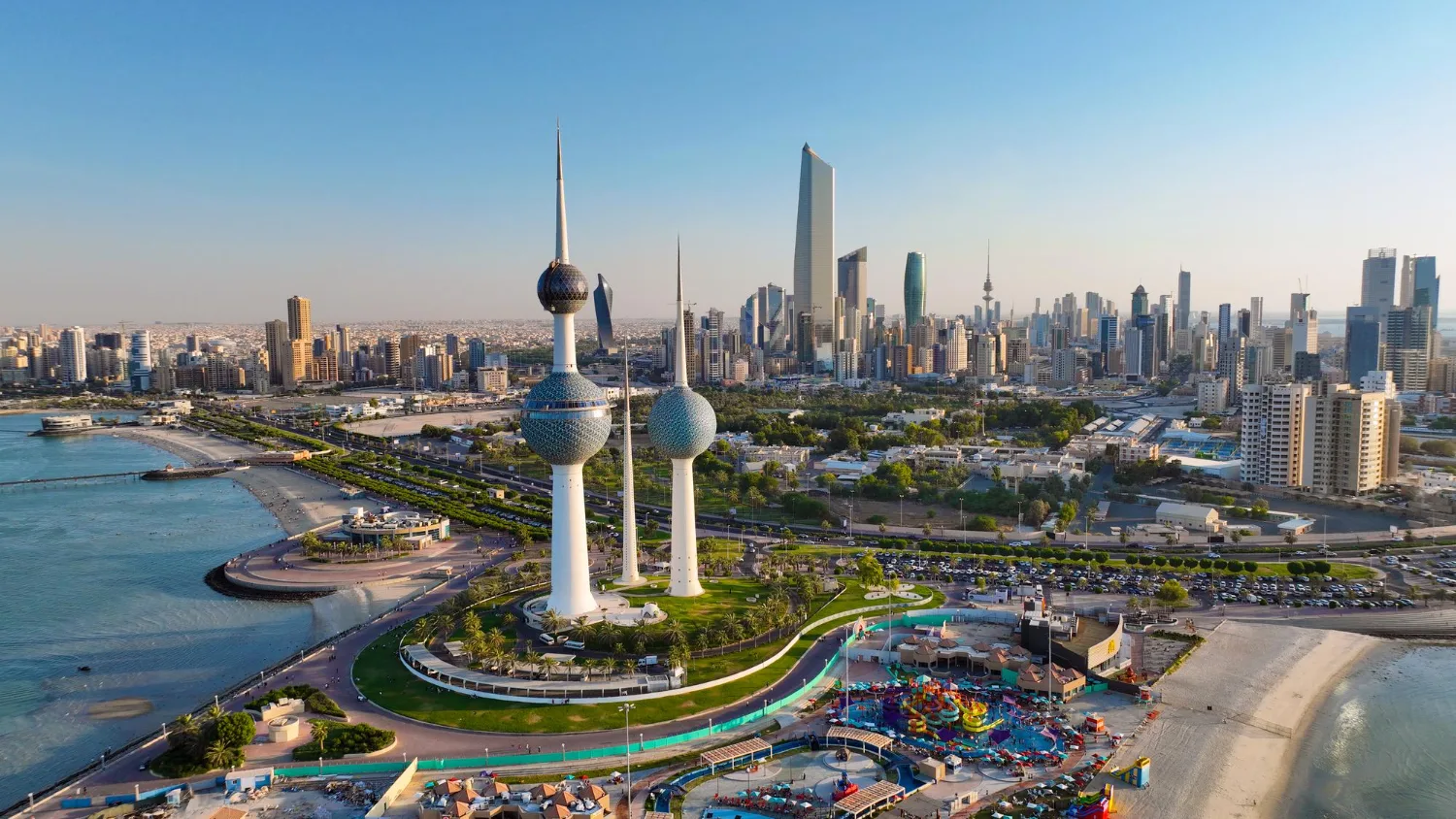
Kuwait is two hundred kilometres north to south and a hundred and seventy across, and almost nobody comes to look at it. Eight days is enough to reach all of it: a looted and returned Islamic art collection, a Greek fortress on an island that has been empty since 1991, a settlement in the northern desert occupied around 5500 BC, a British oil company town people still live in, and a lagoon city dredged out of nothing in the far south.
Kuwait City, what is left of the old town
Almost nothing here predates the oil. The city wall came down in 1957 and the mud-brick town behind it was cleared through the 1960s, so the surviving fabric is Souq Al-Mubarakiya, restored and still trading in spices, gold and fish, and Sadu House on the seafront, where the Bedouin weaving co-operative works and sells. Seif Palace is next door and photographing it is not permitted — worth learning on the first day rather than the sixth.
The collection that came back
The al-Sabah holding is one of the great private collections of Islamic art and it was on show at the National Museum until August 1990, when Iraqi forces packed it into crates and drove it to Baghdad. Most of it was returned the following year under UN supervision, and it now lives at the Amricani Cultural Centre, a converted American mission hospital on the Gulf Road. Walk on to Al Shaheed Park, laid out along the line the demolished wall took and holding the Al-Shaab gate, one of five that were left standing when the rest came down, with the Sheikh Jaber Al-Ahmad Cultural Centre — the opera house, opened in 2016 — on the Gulf Road at the edge of it.
Failaka
Ninety minutes out into the bay, on an island holding two things that do not sit together. One is Tell Sa'ad wa Sa'eed: a Hellenistic fortress of the third century BC, roughly sixty metres square with a tower at each corner, an altar and a temple to Artemis. The Seleucid garrison called the island Ikaros. The other is the village, which held around two thousand people until 1990, was used as an Iraqi position, was mined, and has never been resettled. The walls still carry the holes.
Salmiya and Jabriya
The Scientific Center on the Salmiya waterfront keeps the Fateh Al-Khair, a boom built in 1938 and the last Kuwaiti-built ocean-going dhow to survive; the aquarium beside it was the largest in the Middle East when it opened in 2000, a title Dubai and then Abu Dhabi have taken off it since, which has not made the 1.5-million-litre shark tank any smaller. Back up the Gulf Road at Al-Sha'ab, the Sheikh Abdullah Al-Salem Cultural Centre puts six museums — natural history, science, space, Arabic-Islamic science, fine arts and the open ground between them — on one site. Inland at Jabriya, the Tareq Rajab Museum came through the occupation because the family bricked up the stairway to the basement and plastered over the wall; its calligraphy museum, opened in 2007 a few streets away in the same block, is the better of the two collections. Finish at the Kuwait Towers, opened in 1979 and shot up in 1991, which are the country's signature and know it.
North over the causeway to Subiya
The Sheikh Jaber Al-Ahmad Causeway opened on 1 May 2019 and runs thirty-six kilometres over open water, forty-eight and a half with the Doha spur. On the far side, the Subiya desert holds Bahra 1 — an Ubaid-period settlement occupied from somewhere around 5500 BC, dug by a Kuwaiti-Polish team since 2009 — and the site catalogued as H3, where a British excavation recovered bitumen slabs bearing the impressions of reed bundles and barnacles: the oldest physical evidence of a seagoing boat found anywhere. Neither site is fenced, signed or staffed. Bubiyan is on the horizon and closed, being military ground with a port under construction on it.
Jahra and the ridge
The Red Fort at Jahra is mud brick and was the position Sheikh Salim Al-Mubarak held against the Ikhwan on 10 October 1920 — the battle that produced the city wall pulled down in 1957. East of the town, the Jahra Pool Reserve is a reedbed fed by treated water and the best birding in the country; access runs through the Kuwait Environment Protection Society and has to be arranged in advance. Route 80 climbs Mutla Ridge behind it, which is the road the retreating Iraqi convoy was destroyed on over 26 and 27 February 1991. The wreckage was cleared decades ago and there is nothing to see, which is the right thing to know before driving out expecting otherwise.
Ahmadi and the oil coast
The Kuwait Oil Company laid Ahmadi out from 1946 as a company town — bungalows, clipped hedges, a hospital, a grid of numbered streets — and people live in it still. The Oil Display Centre is free, small and specific, and covers Burgan, struck in 1938, still the second largest oil field ever found, and among the roughly seven hundred wells set alight in 1991; the last of those fires was capped that November. Stop at the Qurain Martyrs Museum on the way down: a suburban house where a resistance cell fought Iraqi armour for ten hours on 24 February 1991, kept with the shell holes in it. Al Kout in Fahaheel is built around a working fishing harbour and is where the coast eats.
Khiran and the manufactured coast
Fifty minutes further south past the Al-Zour refinery to Sabah Al Ahmad Sea City, where a developer has cut canals inland from the Khiran inlets to manufacture waterfront in a country that had almost none. The coast was surveyed for it between 1987 and 1989, the invasion stopped everything, digging began in earnest in 1998, the sea was let into the first channels in 2004 and the city was inaugurated in 2016. The finished plan runs to some two hundred kilometres of shoreline, none of it reclaimed from the sea — the water was brought to the desert rather than the other way round. It is a real place with real residents and it is also the clearest statement Kuwait makes about what it thinks land is for. The airport is an hour and a quarter back up the same road.
Good to know
Kuwait issues a tourist e-visa to nationals of some fifty-three countries through kuwaitvisa.moi.gov.kw and nowhere else, with visa on arrival at the airport for most of the same list and, since August 2025, for any foreign resident of a GCC state whatever their nationality; the mechanics have changed more than once since 2020, so read the ministry's own page rather than an agency one and allow a few days. One entry rule is older and absolute: Law No. 21 of 1964 boycotts Israel, and Kuwait refuses entry to Israeli passport holders and to travellers of any nationality whose passport carries an Israeli visa or stamp. Airlines serving Kuwait are bound by the same law, so it bites in transit as well as at the desk — if there is Israeli evidence in your passport, settle that before you book anything else. Alcohol has been illegal since 1964 — there is none, anywhere, and carrying any through customs is treated seriously. Photography restrictions are wide and enforced: palaces, ports, oil installations, military ground, government buildings and the causeway approaches, and being asked to delete pictures is an ordinary interaction rather than a crisis. Drones need a Directorate General of Civil Aviation permit that no ordinary visitor will get; an undeclared one is taken off you at customs and flying without the paperwork is fined in thousands of dinars. Summer is not a season for a visitor. Mitribah, in the north-western desert, recorded 53.9 °C on 21 July 2016, which the WMO accepted as the highest reliably measured temperature in Asia, and June to September is a matter of moving between air-conditioned rooms. November to March is the trip. Ramadan begins in early February in 2027 and moves about eleven days earlier each year, which puts it squarely inside the good season: eating, drinking or smoking in public during daylight hours is an offence rather than a discourtesy. The weekend is Friday and Saturday and the museums keep to it. Hire a car — the buses run for workers on fixed corridors, and ride-hailing over a week costs more than the rental — but drive defensively, because the road casualty rate is among the worst in the Gulf and lane discipline is notional. Do not leave the tarmac in the northern or western desert: ordnance from 1991 is still being cleared. The Failaka ferry is tidal and seasonal and does not publish a schedule you can rely on, so confirm the day before. The Subiya archaeological sites are open desert with nothing built for visitors; if you want anything explained, the National Council for Culture, Arts and Letters is the body to write to. The dinar is the highest-valued currency in the world — one is worth a little under three euros, around three and a quarter dollars — cards work everywhere, and prices on the ground are gentler than that exchange rate makes them sound.
Shorter or longer?
Add three or four days. The flight is an hour and a quarter, and Bahrain holds the Dilmun burial mounds and the tell at Qal'at al-Bahrain — the other end of the same Bronze Age Gulf story you meet on Failaka and at Subiya.
Kuwait City, the al-Sabah collection, Failaka and Ahmadi. Drops Subiya, Jahra and the south, and needs no car at all if you are willing to accept the taxi bill.