Fourteen days across a country you could drive in four hours, taking the long way round: baroque Vilnius and the pits at Paneriai, a lake district with a shut nuclear plant at the end of it, a hill of crosses the Soviet authorities bulldozed and people rebuilt overnight, a missile silo under a Žemaitijan forest, the drifting sand of the Curonian Spit, and the modernist city Lithuania built during the nineteen years it had no capital.
Vilnius old town
One of the largest surviving baroque town centres in this half of Europe, listed by UNESCO in 1994, and still a working city rather than a preserved shell. Start at the university, founded in 1579 and built outward into thirteen linked courtyards over the following centuries, then walk down to the Gates of Dawn and back up through Užupis, which declared itself a republic on April Fools' Day 1997 and has the constitution nailed to a wall in twenty-odd languages.
Vilna, and Paneriai
Before the war this was Vilna, the centre of Jewish learning in eastern Europe and the home of the YIVO institute, founded here in 1925. The Great Synagogue was wrecked in the war and demolished by the Soviets in the 1950s; a school stands on it, and archaeologists have been digging underneath since 2011. Then take the suburban train ten kilometres to Paneriai, where roughly a hundred thousand people were shot into fuel pits between 1941 and 1944 — about seventy thousand of them Jews, most from this city, and the rest Poles, Soviet prisoners of war and Roma. The KGB cells under the old headquarters on Gedimino are the afternoon after that, if you still want one.
Trakai
A castle on an island in Lake Galvė, reached by two footbridges, and almost entirely a reconstruction — the ducal palace was rebuilt through the 1950s and finished around 1961, over objections from Moscow that it glorified a feudal past. The more interesting thread is the Karaim, a Turkic community brought here from Crimea by Vytautas around 1397, whose kenesa and wooden three-windowed houses are on the street into town, and whose kibinai are the reason half of Vilnius drives out at weekends.
Kernavė, then north-east
Collect the hire car and drive out to Kernavė, five turf hillforts stepped along a terrace above the Neris, which was the seat of the early Lithuanian state and was named in a chronicle in 1279. It has been a UNESCO site since 2004 and looks like almost nothing, which is the point — the town under the grass burned in 1390 and was never rebuilt. Then east across country to the lakes, stopping at the ethnocosmology museum above Molėtai if the sky is clear.
Aukštaitija National Park
Lithuania's first national park, designated in 1974, and 126 lakes joined by channels you can paddle for days without a portage worth the name. The water mill at Ginučiai has its machinery in place, the wooden church at Palūšė went up in 1750 without a nail in it, and the hill at Ladakalnis looks down on six lakes at once. Hire a canoe rather than walking: the trails are flat and the water is the whole landscape.
Visaginas and the plant
The far north-east corner, where Lithuania, Latvia and Belarus meet on Lake Drūkšiai, the largest lake in the country and, from 1983 to 2009, the cooling pond for two of the largest reactors ever built. Ignalina's units shut in 2004 and 2009 under a protocol to the EU accession treaty, and decommissioning runs to 2038. Visaginas, six kilometres away, was laid out in pine forest in 1975 for the people who would run it — curved avenues instead of a grid, a Russian-speaking town in a Lithuanian district, and no second industry.
Anykščiai
West into Aukštaitija proper. The narrow-gauge railway here is 750 mm, opened in 1899, and the surviving stretch to Rubikiai runs heritage services in summer with a draisine you can pedal yourself between them. The treetop walkway, 300 metres of steel through the canopy at about twenty metres, opened in 2015 and was the first of its kind in the region. Puntukas, in the woods south of town, is a glacial boulder of some 265 tonnes carved in 1943 with the faces of Darius and Girėnas, who flew a second-hand aeroplane out of New York in July 1933 and came down in a forest near Soldin in Germany — now Myślibórz in Poland — about 650 km short of Kaunas. They crashed nowhere near here; the sculptor cut the relief into this boulder a decade later because this was the boulder.
The Hill of Crosses
Twelve kilometres north of Šiauliai, on a mound beside a main road, stand several hundred thousand crosses — nobody has a firm count and the number rises every week. The Soviet authorities bulldozed the hill in 1961 and again in 1973 and 1975, burning the wooden ones and dumping the metal for scrap, and each time it was rebuilt at night within days. John Paul II said Mass here on 7 September 1993. Šiauliai itself has the Frenkel villa, built on leather money, and a NATO air policing detachment on the old Soviet airfield.
Plateliai and Plokštinė
Into Žemaitija, the north-west, which has its own dialect and a Shrovetide mask tradition that the museum at Plateliai takes seriously. Six kilometres away, under a forest floor, is Plokštinė: four silos built in 1960–62 for R-12 medium-range missiles, operational from 1963 to 1978, and one of the first underground launch complexes the Soviet Union completed anywhere. It reopened as the Cold War Museum in 2012 and you go down inside a silo. Take a jacket — it is cold down there in any weather.
Klaipėda
Memel until January 1923, when Lithuanian irregulars staged a revolt and the Allied Conference of Ambassadors, presented with a fait accompli, handed the territory over; a League of Nations convention formalised the arrangement in 1924. German again in March 1939 after an ultimatum from Berlin, and Lithuanian again in 1945. The old town is half-timbered and modest, the port is the country's only one and does not freeze, and moored in it is the floating gas terminal named Independence, which arrived in October 2014 and ended Gazprom's monopoly within months. Cross to Smiltynė on the passenger ferry for the fort at Kopgalis and the beach on the seaward side.
Onto the spit: Juodkrantė
Take the car across on the vehicle ferry, pay the park fee, and stop first at the Hill of Witches, a sculpture trail of oak figures begun by Lithuanian carvers in 1979 and still added to. South of the village is the cormorant and grey heron colony: the birds returned in 1989, there are thousands of nests, and the pine wood underneath them is dead and white. The reserve was created to protect the one patch of old forest on the spit that nobody planted, which is the patch the birds chose.
Nida and the Parnidis dune
The last Lithuanian village on the spit, four kilometres from the Russian border, with a fishermen's quarter of blue and red houses and carved weathervanes that once identified which village a boat came from. Climb Parnidis at the south end for the sundial obelisk, put up in 1995 and rebuilt after a storm took it in 1999, and for the view down the sand into Kaliningrad. Thomas Mann built a summer house on the hill above the lagoon in 1930 and used it for three summers before leaving Germany; it is a museum now, and the best small one in the country.
The Nemunas delta
Back up the spit, across on the ferry and south into the delta, which is flat, wet and full of storks. The ringing station at Ventės Ragas has been catching and banding migrating birds since 1929 and is one of the oldest in Europe; autumn is when the nets are busy. Rusnė is the only island town in Lithuania and used to be cut off by floodwater every spring until the viaduct opened in 2019. At Mingė the street is the river, and the houses face it from both banks.
Kaunas
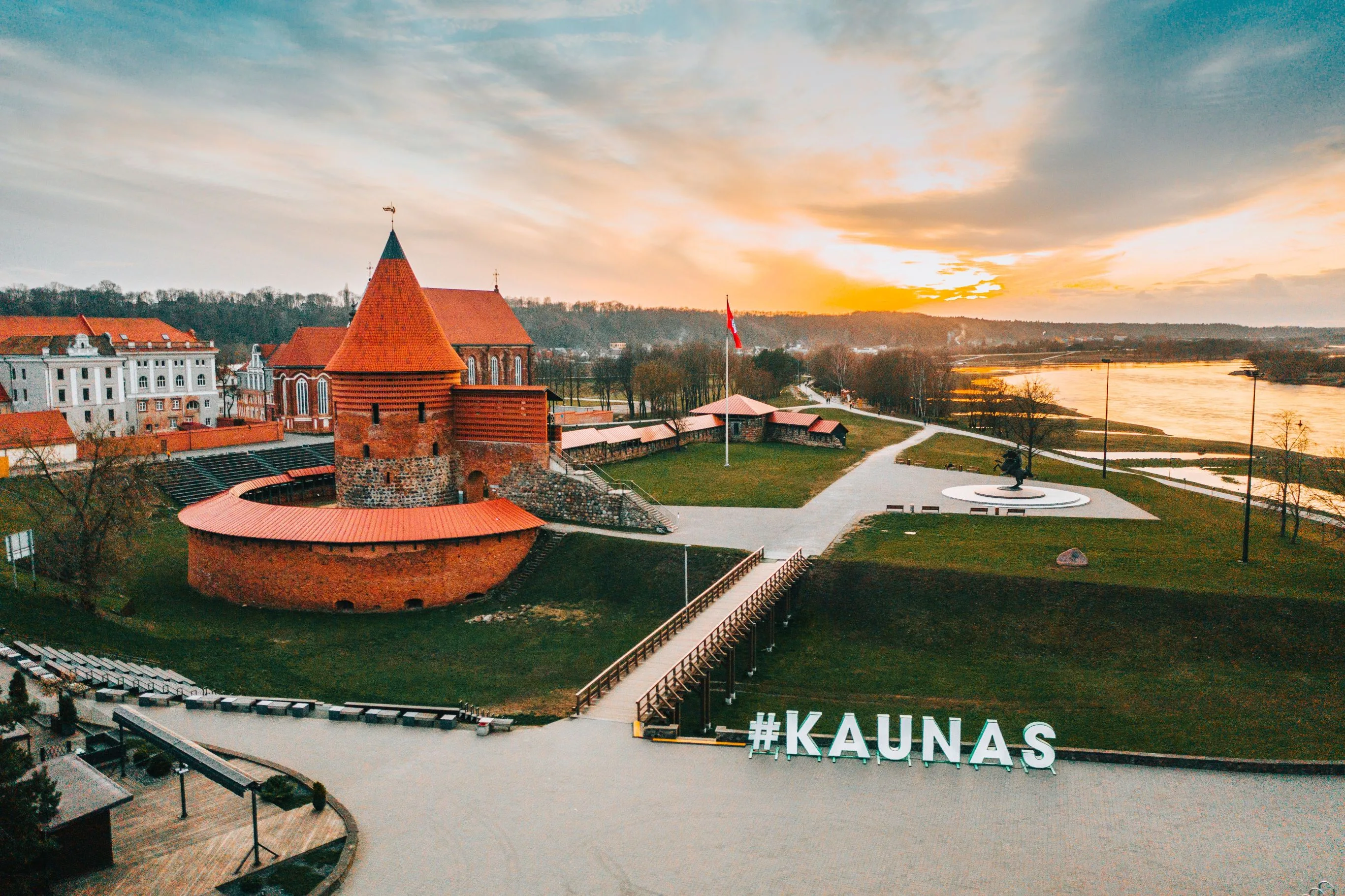
Poland seized Vilnius in October 1920 and Lithuania refused to accept it, so the government moved here and called Kaunas the temporary capital for the next nineteen years. In that time it built itself a state: ministries, a bank, a university, thousands of buildings in a stripped modernism that UNESCO listed in 2023 as the architecture of optimism. Ride the Žaliakalnis funicular of 1931, look at the Christ's Resurrection basilica that was begun in 1934, spent the Soviet decades as a radio factory and was consecrated in 2004, then go out to the Ninth Fort, where tens of thousands were killed. Sugihara's consulate, where transit visas were written through the summer of 1940, is a short walk from the centre.
Good to know
The ends of this route run on public transport and the middle does not. Trains handle Vilnius–Trakai, Vilnius–Ignalina and Vilnius–Kaunas–Klaipėda cheaply and reliably, but the crosswise links — Visaginas to Anykščiai, Anykščiai to Šiauliai, Šiauliai to Plateliai — are thin to non-existent, so hire a car for days four to fourteen and give it back in Kaunas. Taking a car onto the Curonian Spit means the vehicle ferry from Klaipėda's Naujoji perkėla and a per-vehicle ecological fee that is several times higher in July and August than in winter; check the rental agreement allows the crossing, expect a queue of an hour or more on summer weekends, and book Nida months rather than weeks ahead, because there are only so many beds on a sandbar. The cycle path down the spit is better than the road for everything except luggage. In the Nagliai strict reserve, between Juodkrantė and Pervalka, you may only be on the marked boardwalk; the fines are real and the sand is the thing being protected. Nida is four kilometres from the Kaliningrad frontier and the beach south of the marker is a border zone, not a walk. In the east the same applies to Belarus: Lake Drūkšiai and the edge of Aukštaitija National Park run to a controlled and fenced border, so stay on marked trails and carry a passport in those districts. Visits to the Ignalina site itself are by prior arrangement with the plant, need passport details weeks in advance and bend around whatever the decommissioning teams are doing that week — request it early and do not build a day around it. Plokštinė runs guided descents on seasonal hours that shrink sharply outside summer. Lithuania reports some of the highest tick-borne encephalitis rates in Europe and the vaccine is a course begun months ahead, not something to arrange at the airport; June in the delta is mosquito season and the repellent is not optional. Entry is Schengen, not Lithuanian: EU and EEA nationals need only an ID card, and visa-free visitors on American, British, Canadian or Australian passports get ninety days in any hundred and eighty across the whole area, now logged biometrically by the EU Entry/Exit System instead of by a stamp — days spent in Poland or Latvia on the same trip come out of the same allowance. ETIAS, the pre-travel authorisation for that same group, has been announced for late 2026 and was not yet required at the time of writing; check its status before you book rather than assuming either way. The euro has been the currency since 2015 and cards work everywhere, including on the ferries.
Shorter or longer?
Add four days below Vilnius: Grūtas, where the Soviet monuments were collected in 2001 after the country pulled them down, the pine-forest villages at Zervynos and Marcinkonys in Dzūkija National Park, then the Nemunas castles at Raudonė and Panemunė on the way into Kaunas.
Vilnius, Trakai, Kaunas, Klaipėda and Nida, all of it on trains, buses and one ferry. Drops the lakes, Ignalina, Anykščiai and Žemaitija — and with them the car and most of the cost.