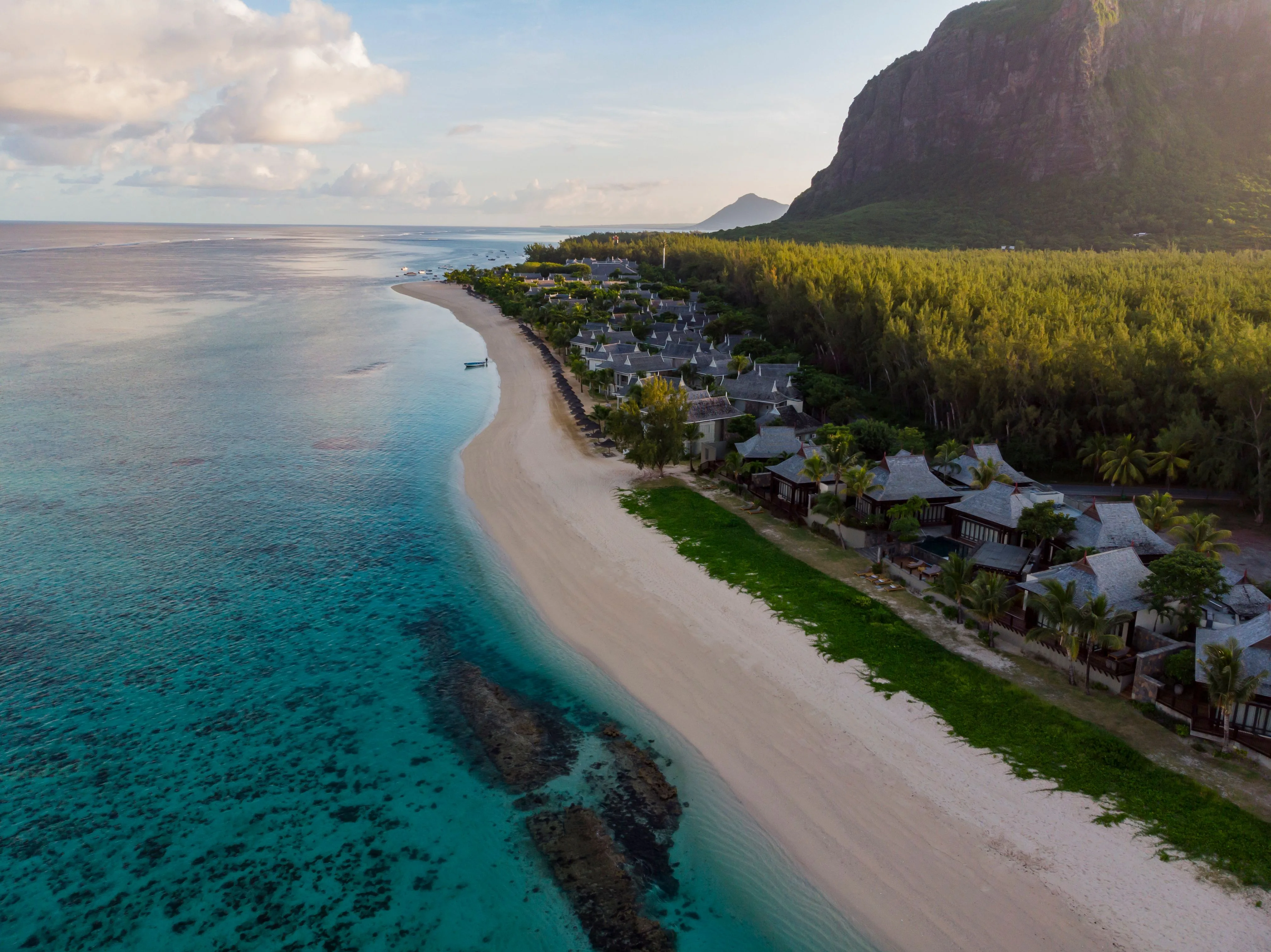
Two islands about 570 kilometres apart that lost more of their native life than almost anywhere on earth and have spent forty years putting some of it back. The depot where close to half a million indentured labourers landed, an island where imported tortoises were given a dead species' job, fenced weeding plots in the last uplands, the basalt block that sheltered runaway slaves — and Rodrigues, which is autonomous, Creole, and closes its own octopus season by law.
Port Louis
Start at Aapravasi Ghat on the harbour, where the stone steps up from the water are the ones close to half a million indentured labourers from India climbed between 1834 and the early twentieth century; UNESCO listed the site in 2006 and roughly two thirds of Mauritians descend from people processed through it. Then the Central Market, Chinatown, and the Blue Penny Museum, which owns an unused one-penny and two-pence of 1847 — the first stamps issued anywhere in the British Empire outside Britain, and famous because the engraver cut POST OFFICE into the plate where the later printings read POST PAID. They are kept in the dark and lit only in short bursts.
Pamplemousses and the citadel
The botanical garden north of the capital was laid out around a plantation Pierre Poivre took over in 1770 to break the Dutch monopoly on nutmeg and clove — the giant Amazon water lilies and the talipot palms are the set pieces, the spice beds are the reason it exists. Back in town, climb to Fort Adelaide above the Champ de Mars, which has been a racecourse since 1812.
The north coast
Cap Malheureux is where a British invasion force came ashore on 29 November 1810 and had the French capitulation signed five days later, three months after losing the only naval battle inscribed on the Arc de Triomphe at Grand Port down the other end. There is a red-roofed church, a view out to Coin de Mire, and the least demanding swimming in the country at Pereybère.
Bras d'Eau
Mauritius made this its second national park in 2011, and it is not the postcard: a working plantation of introduced mahogany and eucalyptus with fragments of native wood in it, and one of the better places on the island to find the Mascarene paradise flycatcher, which survives here as its own Mauritian subspecies. Trails are flat, the mosquitoes are serious after rain, and almost nobody else is there. The lagoon at Poste Lafayette takes the south-east trades side-on, which is why the kitesurfers are there and the swimmers mostly are not.
South to Mahébourg
Down the east coast, stopping at Vieux Grand Port, where a Dutch squadron sheltered in 1598 and named the island for Maurits van Nassau, and where the first attempt to actually live on it went ashore forty years later in 1638. The foundations of Fort Frederik Hendrik are under a small museum. Mahébourg itself is a grid of low houses and the National History Museum, which holds what was salvaged from the frigates sunk in the bay in August 1810.
Île aux Aigrettes
Twenty-six hectares of coral limestone ten minutes off Pointe Jérôme, a nature reserve since 1965 and hand-restored by the Mauritian Wildlife Foundation since 1985. The guided walk takes about two hours and passes ebony that was replanted, pink pigeons that were bred back from about ten birds, and free-ranging Aldabra giant tortoises brought in from 1,700 kilometres away in 2000 to do the seed dispersal an extinct Mauritian tortoise used to do. Book it before you arrive; you cannot land alone.
East to Rodrigues
An hour and a half over open water in a turboprop to an island of about 108 square kilometres and forty-odd thousand people, mostly Creole and Catholic, running its own affairs through a regional assembly since 2002. Port Mathurin is two streets and a harbour. If you can arrange the flight for a Friday, the Saturday morning market is the event of the week and starts before six.
Grande Montagne
Rodrigues was cleared for timber, cattle and lime-burning until almost nothing native was left, and the reserve on the central ridge is the reversal: a few dozen hectares replanted from the 1990s with species propagated from the last surviving individuals. The Rodrigues warbler and the Rodrigues fody, both down to a handful of birds within living memory, breed here again. In the afternoon go and find the fruit bat roost — the golden bat was down to something like seventy animals in 1979, after a run of cyclones took the mature trees it roosts in.
Île aux Cocos
A sand islet on the western reef, permit-only and reached with a licensed boatman, holding one of the larger seabird colonies in the western Indian Ocean — noddies in thousands and white terns that hover at eye level. You walk a marked line and you do not cross it, because the birds nest on the ground. The crossing depends on the tide, so the trip goes when the lagoon says so and not when you would prefer.
Anse Quitor and the caves
The François Leguat Reserve in the south-west has replanted a whole valley of degraded scrub and stocked it with Aldabra tortoises on the same reasoning used at Île aux Aigrettes — Rodrigues had its own giant tortoises in herds Leguat put at two or three thousand in the 1690s, and none after about 1800. Caverne Patate next door is a limestone system you go through with a guide and a torch; the bones of the solitaire, the island's own flightless relative of the dodo, came out of caves like it.
The east coast on foot
The best day on the island costs nothing. From Saint François the path runs south above the water to Trou d'Argent and on towards Baie Malgache, over headlands of dead coral with small beaches cut into them and no road anywhere near. Three to four hours at a slow pace. Take water; there is nothing to buy between the two ends.
Back west, and Chamarel
Fly back and drive across to the south-west. Chamarel sits above the plain on volcanic ground: the coloured earths are a small fenced patch of weathered basalt that separates into bands and is much less interesting than the waterfall a few hundred metres away, which drops about a hundred metres in one go. The rum here is distilled from cane juice rather than molasses, which in a country built on sugar is a recent and slightly heretical idea.
Black River Gorges
The national park was declared in 1994 and covers around 6,750 hectares, which is most of what is left of the wet upland forest. Start at Pétrin, where the fenced Conservation Management Areas are visible from the road — plots cleared of Chinese guava and privet by hand and kept clear, because that is the only method anyone has found that works. Macchabée trail into the gorge, or up Black River Peak at 828 metres, the highest ground in the country.
Le Morne Brabant
A basalt block 556 metres above the sea at the south-western corner, listed by UNESCO in 2008 not for the rock but for what happened on it: runaway slaves lived on the summit and in its caves, and the mountain is the national symbol of that refusal. The path to the plateau is open; above it you go with an accredited guide, and the rule exists because people have died there. Three to four hours up and back, and start early.
Good to know
Mauritius was certified free of malaria in 1973; a vivax reintroduction in the mid-1970s took two decades to clear and there has been no locally acquired case since the late 1990s, so there is no prophylaxis to take. Dengue and chikungunya both circulate and both have produced real outbreaks, so repellent and covered ankles at dusk are the actual precaution — particularly at Bras d'Eau and anywhere near standing water after rain. A yellow fever certificate is demanded on arrival from anyone aged one year or over who has come from a country with risk of transmission, or who has spent more than twelve hours in transit in the airport of one, and it is checked. Cyclone season runs from November to May and peaks between January and March; warnings are issued in classes I to IV, and from class III the shops shut, the buses stop and you stay indoors — treat any class II as the moment to move a flight rather than the moment to watch the sky. Self-drive is genuinely the right answer here: the island is 65 kilometres end to end, traffic drives on the left, a national licence is accepted, and the motorway is thick with speed cameras. The Metro Express light rail covers the Port Louis–Curepipe corridor and nothing you want on this route. Rodrigues is the other case entirely: same left-hand rule, but the roads over the central ridge are narrow, steep, unlit and often single-track, there are only a couple of filling stations on the whole island, and the small hire fleet is booked out well ahead in the high season. Île aux Aigrettes must be booked in advance through the Mauritian Wildlife Foundation and cannot be visited independently; the same applies to Île aux Cocos on Rodrigues, which needs a permit and a licensed boat. Black River Gorges charges no entry fee — Mauritius has nothing resembling an East African park tariff — but the Conservation Management Areas inside it are fenced and closed, and the trails are marked far better on paper than on the ground, so carry the offline map. Above the plateau on Le Morne an accredited guide is compulsory. Rodrigues is served by Air Mauritius alone, on small aircraft with a hard baggage allowance, and the flights fill months ahead during Mauritian school holidays and around Christmas; wind at Plaine Corail cancels them, so never plan a same-day connection to an international departure. The Rodrigues octopus fishery closes for about two months each year by decision of the regional assembly, in recent years somewhere between August and October, and in those weeks the thing the island is famous for eating is simply not on the menu. Cane harvest runs roughly July to December and puts slow lorries on every south-coast road. Cards work in towns; reserve entries, boatmen and Rodriguan guesthouses often do not take them.
Shorter or longer?
Add five or six days on the neighbouring island — forty-five minutes by air, and a completely different geology: the cirques above Saint-Denis, the Piton de la Fournaise, and a walking network Mauritius does not have.
Port Louis, Mahébourg with Île aux Aigrettes, Black River Gorges and Le Morne. Cuts Rodrigues entirely, which removes both flights and the largest single cost, and keeps every part of the restoration story that is on the main island.