A loop through a country most people fly over — limestone galleries you drive through rather than walk, a cave monastery above a river bend that still has monks in it, a circular fortress finished in the 1540s, an unrecognised state with its own currency, and the three protected wine regions the country reorganised itself around after it lost its export market twice.
Chișinău
Arrive, change money, and walk. The centre is a grid laid out in the 1830s under Russian administration, rebuilt after the 1940 earthquake and again after the war flattened most of it — the Nativity Cathedral and its free-standing belfry, the 1840 arch beside it, the Great National Assembly Square. Then the part nobody sends you to: the Soviet modernism of the late seventies and eighties, the Romanița tower, the derelict circus up in Râșcani with its concrete crown. The central market off Bulevardul Ștefan cel Mare is where to eat at lunchtime.
The city that was, and Mileștii Mici
A morning on the Chișinău that the twentieth century removed. At the 1897 census close to half the city was Jewish; the pogrom of Easter 1903 killed forty-nine people over two days, was reported around the world, and is one of the events that moved a generation of Jewish emigration out of the empire. The old Jewish cemetery on Milano Street is overgrown and worth the hour. In the afternoon, twenty minutes south to Mileștii Mici, where a limestone quarry became a state cellar in 1969 and now holds the largest collection of wine anywhere — you are driven along streets named after grapes, several kilometres of them, at about twelve degrees. Book it days ahead and take a jacket.
Cricova, then north to the Răut
Cricova first, fifteen kilometres north: another quarry, converted in 1952, with something like 120 kilometres of galleries, a sparkling-wine operation still using the traditional bottle-fermented method, and a collection room that is half museum and half diplomatic gift cupboard. Out by early afternoon and north-east to Orheiul Vechi, where the Răut has cut a gorge into a limestone plateau and left a peninsula with a village on it. Sleep in Butuceni, where the guesthouses are converted houses and dinner is whatever the household cooked.
Orheiul Vechi on foot
The whole reserve is walkable in a day and the layers are the point. Monks cut the cave church into the cliff face in the thirteenth century; it was abandoned under Soviet rule and reoccupied in 1996, and there is usually someone in it. Above it stands the village church, rebuilt in stone in 1904, and under both of them are the earthworks of a Getic fortress and the street plan of Shehr al-Jedid, a Golden Horde town that stood here in the fourteenth century and was gone within fifty years. Walk the rim to Trebujeni and back along the river.
Țipova and Saharna
North along the Nistru to the two cliff monasteries. Țipova is the larger — chambers and a church cut into the rock face high above the river, reached down a path from the plateau, with a waterfall gorge below it. Saharna, half an hour further, is the pilgrimage one: a monastery founded in 1776 at the mouth of a ravine with a chain of small waterfalls running up it, a rock the faithful say carries the Virgin's footprint, and coach parties on saints' days. Do Țipova early and Saharna after lunch.
Soroca
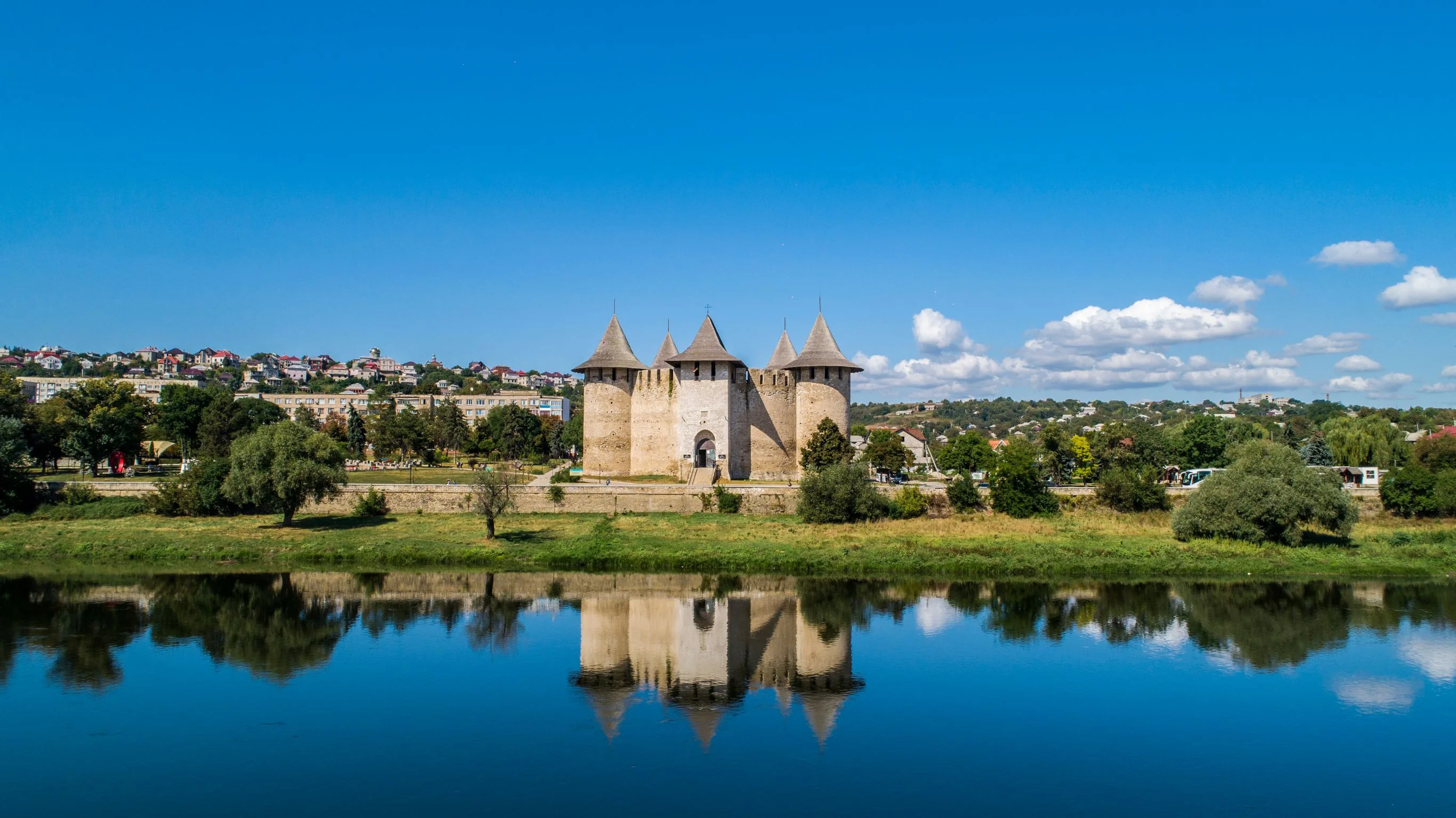
Two hours up through Șoldănești and Florești to the northern Nistru. The fortress is the reason to come: Ștefan cel Mare put a wooden fort here around 1499 and Petru Rareș rebuilt it in stone between 1543 and 1546 as a circle with five towers, one of the few Moldovan fortresses never taken by assault. Restoration finished in 2015 and you can walk the wall. Then the hill above the town, where Roma families have built the mansions Soroca is known for — turrets, columns, roofs copied from buildings their owners saw abroad. Ask before photographing anyone's house.
South to Curchi, and back to the capital
Down through Florești and Orhei with one stop that justifies the day. Curchi monastery was founded in 1773 and its Nativity cathedral, built between 1868 and 1872, is the best piece of nineteenth-century church architecture in the country — a great domed volume that was used as a psychiatric hospital for most of the Soviet period and has been under restoration since the early 2000s. On into Chișinău by late afternoon.
Bender and Tiraspol
Leave the hire car in Chișinău — almost every rental contract in Moldova excludes the left bank and taking the vehicle across voids the insurance. Take a marshrutka instead. At the de facto crossing you are issued a paper slip stating how long you may stay; keep it, because they ask for it on the way out. Bender's fortress was rebuilt for Suleiman between 1538 and 1541 and Charles XII of Sweden spent four years in exile beside it after Poltava. Tiraspol, across the river, still has Lenin outside the Supreme Soviet, a T-34 on a plinth, and the Kvint distillery, which has made brandy here since 1897 and appears on the banknotes.
Căușeni and Purcari
South-east into the Ștefan Vodă wine zone with one detour first. The Church of the Assumption at Căușeni is sunk into the ground so that its roof would not stand higher than an Ottoman mosque, and the frescoes inside were painted between 1763 and 1767 — the finest surviving church painting in the country, in a building that looks like a shed from the road. Then Purcari, a wine estate founded by imperial decree in 1827 whose Negru de Purcari took a medal at the Paris exhibition of 1878, and which now sits at the centre of the country's best-known protected designation.
West to Comrat
Across the south to Gagauzia, an autonomous territorial unit created by law in December 1994 after a secession crisis that came close to a second war and was settled instead by a statute. The Gagauz are Orthodox Christians who speak a Turkic language, and Comrat is a small administrative town with a People's Assembly, a state university teaching in three languages, and a history museum that puts the 1994 settlement at the centre of the story rather than in a footnote. Ask about the referendums; you will get several answers.
The Lower Prut
South-west through Cahul to the Prut floodplain and the wetlands on the Romanian border. Prutul de Jos became Moldova's first UNESCO biosphere reserve in 2018 and its core is Lake Beleu, a shallow lake connected to the river by two channels, on the flyway that runs down to the Danube delta — pelicans, herons, glossy ibis in numbers depending entirely on the water level, which varies enormously year to year. Arrange the visit through the reserve administration at Slobozia Mare; a boat is only possible when the lake is high enough.
Up the Prut to Hîncești
The road back runs north along the river through Leova with one worthwhile stop. The palace at Hîncești was built for the family of Manuc Bei — the Armenian merchant and diplomat who brokered the treaty that handed this land to Russia in 1812 — and reopened as a museum in 2018 after a long restoration. Chișinău is another forty minutes on. If it is the first weekend of October you have timed it well: National Wine Day fills the main square and every producer on this route is in it.
Good to know
Moldova is not in the EU or Schengen — it has been a candidate since June 2022 and opened accession negotiations in June 2024, but nothing has changed at the border yet. EU, UK, US, Canadian, Australian, Japanese and many other passports enter visa-free for 90 days in any 180, and that allowance is counted separately from any Schengen stay; EU citizens may enter on a national ID card. Chișinău is the only airport with scheduled international flights, and the overland alternatives are the overnight train from Bucharest, the day train to Iași, and buses from Romania. The currency is the Moldovan leu; cards work in Chișinău hotels, supermarkets and the better restaurants and in very little else, so carry cash for guesthouses, monasteries and rural fuel stations. Several EU operators now include Moldova in their roaming allowance under an arrangement agreed with the EU — check your plan before buying a local SIM, because data here is cheap and fast either way. Romanian is the state language, renamed from "Moldovan" by law in March 2023; Russian is widely spoken, Gagauz in the south, and on the left bank you should assume Russian. Driving is on the right, an International Driving Permit is sensible with a non-EU licence, and a green card is required for a foreign vehicle. The M-roads and the main R-roads have been substantially rebuilt with EU and EBRD money and are fine; the village roads on this route are not, and neither are they lit. Horse carts, farm machinery and livestock use them after dark, so do not drive at night — the one rule worth keeping absolutely. The drink-drive threshold is very low and enforced routinely, which is the practical argument for hiring a driver on the two cellar days rather than trying to spit everything out. Cricova and Mileștii Mici both require reservations and will turn you away without one; the underground tours are by vehicle and the galleries hold at around twelve degrees all year, so bring a layer even in August. Transnistria needs its own paragraph. It has run its own currency, customs posts and administration since 1992, no government recognises it, and no embassy has consular reach there, which is why several foreign ministries — the British among them — advise against all but essential travel. The registration slip you are handed at the crossing states the hours you may remain; overstaying it produces a fine and a long conversation on exit, and staying overnight requires registering with the local migration office. Do not photograph checkpoints, soldiers or the crossing itself. Since Russian gas transit through Ukraine ended on 1 January 2025 the left bank has had recurring electricity and heating problems, so check the situation the week you go rather than assuming last year's conditions. On the right bank the war next door shows up mainly as drone and missile debris incidents in the northern and eastern border districts and as occasional short airspace closures; the country itself is calm and rural Moldova is very safe. Winter is the season to avoid unless you have a reason: fog, ice, and secondary roads that are cleared late. May to early July and September to mid-October are the good windows, and the second of those is the harvest.
Shorter or longer?
Add four or five days on the Romanian side. The train from Chișinău reaches Iași in a morning, and from there it is the Bucovina monasteries at Voroneț, Sucevița and Moldovița — the painted churches this whole region's medieval art came out of, and the other half of a principality the 1812 treaty cut in two.
Chișinău throughout: the city, Cricova and Mileștii Mici, Orheiul Vechi as a long day trip, and Bender and Tiraspol by marshrutka. Cuts the north, Gagauzia and the Prut — which is most of the driving and about half the cost.