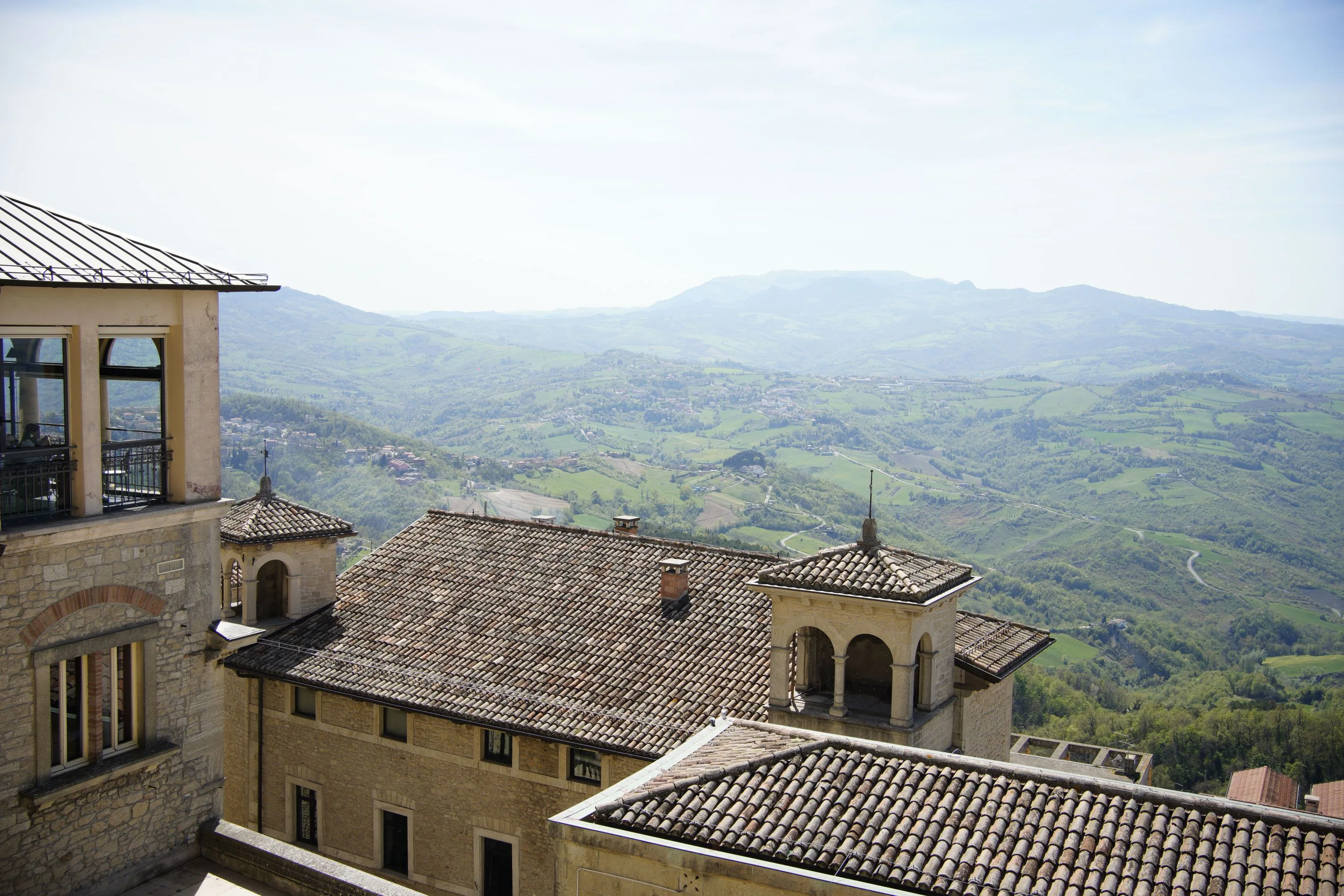
Sixty-one square kilometres, thirty-four thousand people and about two million visitors a year, nearly all of whom come up from Rimini after breakfast and are gone by five. Three days arriving by bus from Rimini and sleeping inside the walls on Monte Titano — one for the crag and its towers, one for the ground below them and Borgo Maggiore, and one for the seven other castelli, which is the half of the country almost nobody sees.
The crag
Piazza della Libertà and the Palazzo Pubblico first, because the country is governed from it. The Guard of the Rock changes outside on the half hour, but only on the summer schedule — turn up in November and there is no ceremony, which is worth knowing before you plan a morning around it. Two Captains Regent are elected by the Great and General Council every six months, always serve jointly, and each can veto the other — a custom running back to 1243, and one of the things UNESCO cited when it listed the centre and Monte Titano in 2008. Then the ridge. Guaita is the oldest of the three towers and the one on every photograph; Cesta, on the highest of the mountain's three peaks, holds the Museum of Ancient Arms; Montale, the third, is closed to visitors and you look at it from the path. The Passo delle Streghe between the first two is the walk that justifies the day. Stay put for the evening — the last coaches leave around five and the shops selling replica firearms shutter with them.
The tunnel and Borgo Maggiore
Two of the day's three stops are still up on the hill, so start there rather than taking the cable car first. The Museo dell'Emigrante is in the old Santa Chiara monastery on Contrada Omerelli, inside the walls, and it is the corrective to the souvenir shops: for most of the last two centuries this was a country people left. Below the historic centre, where the line terminated, is the Montale tunnel — 800 metres of the Rimini–San Marino railway relaid in 2012 with the restored AB-03 railcar standing in it. The railway opened in 1932, ran 31.5 kilometres through seventeen tunnels, was wrecked by the RAF on 26 June 1944 and never reopened. Refugees slept in these tunnels. Opening is seasonal and restricted to certain days, so confirm it before you build a morning around it. Then the cable car, running since 1959, drops to Borgo Maggiore in two minutes; walking down takes about forty. Borgo is the older commercial half of the pairing, built round the mercatale below the crag where the market has been held since the Middle Ages, and the concrete sanctuary above the square is by Giovanni Michelucci, finished in the 1960s and a genuine shock after the battlements.
The other seven castelli
Nine castelli make up the republic; the Città and Borgo Maggiore took the first two days, and the remaining seven are off the rock, where the country is working Romagna — light industry, warehouses and roundabouts, and where nearly everyone actually lives. Serravalle is the largest by both area and population and holds the Stadio Olimpico, where the national team plays its home games. Domagnano gave up an Ostrogothic hoard at a farm in the 1890s — gold eagle brooches from around AD 500, now in the British Museum and in Nuremberg, and not one piece of it in San Marino. Faetano asked to join the republic in 1463 after the Treaty of Fossombrone handed it Fiorentino, Montegiardino and Serravalle; the borders have not moved since, which is the real claim to age. Montegiardino is the smallest castello and has a walled centre you can cross in four minutes. Fiorentino has the ruined tower at Pennarossa. Acquaviva and Chiesanuova are the two that only completism justifies stopping in — a day gets you five of the seven at a reasonable pace, and all seven only if you stop moving.
Good to know
San Marino issues no visa and runs no border. You arrive through Italy, so Schengen rules govern the whole trip and the only marker of the frontier is a sign on the road. It is not in the EU or Schengen, but it is in a customs union with the EU and uses the euro under a monetary agreement, minting its own coins — these go straight to collectors and you will never see one in change. Two consequences of being outside the EU actually bite. First, mobile roaming: "roam like at home" does not cover Sammarinese networks, so a phone that latches onto a local operator instead of an Italian one can bill at non-EU rates. On the crag both are in range; set network selection to manual, or check the carrier name before using data. Second, there is no duty-free advantage worth planning around beyond lower excise on a few goods. Getting there is bus 72 from outside Rimini station, roughly fifty minutes and about €6 each way, hourly and thinner on Sundays; Rimini and Bologna are the airports. Driving up from the coast is half an hour of switchbacks and the historic centre is closed to traffic — use the terraced car parks and the lifts, or park in Borgo Maggiore and take the cable car. The tourist office in the Città sells a passport stamp for a few euros, which is the only stamp you will get. Buy the Museum Card rather than separate tickets if you intend to enter both towers, the Palazzo Pubblico and the State Museum. The state museums and the towers stay open through the winter but on much shorter hours, the Guard of the Rock ceremony stops altogether, and the ridge sits in cloud for days at a time from November to February — the view that the towers exist for is not guaranteed. Come on 1 April or 1 October for the investiture of the Captains Regent, or 3 September for the crossbow tournament in the Cava dei Balestrieri; both fill the town, so book beds well ahead. Overnight guests pay a small tourist tax at checkout. The historic centre is steep, cobbled and stepped throughout, and there is no route through it that avoids a climb.
Shorter or longer?
Two or three more days on the Italian side of the frontier. San Leo is twenty-odd kilometres west, a fortress on a rock that makes Monte Titano look approachable, and the Marecchia valley below it runs back down to Rimini past Sant'Agata Feltria and Verucchio. It is the same geology and the same medieval quarrel, without the souvenir shops.
The standard trip, and it is not a bad one: up on the morning bus, the towers and the Passo delle Streghe, down mid-afternoon. What you lose is the evening, which is the only time the walled town stops being a shopping street, plus the railway tunnel and the other seven castelli entirely.