Both Islands in Eight Days
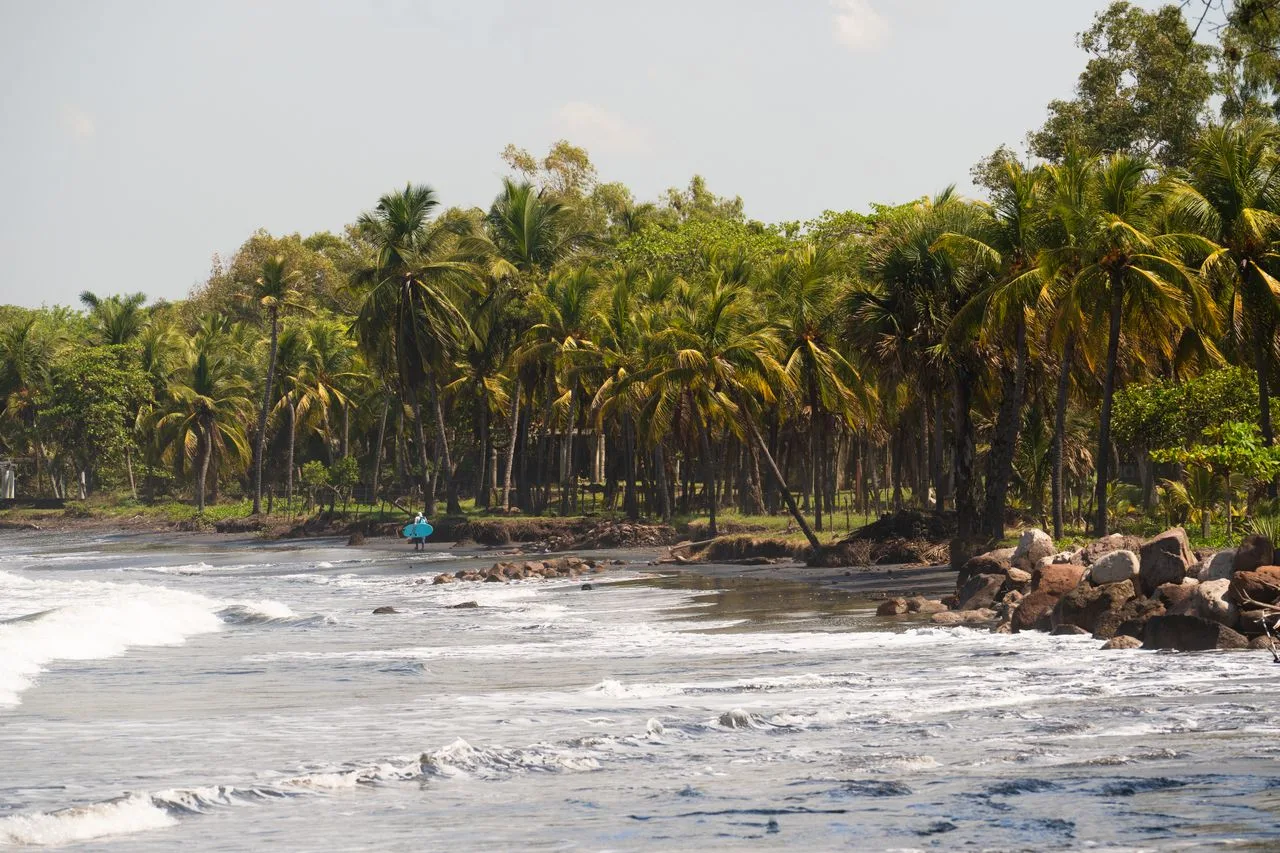
Two equatorial islands the size of a small county, driven slowly: the capital and its cocoa workshop, the plantation complexes the forest is taking back, a crater lake in the cloud forest, the volcanic needle in the south, the equator itself on an islet off the last beach — then thirty-five minutes north by small aircraft to Príncipe, which has eight thousand people on it and a biosphere reserve over most of the rest.
São Tomé town
A capital of about seventy thousand people that you can cross on foot in half an hour. Start at the Fort of São Sebastião, built in 1575 and now the national museum, then the market and the cathedral. In the afternoon go to Claudio Corallo's workshop in Água Grande — an hour of tasting and a lecture on fermentation that is really an argument about why Santomean cocoa collapsed and what it took to sell it again. Book it a day ahead. Eat calulu somewhere with plastic chairs and change money if you have not already.
The northern roças and the dry coast
North out of town to Roça Agostinho Neto, the largest plantation complex on the island and still lived in — families in the workers' quarters, laundry across the colonnades, the hospital block open to the sky. It was called Rio do Ouro until 1975. Carry on to Guadalupe and round to the north-west tip at Lagoa Azul, where baobabs grow on a coast that gets a fraction of the rain the south does, then down to Neves for the beer factory and the fishing beach. There is no cross-island road back from Neves, so the afternoon is the north coast again in the other direction.
Monte Café and Lagoa Amélia
Up into the centre. Monte Café sits at around 700 metres and was a coffee estate; the drying terraces and the machinery hall are still there and there is a small museum run by people who worked in it. Beyond it the road ends at Bom Sucesso, the botanical garden at the edge of Óbo national park, where you pick up a guide. The walk to Lagoa Amélia is about ninety minutes each way through cloud forest — the lake is a crater that has silted up into a floating peat bog, and you stand on it rather than look at it. Wet, muddy and cold by equatorial standards. Take a fleece.
South down the east coast
The best road on the island and the one to take slowly. Santana first, a dozen kilometres out, with its islet a short way offshore. Then Água Izé at twenty kilometres — the estate that put the island into cocoa in the 1860s, with a hospital façade, a chapel and the bed of the plantation railway running down to its own jetty. After that the long green run down to São João dos Angolares. Beyond the town the road bends inland and Pico Cão Grande appears above the forest: a plug of solidified magma left standing when the volcano around it eroded away, its summit 663 metres above the sea and about 370 metres above the ground at its foot. It is a viewpoint, not a walk — the climbing on it is a technical big-wall route.
The far south and the equator
The wettest corner of the country and the emptiest. Praia Jalé is a nesting beach — four of the five sea turtle species recorded in the archipelago come ashore to lay, and the monitors of Programa Tatô patrol this stretch through the season, which runs roughly October to March and peaks around December and January. Never walk a nesting beach at night without them. Then Porto Alegre at the end of the road, and a short boat across to Ilhéu das Rolas, where a stone marker sits on latitude zero and you can swim in both hemispheres in the same afternoon, which is a stupid thing to do and worth doing.
North to the airport, then Príncipe
Back up the east coast, about three hours for sixty-five kilometres, which tells you everything about Santomean road speeds. Then the flight: thirty-five minutes north-east in a small turboprop over open ocean, and Príncipe comes up out of the water as a set of green spires. Santo António is the smallest capital of any autonomous region you will visit — a couple of streets, a bridge, a church. Walk it before dark and then do nothing, which is the correct use of the island.
Sundy and the north-west
Roça Sundy is the plantation house where Arthur Eddington's expedition observed the total solar eclipse of 29 May 1919 and produced the measurement of starlight bending round the sun that made general relativity front-page news. The building has been restored as a hotel and the site is marked. From there it is a short walk down to Praia Banana, the curved beach that turns up in Bacardi advertising and on every poster of the island, and a boat or a track to Bom Bom in the north. The whole island and its waters have been a UNESCO biosphere reserve since 2012; the forested southern third is the Obô Natural Park inside it, and you need a guide and usually a boat to get in there at all.
The reserve, and out
Give the last morning to the forest or the water. Pico Papagaio is the classic walk — a steep four to five hours return with a guide, endemic birds most of the way and a decent chance of seeing nothing through the cloud at the top. The alternative is a boat down the west coast to Praia Grande and the empty southern beaches, which is easier and probably better. Then the first flight of the day back to São Tomé rather than the afternoon one: the intercontinental departures leave São Tomé late at night, so a morning hop leaves most of a day of slack if the weather grounds the aircraft, and an afternoon one leaves none.
Good to know
Entry is easier than most of the region. EU, UK, US, Canadian and a number of other passports enter visa-free for short stays — commonly quoted as fifteen days — and everyone else uses the online pre-registration or e-visa run by the immigration service, which you want to start at least a fortnight ahead because it is a small office. Six months' passport validity. The yellow fever rule is where people come unstuck: the certificate is demanded of arrivals from countries with a risk of transmission, and the cheap routings into São Tomé are through Luanda, Libreville and Accra, all of which put you in that category. Fly from Lisbon and you may not need it; connect through anywhere on the mainland and you almost certainly will, so get it anyway — since 2016 it is valid for life. Malaria is present on both islands and transmission has fallen a long way after sustained spraying and net programmes, but the islands are equatorial and every travel clinic will still prescribe prophylaxis. The dobra is pegged to the euro at a fixed rate of 24.5 and euros are accepted almost everywhere, which removes the usual currency argument. Cash removes the other one: there are ATMs in São Tomé town and effectively none on Príncipe, cards work at the better hotels and nowhere else, so draw what the whole trip needs before you fly north. Roads: the coastal ring is surfaced and potholed, and progress on it averages something under 30 km/h once you allow for dogs, pedestrians, roadworks and the fact that the road is also the pavement. Anything into the interior — Bom Sucesso, the tracks above Monte Café, the south beyond Porto Alegre — wants clearance and four-wheel drive, and laterite in the rains is genuinely slippery rather than merely inconvenient. Self-drive is realistic on the coast if you are comfortable with that, but a car with a driver costs little more, solves the Portuguese, and means somebody else changes the wheel; almost nobody outside the hotels speaks English. Season matters more than usual. The gravana, roughly June to September, is cool, overcast and dry, and is the best window for walking; December to February is hot, sunny and the beach season; March to May and October to November are wet, and the south of São Tomé is one of the wettest places in Africa. The Príncipe flights are the fragile link — STP Airways and Africa's Connection fly small aircraft with hold allowances around ten to twelve kilos, schedules change, and weather cancels. Take the first Príncipe departure of the day when you are heading home, never the afternoon one, and give the return a spare night in São Tomé if the schedule allows it — a cancelled hop against an evening intercontinental flight is a missed intercontinental flight. Expect to be asked to leave a bag in São Tomé. Óbo national park requires a guide from Bom Sucesso and this is not a formality: the trails are unmarked and the cloud comes down. Turtle beaches are patrolled by Programa Tatô monitors in nesting season — go with them or not at all.
Shorter or longer?
Four or five more days. Pico de São Tomé, at 2,024 metres, is two days from Bom Sucesso with a guide and a night in the forest — steep, wet and rarely dry at the top. Then two extra nights on Príncipe to reach the southern beaches and the offshore islets by boat rather than looking at them on a map.
Drop Príncipe and the flight that goes with it, which is most of the fixed cost and all of the schedule risk. The capital, the northern roças, Bom Sucesso and the run south to Cão Grande and the equator fit comfortably into five days on São Tomé alone.