The northwest quarter, which was closed to tourists until September 2019 and holds most of what Saudi Arabia has to show for itself: a Red Sea merchant town of coral-stone houses, the Nabataeans' southern capital, a canyon wall of pre-Arabic inscriptions, the oasis a Babylonian king ruled from for ten years, an abandoned Ottoman railway, and a granite coast facing three other countries across the water.
Jeddah, Al-Balad
The old merchant quarter, UNESCO-listed in 2014, is built of coral rag quarried out of the Red Sea and faced with roshan — projecting wooden screens that shade a window and let air through it, which is the whole air-conditioning strategy of a pre-electric city. Much of it was collapsing ten years ago and a great deal of it is now scaffolded. Walk it in the evening, when the souks open and the heat drops.
The Jeddah coast
North up the corniche to Obhur, where the reef comes close enough inshore that the dive operators are working twenty minutes from the car park. The Red Sea here has had a fraction of the pressure the Egyptian side has taken. Afterwards, the Corniche itself: thirty-odd kilometres of open waterfront and a fountain that throws seawater about 260 metres up, which is worth seeing once.
North to AlUla
Fly. The road is around 700 kilometres and the flight is short, and the alternative overland route runs through Medina, which needs more thought than a driving day deserves. AlUla old town is a mud-brick maze abandoned in the twentieth century and partly rebuilt since; the oasis behind it is still a working palm grove with channels running under the trees.
Hegra
The Nabataeans' second city, 500 kilometres south of Petra and cut in the same manner into freestanding sandstone outcrops: 111 monumental tombs, 94 of them with carved facades, many carrying inscriptions that name the owner and the mason and curse anyone who reuses the grave. UNESCO listed it in 2008, the first Saudi site on the list. You cannot drive in — entry is on a booked tour from the visitor centre, in a bus, with a guide.
Dadan and Jabal Ikmah
Older than Hegra and less visited. Dadan was the capital of the Dadanite and then the Lihyanite kingdoms, and its lion tombs are cut high into a red cliff above the palms. Twenty minutes on, the narrow canyon at Jabal Ikmah is covered in inscriptions — Dadanitic, Lihyanite, Thamudic, Nabataean, Aramaic, scratched by people passing through over several centuries. UNESCO added it to the Memory of the World register in 2023.
The outcrops and the reserve
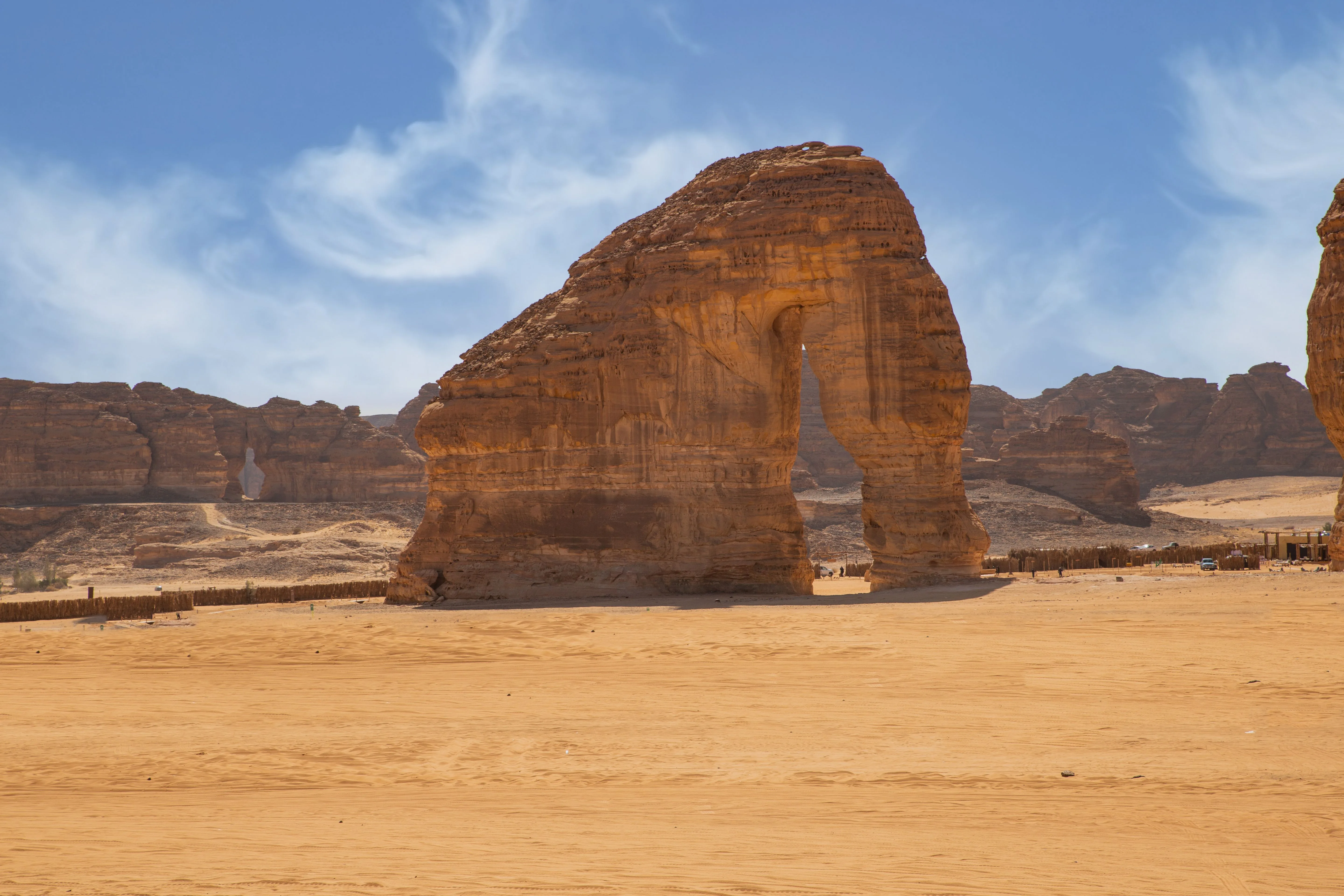
A slower day. Elephant Rock is a wind-cut sandstone monolith on the desert floor northeast of town and it is exactly as photographed, which is either the point or the problem. Sharaan, 1,540 square kilometres of sandstone country outside town, is the reserve where ibex, gazelle and oryx have been released and where the Arabian leopard is meant to go back eventually — the breeding centre itself is at Taif, eight hours south, so there is no leopard to see here. Access is on booked reserve trips only. Finish with the oasis walk at dusk.
Tayma
North-east across open desert to an oasis with a wall around it several kilometres long and a well, the Haddaj, that is one of the largest ancient wells in Arabia. Nabonidus, the last king of Babylon, moved his court here in about 553 BC and stayed roughly ten years while his son ran the capital — a decision nobody has satisfactorily explained, and the reason a Babylonian royal inscription was found in a Saudi oasis.
Tabuk
A garrison town that became a provincial capital. The Ottoman fort in the centre is the set piece; the better stop is the Hejaz Railway station and its workshops, restored, with rolling stock standing on rails that go nowhere. The line reached Medina in 1908 and cut the pilgrimage from about forty days by camel to under five by train. It was attacked repeatedly during the Arab Revolt and the section south of Ma'an has carried nothing since 1920.
Wadi Disah
Southwest into the Hisma, where sandstone towers stand on a granite base and the erosion has left columns that look deliberate. The wadi floor carries water for much of its length, with palms and reeds growing out of it between walls a couple of hundred metres high. The soft sand at the entrance is where hire cars get stuck; the drivers at Disah village run pickups through it for a fixed price and it is worth taking one.
Al Bad' and Maghair Shuayb
West into what the sources call Midian. The Nabataeans cut tombs here too — fewer than at Hegra, plainer, and standing on their own in a field with nobody selling tickets. Local tradition attaches the site to Jethro and to Moses' years in exile, which is why the guidebooks call them the Caves of Jethro. The town below is small and the petrol station is the landmark.
The Gulf of Aqaba at Magna
Down to the water. Magna is a palm oasis with springs running out of the rock almost onto the beach, and the reef is close enough in to snorkel from the sand. This whole coast now sits inside the NEOM development area, and stretches of it have been closed at short notice for construction — confirm access before committing the day, and take the closure at face value if it comes.
Wadi Tayyib al Ism and Haql
North along the coast. A granite cleft splits the mountains and runs down to the sea, wide enough in places for one vehicle and cool at the bottom of it. Fifty-odd kilometres short of Haql the Georgios G is still standing on the reef off Bir al-Mashi — a Greek freighter that hit the coral in April 1978 with a hold full of flour, which caught and burned for days. At Haql itself the Gulf of Aqaba is about fifteen kilometres across and you can see Egypt, Jordan and Israel from one stretch of beach.
Back over the escarpment
Inland and up. The road climbs off the coastal plain onto the plateau and the temperature drops several degrees on the way — Tabuk gets frost in winter, which surprises people who have spent a fortnight thinking about heat. Domestic flights out go via Riyadh or Jeddah; there is usually time for the railway workshops if you skipped them on the way north.
Good to know
The tourist e-visa is issued through visa.visitsaudi.com and nowhere else — 300 riyals for the visa itself, with the compulsory medical insurance and checkout charges taking the real total to around 500, usually granted within a few days, valid a year for multiple entries with stays up to 90 days. Several nationalities can also get it on arrival, and holders of a valid US, UK or Schengen visa have an easier route in. Mecca is closed to non-Muslims outright and the restriction is enforced at checkpoints on the approach roads, which are signposted with bypasses: on Highway 40 out of Jeddah, follow the signs and not the satnav, which will happily route you through. Medina is the more nuanced case — the closed area is the Haram zone around the Prophet's Mosque rather than the whole city, and the Haramain train serves the station, but the boundary is real and it is worth confirming locally rather than assuming. This route avoids both. Saudi Arabia does not admit holders of Israeli passports, and the view from Haql misleads on the practicalities: there is no crossing to Egypt or Israel anywhere on this coast, and the one land border here is Durra, thirty kilometres north of Haql, into Aqaba in Jordan — which is the sensible way to chain this route onto Petra. Alcohol is prohibited entirely and importing it is treated as a serious offence, so there is nothing to budget for and no bar to look for. Go between November and March: from May to September the interior sits above 40 °C and Wadi Disah and the open desert become genuinely dangerous rather than merely unpleasant. Ramadan moves about eleven days earlier each year and currently falls across February and March — eating, drinking and smoking in public during daylight are not done, and daytime hours shorten everywhere. Driving is the only realistic way to do the northern half: an International Driving Permit is required alongside your home licence, petrol runs a little over two riyals a litre so distance costs almost nothing, and the roads are excellent, empty and fast, which is why the crash rate is what it is. Hegra cannot be entered independently and tours sell out in the winter season, so book before you fly. Cards work almost everywhere; Saudi Arabia is more cashless than most of the region. Women no longer need an abaya and can drive, travel and check into hotels alone, though modest dress covering shoulders and knees is expected and a scarf is useful.
Shorter or longer?
Add five or six days from Jeddah: the escarpment road to Abha, the stone-and-mica village at Rijal Almaa, and the free ferry from Jazan out to the Farasan reef. The southwest highlands catch the monsoon and are the one part of the country that is green and cool in August, which reverses the whole logic of this route.
Jeddah for two nights, fly to AlUla for four, fly out. Keeps Hegra, Dadan and the oasis, drops Tayma, Tabuk, the wadis and the coast, and removes every kilometre of driving.