Advisory - travel not recommended · checked 5 Aug 2026
Somalia
Foreign ministries advise against ALL travel to south-central Somalia, including Mogadishu, where al-Shabaab attacks occur regularly and there is effectively no consular assistance. Somaliland in the northwest issues its own visas, has been comparatively stable since 1991 and does receive visitors — an armed police escort is legally required outside Hargeisa. Standard scores are suspended while this alert is active.
Official advisory →Read the advisory first: foreign ministries advise against all travel to south-central Somalia, including Mogadishu, where al-Shabaab attacks are regular and there is effectively no consular assistance. This route does not go there and does not pretend it could. It works Somaliland in the northwest — Hargeisa, the Awdal coast at Zeila, the rock shelters at Laas Geel, Berbera and the escarpment towns behind it — which issues its own visa, has been comparatively stable since 1991 and does receive a small number of visitors under an armed police escort that is required by law outside the capital. Comparatively is the operative word, and the softer regional wording is not universal: several ministries, the United States among them, apply their do-not-travel advice to the whole country, Somaliland included. The route also stays out of Sool and Sanaag in the east, where fighting from February 2023 displaced more than 200,000 people from Las Anod, where Somaliland has not controlled the town since August that year, and where the warnings are as severe as anywhere in the south.
Hargeisa
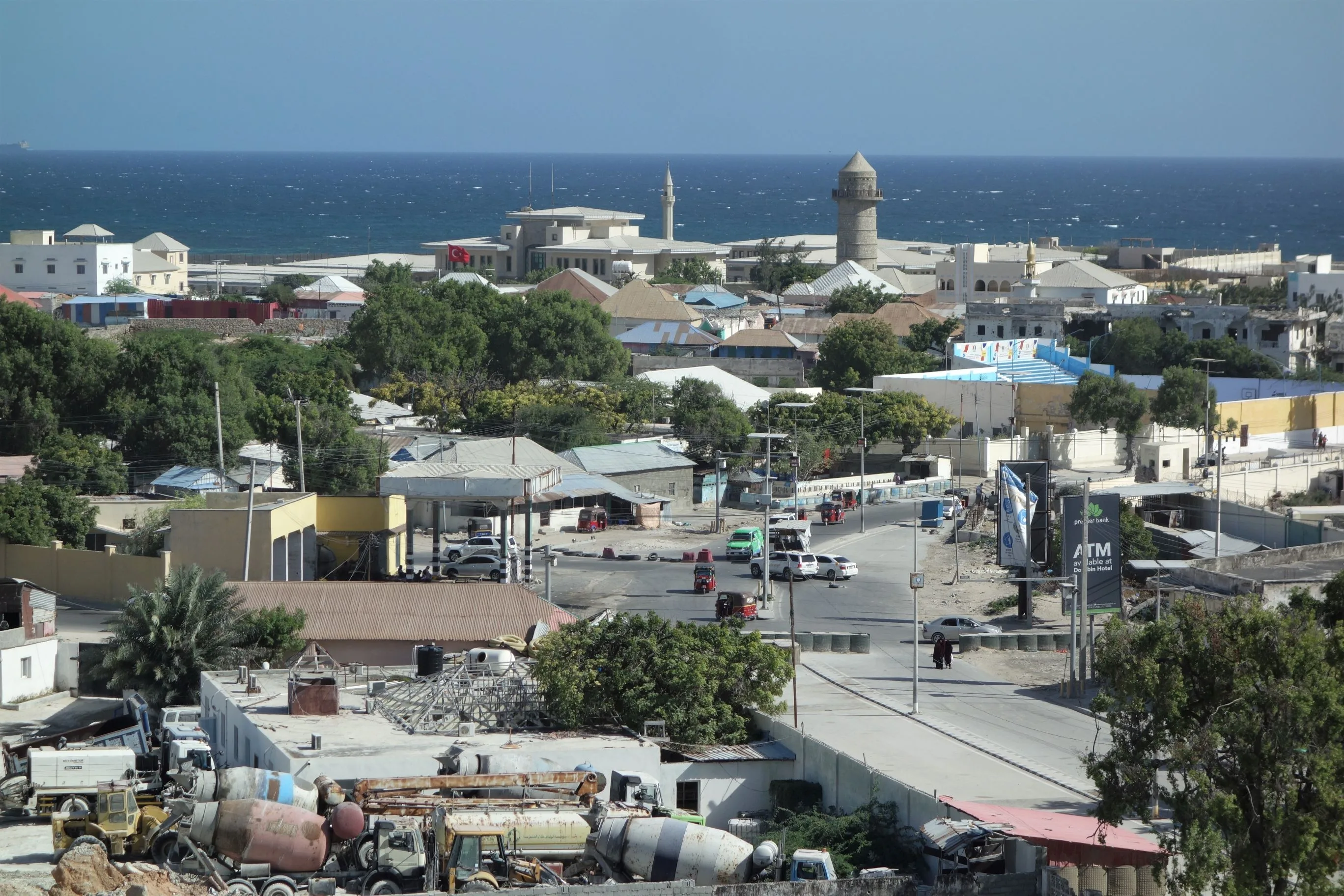
Egal International sits a few kilometres from the centre and the arrival is the first lesson in what this place is: a Somaliland visa, issued here for cash dollars, in a passport that a Somali federal visa would not help you with at all. The two documents are not interchangeable in either direction. Do nothing else on day one except register your itinerary with the tourism ministry, which is how the escort gets assigned, and change enough money to see what the notes look like.
The capital on foot
Hargeisa was shelled and bombed by its own government in 1988, during the campaign against the Isaaq that a UN-commissioned investigation and most subsequent scholarship describe as genocide. Something close to nine-tenths of the city was destroyed and several hundred thousand people fled over the border into Ethiopia. The death toll is genuinely disputed and no count is authoritative: figures from around 50,000 to 200,000 are cited, and mass graves on the edge of the city are still being exhumed. The MiG on a plinth in the centre is a memorial to that, not an ornament, and the panels around its base are painted with the killing rather than the aircraft. The livestock market on the edge of town is one of the largest in the Horn and moves the animals that pay for the state. The Hargeisa Cultural Centre, opened in 2014, runs the library and the book fair that has been held here every summer since 2008 — poetry is a serious business in Somali and this is where you find that out.
West to Borama
The first escort day: an SPU officer, a rifle and the front seat of your vehicle, which is the law rather than a service you can decline. Three hours west on tarmac to Awdal, the greenest region in the territory and the one that feeds the rest of it. Amoud University opened in 1998 in a set of buildings the diaspora paid to repair, and it was the first university anywhere in Somaliland — a thing built while the recognised state to the south had no functioning ministry of education at all.
Down to Zeila
Due north to the Gulf of Aden on a road that stops being a road for long stretches — five hours or more depending on the season and what the last rains did to the crossings. Zeila was the port of the Adal Sultanate and came under Ottoman control in the mid-sixteenth century; the British ran their western district from here, and the protectorate's own capital was Berbera until it moved inland to Hargeisa in 1941. What killed the town was not that move but the trade going elsewhere — to Berbera, and to the French railway at Djibouti. What stands is coral-stone walls, two ruined minarets and a population a fraction of what the place once held.
The Saad ad-Din islands
A small boat out to the low coral islands off the point, where the mangroves and the shallows hold flamingos, pelicans and turtles that nest on the sand. Saad ad-Din takes its name from Sa'ad ad-Din II, the last sultan of Ifat, killed here by an Ethiopian force early in the fifteenth century; his sons went into exile and founded the Adal Sultanate that later ran Zeila. There is no dive operation and no schedule; you arrange a fisherman the evening before and go early, because by ten the light is flat and the heat is serious. The escort comes with you and the coastguard post has to be told you are going — this is a stretch of water the Djibouti border, the Yemen crossing and the smuggling routes all run through, and an unannounced boat is a problem for everyone.
The long drive back
Zeila to Hargeisa is the hardest day on the route — back through Borama and east, eight hours or so with checkpoints, and the coastal shortcut towards Berbera is sand rather than road and is not the answer. Break it at Borama for lunch. The compensation is that you spend a day watching the country change from salt flat to escarpment to plateau, which is the geography that explains why the towns sit where they do.
Laas Geel, and on to the coast
An hour north-east on the Berbera road, then a track to a granite outcrop with shelters cut into its underside. A French archaeological team led by Xavier Gutherz documented the paintings in December 2002 and published them the following year: cattle with lyre-shaped horns and decorated necks, human figures with arms raised, dogs, a giraffe. The dating is argued over and the usual range given is several thousand years BC. The pigment has held because the overhangs shed rain and because nobody built anything here. A permit from the tourism ministry in Hargeisa is required and is checked at the site. Then two more hours down the escarpment to Berbera, and the temperature climbs the whole way.
Berbera
The old town is coral-stone and lime, Ottoman and colonial and half-collapsed, and the port beside it is the single most important asset the territory has. DP World signed a thirty-year concession in 2016 and the new container terminal opened in June 2021; the corridor road runs from the quay to the Ethiopian border, which is the whole commercial argument for the place. The runway is the other curiosity — 4,140 m laid by the Soviet Union in the 1970s, inherited by the United States after Moscow switched sides in the Ogaden war, and later designated as an emergency landing site for the Space Shuttle.
The Gulf of Aden coast
Batalaale beach west of town is empty white sand and the reef offshore has been dived by almost nobody, which means it is in unusually good condition and also that there is no operator, no compressor and no rescue. Snorkel from the shore and stay conservative. Inland from here is Dhambalin, a painted shelter found in 2007 that carries what is generally described as the earliest depiction of a mounted hunter in the Horn — access needs arranging in Berbera and is not always granted.
Up the Sheikh pass
The escarpment behind Berbera rises about 1,400 m in a short distance and the road up it is a sequence of hairpins cut in the colonial period and repaired since with varying enthusiasm. At the top, Sheikh is cool enough to need a jacket at night. Sheikh Secondary School opened in 1958 as a British-run boarding school and educated a remarkable proportion of the people who later ran both Somaliland and Somalia; it fell apart in the war and has been rebuilt.
Burao
South-east across the plateau to the second city and the largest livestock market in the region — sheep and goats in tens of thousands, trucked to Berbera and shipped to Saudi Arabia, with the volume spiking before the Hajj. Burao is also where the Grand Conference of the Northern Peoples met in the spring of 1991 and where the restoration of independence was declared on 18 May that year. Dahabshiil, now one of the larger money-transfer businesses in Africa, started here in 1970 as a trading company.
Back to Hargeisa
Two and a half to three hours west on the best tarmac in the territory, arriving with the afternoon free. Spend it on Independence Avenue watching the changers, then out on the departure flight — schedules out of Egal are thin and change, so confirm the day you arrive rather than assuming the one you booked. Note that the eastern road from Burao towards Erigavo and Las Anod goes nowhere you should be going, and your escort will tell you the same.
Good to know
The advisory is the first thing to settle and it is not uniform. Foreign ministries advise against all travel to south-central Somalia, and to Sool, Sanaag and the eastern districts where fighting around Las Anod from February 2023 displaced more than 200,000 people and where Somaliland lost control of the town itself in August that year. The wording applied to Hargeisa, Berbera and the west is softer in some capitals — several European ministries separate Somaliland out and advise against all but essential travel there — while others, the United States among them, keep the whole country at do-not-travel with no regional carve-out at all. Which of those two you are reading decides whether an insurer will look at you. Read your own ministry the week you travel rather than the month you book, and understand that this route is written on the assumption that you have done so and decided anyway. Insurance is the practical consequence: a standard policy pays nothing in a country under an against-all-travel advisory, and the specialist high-risk cover with medical evacuation that does pay is bought separately, needs the itinerary declared in advance, and costs several hundred euros for a fortnight. Buy it or do not go — there is no functioning hospital here that can handle a serious injury and evacuation is to Addis Ababa or Nairobi. The visa is a Somaliland visa, issued on arrival at Egal International for most nationalities against cash US dollars — around US$60 for a single entry at the time of writing, though the figure moves and the counter takes nothing else — or in advance at a Somaliland liaison office in Addis Ababa, Nairobi, Djibouti, London or Washington. A federal Somali visa is not valid in Somaliland and a Somaliland visa does not let you into the south. Your own country almost certainly has no diplomatic presence in Hargeisa, so the nearest consular help is in Ethiopia or Kenya, which is why an evacuation number and a local fixer who answers his phone matter more than usual. The armed escort is a legal requirement rather than an upsell: an SPU officer accompanies any foreign visitor travelling outside Hargeisa, is assigned through the tourism ministry, and is paid a daily fee plus his food and bed, which you cover. Assume roughly US$20 to $30 a day and budget his meals on top. A separate permit from the same ministry is needed for Laas Geel and is checked at the site. None of that paperwork is something you file yourself in practice: a local fixer registers the itinerary, books the escort, gets the permits and finds the vehicle, and he is a compulsory cost rather than a convenience — reckon on US$40 to $60 a day on top of the driver, agreed in writing before you land, and pick one whose previous clients you can actually reach. Money is the other thing that catches people. Foreign cards do not work anywhere, there is no ATM that will take one, and the entire economy runs on two rails: US dollars in cash for anything substantial, and mobile money — Zaad, on the Telesom network — for everything else, which is denominated in dollars and which you can be signed onto with a local SIM in about ten minutes. Bring more clean, unmarked, post-2013 dollar notes than you expect to need, and split them. The Somaliland shilling exists physically, trades in the thousands to the dollar and is used for small purchases, which is why the changers stack it in bricks. Alcohol is prohibited throughout and there is no discreet exception. Khat arrives from Ethiopia in the early afternoon and a great deal of the country stops working when it does, so schedule anything official for the morning. Do not photograph police, checkpoints, the port or anything military, and ask before photographing people. Ramadan changes every opening hour and every meal. Season matters absolutely on the coast: Berbera runs past 45 °C through the summer and the Zeila road is worse, so this is a December-to-February route and attempting it in July is a medical decision rather than a scheduling one.
Shorter or longer?
Two more days on the escarpment above Berbera at Ga'an Libah, a juniper-forested massif at around 1,700 m that is one of the last pieces of highland woodland in the territory and is being cut for charcoal faster than it regrows. Camping, with the escort, and a long look at what deforestation actually costs a dry country. Two nights outside a town is not the same exposure as two nights in one — it is further from any clinic, out of phone coverage in places, and it needs the ministry's agreement rather than just your driver's. Ask the escort commander before you ask the guide.
Cut Awdal entirely — Borama, Zeila and the eight-hour return — and run Hargeisa, Laas Geel, Berbera, Sheikh and Burao. This removes every bad road on the itinerary, halves the escort bill and keeps the rock art, the port and the livestock market. It is the sensible first visit.