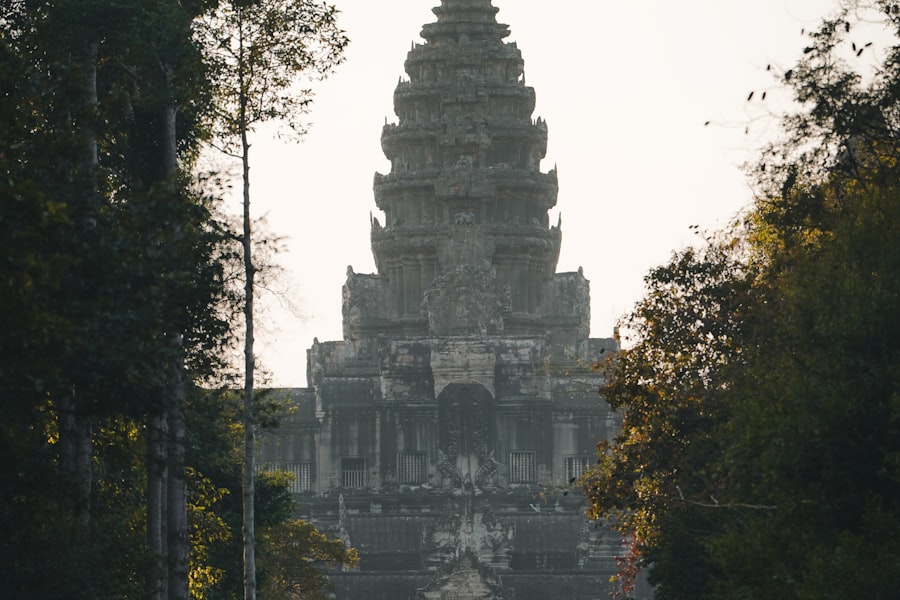
Follow the river south from Luang Prabang through ancient capitals to the delta. Every morning smells of incense.
Luang Prabang
The whole town is a UNESCO site — a peninsula between the Mekong and the Nam Khan, with French shutters on Lao timber and thirty-odd working monasteries in walking distance. Do nothing on the first afternoon except climb Mount Phousi for sunset and eat at the night market, where a vegetarian buffet costs about a euro.
Alms and the palace
The tak bat alms procession happens at first light and has become a spectacle; watch from a distance, sit if you participate, and do not use flash. Later, the Royal Palace Museum and Wat Xieng Thong, whose tree-of-life mosaic on the rear wall is the finest single piece of art in Laos.
Pak Ou and Kuang Si
Upriver by longboat to the Pak Ou caves, two chambers in a limestone cliff holding several thousand Buddha images left by pilgrims over centuries. In the afternoon, the Kuang Si falls — limestone terraces in a turquoise that looks edited, plus a bear rescue centre at the entrance run by Free the Bears.
South to Vang Vieng
The road climbs out of Luang Prabang through hill villages and mountain switchbacks — six hours by minibus, or two by the Chinese-built express train, which halved the country's internal distances when it opened in 2021. Vang Vieng has quietened down from its notorious years and is now mostly karst, caves and kayaks.
Vientiane
The quietest capital in Southeast Asia, and pleasant for exactly that reason. Pha That Luang is the national symbol; Wat Si Saket survived the Siamese sacking of 1828 with several thousand Buddha images intact. COPE, the prosthetics centre, explains the unexploded ordnance still being cleared from the American bombing — the essential stop here.
Thakhek
A small Mekong town facing Thailand across the water, and the start of the Thakhek loop through limestone country. Rent a motorbike or take a shared van; either way the road east runs into karst towers that rise straight out of paddy with no foothills at all.
Konglor cave
A river runs 7.5 km (4.7 mi) straight through a mountain, and you cross it in a longtail boat with a headtorch and a boatman who knows exactly where the shallows are. The ceiling reaches sixty metres in places. It takes about an hour each way and is the single strangest hour on this route.
Down to Pakse
A long southbound day back to the Mekong and on to Pakse, the gateway to the Bolaven plateau. If you have the appetite, the plateau adds coffee cooperatives and waterfalls on a two-day motorbike loop; if not, Pakse is a night's sleep and a river sunset.
Wat Phou at Champasak
A Khmer temple complex several centuries older than Angkor, climbing a hillside toward a spring the builders considered sacred. It is UNESCO-listed, rarely crowded, and best in the first two hours of the day when the sandstone is still orange and the axis up the terraces is clear.
Si Phan Don
The Four Thousand Islands, where the Mekong braids across fourteen kilometres of width in the dry season. Don Det and Don Khon are joined by a French colonial rail bridge; the Khone Phapheng falls downstream carry more water than any other falls in the world and are the reason no boat has ever run this river to China.
Into Cambodia
The Nong Nok Khiene–Trapeang Kriel crossing is small, slow, and known for informal fees on both sides; have exact dollars and expect to pay a little. South to Kratie on the Mekong, a town of shuttered colonial shophouses that has never quite been discovered.
Dolphins at Kampi
A pool upstream of Kratie holds one of the last populations of Irrawaddy dolphin in the river — around a hundred animals in total, and the number is the point. Go at dawn in a paddled boat rather than a motor one, and accept that you are watching blowholes and backs, not a show.
Kampong Cham and the bamboo bridge
Downstream to Kampong Cham, where for years the villagers of Koh Paen rebuilt a bamboo bridge across the Mekong every dry season and dismantled it before every flood — a concrete one has now replaced it, and the story is worth knowing anyway. Wat Nokor, a Khmer temple with a modern pagoda built inside it, is on the edge of town.
Phnom Penh
The capital sits at the confluence where the Mekong meets the Tonlé Sap — a river that reverses direction twice a year. The Royal Palace and the silver pagoda in the morning; the National Museum for Khmer sculpture in the afternoon; the riverfront when the heat drops.
Tuol Sleng and Choeung Ek
A school turned into prison S-21, and the killing field outside the city. Take the audio guide, take the whole morning, and plan nothing demanding afterwards. Nearly two million people died under the Khmer Rouge between 1975 and 1979 and this is where the country tells you so directly.
The river to Vietnam
A fast boat runs down the Mekong from Phnom Penh to Chau Doc, with immigration handled at the river posts at Kaam Samnor and Vinh Xuong — the best border crossing on this route by a distance. Chau Doc sits under Sam Mountain with floating fish farms moored below the houses.
Can Tho and Cai Rang
Into the delta proper, where the river splits into nine mouths and the roads are canals. The Cai Rang floating market starts at five and is largely finished by eight; boats advertise their cargo by hanging a sample from a pole. It is a wholesale market that tolerates visitors, not a performance for them.
Ben Tre, then Ho Chi Minh City
Ben Tre is coconut country — sampans down palm-shaded creeks, and workshops turning husk into everything from matting to candy. Then north-east to Ho Chi Minh City, where the river journey ends in eight lanes of motorbikes. The War Remnants Museum, if there is an afternoon left.
Good to know
Three countries, three entry systems. Laos issues visas on arrival at most crossings and airports; Cambodia has an e-visa that is accepted at the Lao land border but check which posts before you commit; Vietnam's e-visa must be approved in advance and lists the exact entry point you will use — Vinh Xuong for the river crossing.
Direction matters. Running the river downstream, north to south, means the boats and the current work with you and the two land crossings come at a point in the trip when you are used to the region.
The Lao railway has changed the first half of this route. Luang Prabang to Vientiane is two hours by train against six by road, and tickets sell out days ahead in high season — book as soon as you have dates.
May to October is the wet season: the Mekong is at its most impressive and the delta at its most difficult. November to February is dry, cool and busy. March and April are hot enough inland to change your plans for you.
Shorter or longer?
Laos only: Luang Prabang, Vang Vieng, Vientiane, Konglor and Si Phan Don, flying out of Pakse.
Skip the Lao panhandle. Fly Vientiane to Phnom Penh and give the extra days to Siem Reap and Angkor before continuing to the delta.
Add Angkor and the Cardamom mountains in Cambodia, and continue north from Ho Chi Minh City up the Vietnamese coast to Hoi An and Hue.