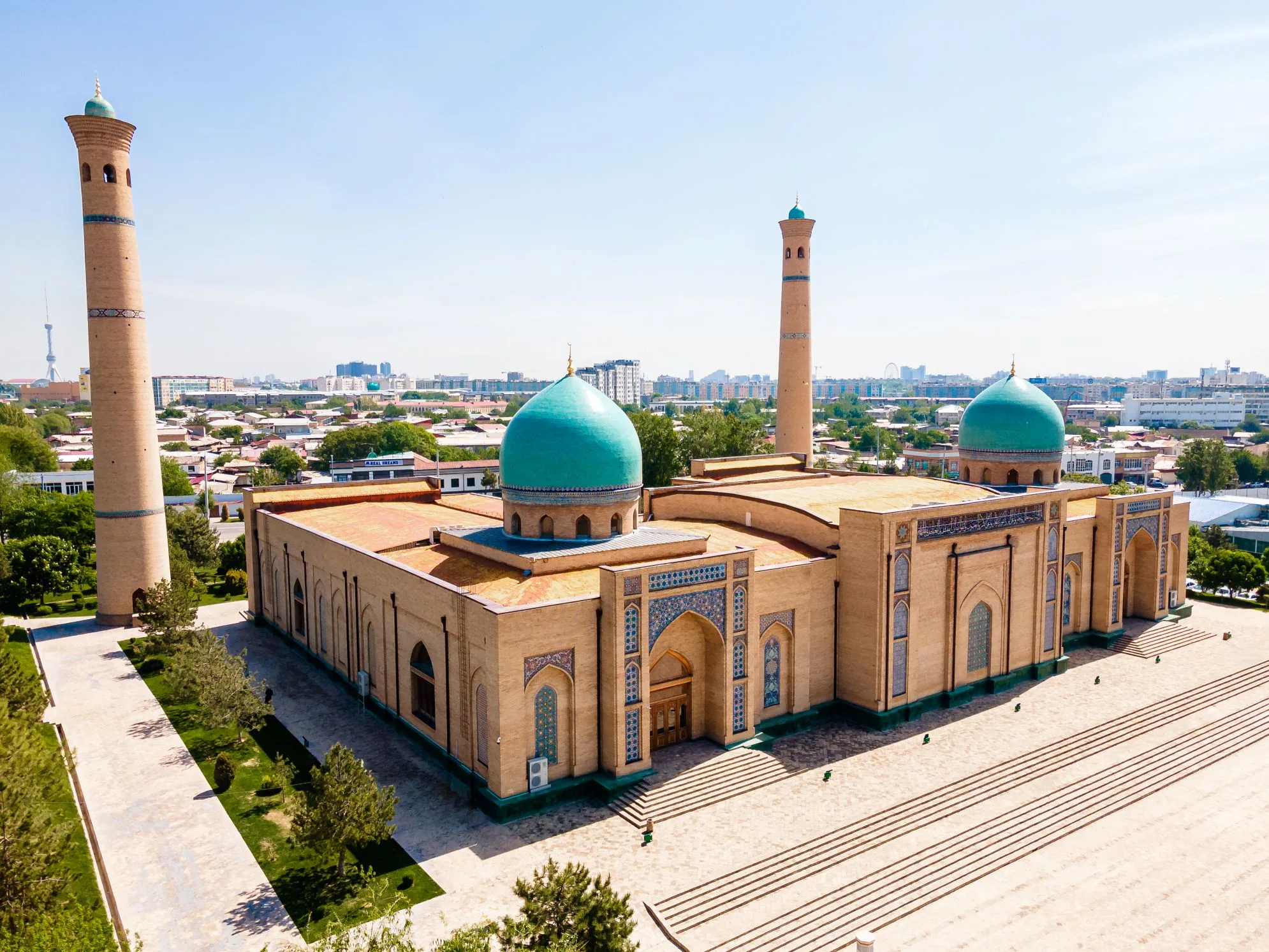
Fourteen days across the whole country, from the irrigated valley at the eastern end to the dried seabed at the western one — the silk and ceramic towns of Fergana, Samarkand in two hours on the fast train and Bukhara by road off the desert edge, a yurt camp on a lake that was made by accident, and the trawlers on the sand at Moynaq.
Tashkent
Most flights land before dawn, so make this a slow day. Chorsu bazaar under its green dome for breakfast, then the metro, which opened in 1977 as the first underground railway in Central Asia, was built to double as a shelter after the 1966 earthquake flattened the city, and could not legally be photographed until 2018. Get off at Kosmonavtlar for the ceramic portraits and at Pakhtakor, which means cotton-picker and is tiled accordingly.
East into the valley
The Angren–Pap line opened in 2016 and runs through a 19 km (12 mi) tunnel under the Kamchik pass. Before it, the only way into Fergana from Tashkent was over a road pass at about 2,270 m (7,450 ft) or through Tajik territory, which is why the valley has always felt like a separate country. Kokand was the capital of a khanate until Russia abolished it in 1876; Khudayar Khan's palace kept a fraction of the rooms it was built with, and the fraction is enough.
Rishton and Margilan
A day with a driver across the valley floor. Rishton has thrown pots from the clay under it for something like a thousand years and still finishes them with ishkor, an alkaline glaze burned from mountain plants, which is why that blue is that blue. Margilan, an hour east, weaves ikat on hand looms — warp threads tied off, dyed, untied and only then woven, which is what gives the pattern its bleeding edges. Both towns sell to Uzbeks first and to visitors second, and the prices say so.
Back through the pass
Out of the valley the way you came in, arriving in Tashkent in the afternoon. Use what is left of it: the Hazrati Imam complex holds what is claimed as the Uthman Quran, an early Kufic manuscript in a glass case with a queue in front of it, and the State Museum of History has the Buddhist sculpture excavated at Fayaz-Tepa on the Afghan border, which is the other Uzbekistan and the one nobody comes for.
Afrosiyob to Samarkand
Two hours and eight minutes on a Spanish-built Talgo running at up to 230 km/h (143 mph): 344 km (214 mi) of steppe on a line that has carried the Afrosiyob since 2011 and is the reason Samarkand is now a day trip people actually make. Take the Registan in the evening, after the coaches have gone — three madrasas facing one square across two hundred and forty years, from Ulugh Beg's of 1420 to the Tilya-Kori finished in 1660, by way of the Sher-Dor and its tigers with human-faced suns on their backs, which are precisely the living creatures the tilework was not supposed to depict.
Samarkand
Shah-i-Zinda first and early — a lane of tiled tombs climbing to the shrine of Qusam ibn Abbas, and the best surface decoration in the country in the first hour of the day. Then Gur-e-Amir, where Timur lies and where the Soviet anthropologist Mikhail Gerasimov opened the crypt on 19 June 1941, three days before the German invasion. Bibi-Khanym was begun in 1399, built too fast and too large, and began collapsing while Timur was still alive. Finish above the city at Ulugh Beg's observatory, where the surviving arc of a sextant some 40 m (130 ft) in radius is cut into the rock.
Shakhrisabz
South over the Takhtakaracha pass, ninety kilometres (56 mi) of switchbacks, to the town Timur came from. The Ak-Saray palace he began in 1380 survives as two pylons of a gateway meant to be the largest in the world, still standing at around 38 m (125 ft). UNESCO listed the centre in 2000 and moved it to the danger list in 2016, after the neighbourhoods around the monuments were cleared for a park and a hotel strip. Go and look at what that decision produced, then drive back.
Nurata and Aydarkul
North-west out of the irrigated belt and into steppe. Nurata has a spring full of fish nobody eats and the rubble of a fort local tradition assigns to Alexander, but the reason to come is past it. Lake Aydarkul did not exist before 1969, when floodwater was released from the Chardara reservoir on the Syr Darya into the Arnasay depression and simply stayed there. It is now one of the largest bodies of water in the country and it is entirely a by-product of the same irrigation system that emptied the Aral.
South-west to Bukhara
Three and a half hours along the edge of the Kyzylkum. Arrive in the afternoon and start at Poi Kalyan — the brick minaret of 1127 that the Mongols left standing when they levelled the rest, the mosque beside it, and the Mir-i-Arab madrasa, which was one of the very few in the entire Soviet Union permitted to keep teaching and is still doing it.
Bukhara
The trading domes are still divided by trade — moneychangers, hatters, jewellers — and two of the three do real business. Lyabi-Hauz is one of the last of the city's ponds; the Soviets filled in most of the rest in the 1920s and 1930s, because they were Bukhara's water supply and its disease vector at the same time. Then the Ark, the emir's citadel until the Red Army took the city in 1920, and out west to the Samanid mausoleum, tenth-century brickwork that survived the Mongols because it had silted over and nobody found it.
Across the Kyzylkum
The desert crossing to Khiva takes a bit over six hours by train and about the same by shared taxi on the road, with the difference being whether you can stand up. The line was extended from Urgench into Khiva itself in 2018, which put a platform ten minutes from the walls. Arrive late enough to walk the top of the Itchan Kala ramparts while the mud brick is still the colour of the ground it was made from.
Itchan Kala
One ticket covers the walled city, which was the first site in Uzbekistan on the UNESCO list, in 1990. The Kalta Minor was begun in 1852 and abandoned when Muhammad Amin Khan died three years later, so what was meant to be the tallest minaret in the Islamic world is a fat turquoise stump. The Juma mosque is a flat-roofed hall standing on 213 carved wooden columns, no two the same and a few of them a thousand years old. Khiva is restored to within an inch of its life, which is a fair complaint and does not survive being inside the walls at six in the morning.
Nukus
North into Karakalpakstan, an autonomous republic with its own Turkic language, closer to Kazakh than to Uzbek, and the poorest region in the country. The reason to stop is the Savitsky museum. Igor Savitsky spent the 1960s and 1970s collecting Russian avant-garde painting that Moscow had banned and would have destroyed, and stored it in a desert town nobody was watching. It holds tens of thousands of works and is the least likely great museum on earth.
Moynaq and out
Two hundred kilometres (124 mi) north to the town that was a fishing port and a cannery until the water walked away from it. A dozen rusted trawlers sit on sand below the old shoreline, and the museum has photographs of the harbour with water in it. The sea itself is well over a hundred kilometres further on across the Aralkum, the newest desert on the planet, and reaching it needs a booked 4WD and another entire day. An electronic music festival has been staged down on the seabed most summers since 2018, which is either the strangest use anyone has found for it or the only sane one. Back to Nukus for the evening flight.
Good to know
Uzbekistan is visa-free for thirty days for most European, British, Canadian and Australian passports, and for United States passports since 1 January 2026, which is recent enough that older guidance still tells Americans to buy the $20 e-visa. You must be registered within three days of arrival, but the old paper book is gone: hotels and guesthouses now file the stay through the E-Mehmon system and most still print a QR slip. Take every slip anyway and keep it until you have left, because the check, if it comes, comes on departure, and a piece of paper settles it faster than an argument about whose database is down. Nights that produce no slip, such as the yurt camp or an overnight train, are accepted; a run of unregistered private nights is not. Book the Afrosiyob the moment your dates are fixed: the Tashkent–Samarkand–Bukhara service sells out days ahead through spring and autumn, and foreign cards fail on the railway site often enough that most people have a hotel or an agency buy the ticket for a small fee. The Bukhara–Khiva train runs on a much thinner timetable than the main corridor, so fix that leg before you book the nights on either side of it. Heat decides the season: Bukhara and Khiva sit above 40 °C (104 °F) through July and August, and the Moynaq day is four hundred kilometres of desert road with no shade at either end, which is not a summer activity — go in April and May or in September and October. The ship graveyard is at Moynaq itself; the present shoreline is several more hours out on the dried bed and needs a 4WD arranged in advance, not the car that brought you from Nukus. Karakalpakstan is calm, but the constitutional protests in Nukus in July 2022 ended in deaths and a state of emergency, and the region is policed accordingly: do not photograph police, checkpoints or anything military, there or anywhere else in the country. The sum was floated in 2017 and the street changers went with it, so use bank ATMs and carry clean small-denomination dollars for the places that still prefer them. Finally, the Fergana valley's borders are a jigsaw of enclaves whose delimitation was only settled in the 2020s — check that a road stays inside Uzbekistan before letting a mapping app talk you into a shortcut.
Shorter or longer?
Cross into Tajikistan at Jartepa, forty minutes from Samarkand, for Penjikent and a week walking above Iskanderkul. Add seven to nine days. Check the Tajik rule for your own passport before you commit: the e-visa is the standard route and takes a few days, though a lengthening list of nationalities now enters visa-free for thirty days. The Fann Mountains are not in Gorno-Badakhshan, so the GBAO permit everyone warns you about does not apply here — that one is for the Pamir Highway.
Tashkent, Samarkand, Bukhara and Khiva, all of it by train. Cuts the Fergana valley, the yurt camp and Karakalpakstan, and removes every long road transfer in the route.