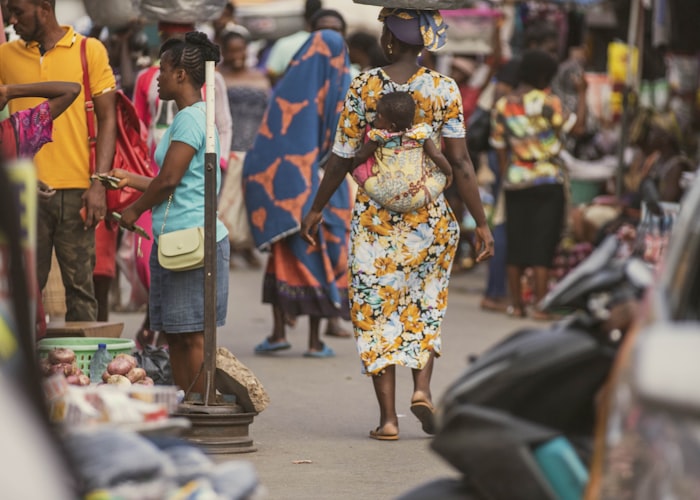
On the Road Through the Sahel
Crossing the semi-arid belt between the Sahara and savanna — a slow overland journey through Mali, Burkina Faso, and northern Ghana.
The Sahel is a band of semi-arid land about 5,000 kilometres long and a few hundred wide, running from the Atlantic coast of Senegal to the Red Sea, between the Sahara above it and the savanna below. The name is Arabic for shore, which is the right image: it is the coastline of a sand sea.
For most of the twentieth century it was a travel region — the overland route from Europe to West Africa ran through it, the Paris–Dakar rally crossed it, and Timbuktu, Agadez and Djenné were on itineraries. Almost none of that is possible now, and the honest version of a Sahel story has to start there.
What closed
Mali since 2012, Burkina Faso since 2015, Niger since roughly the same period. Jihadist insurgencies spreading from the north and east, coups in all three countries between 2020 and 2023, the withdrawal of French and UN forces, and the formation of the Alliance of Sahel States outside ECOWAS. Most foreign ministries now advise against all travel to all three, and the advice is not precautionary.
That removes Timbuktu, Djenné's great mud mosque, the Bandiagara escarpment and Dogon country, Agadez and the Aïr — which is to say it removes most of what the Sahel was known for. The manuscripts of Timbuktu were evacuated down the Niger in trunks and rice sacks in 2012 and are conserved in Bamako. The Festival au Désert has been in exile for over a decade.
What is still open
The western end. Senegal is calm and its northern edge — Saint-Louis, the Senegal river, Djoudj's bird colonies, the Lompoul dunes — is Sahelian in landscape and climate without the security picture. Mauritania has reopened the Adrar circuit: Chinguetti's desert libraries, Ouadane, the Terjit oasis, and the iron-ore train from Zouérat that visitors ride on top of open ore wagons for sixteen hours.
And the southern edge of the belt, in northern Ghana, Benin and Togo, is partly reachable — though the border districts of all three now carry advisories of their own as the insurgency pushes south toward the coast, which is the development everyone in the region is watching.
The Sahel is Arabic for shore, which is the right image: it is the coastline of a sand sea. The tide has been going the wrong way for a decade.
The thing that is not a security story
The Sahel is also where the Great Green Wall is being attempted — an initiative launched in 2007 to restore 100 million hectares of degraded land across eleven countries in a band along the desert edge. The original framing, a literal wall of trees, was quietly abandoned as unworkable; what has replaced it is a mosaic of restoration techniques, much of it farmer-managed natural regeneration, which is less photogenic and works considerably better.
Progress has been far behind schedule and honestly reported as such. But in parts of Niger and Burkina Faso, land that was bare in the 1980s now carries tree cover, largely because farmers stopped clearing regrowth rather than because anyone planted anything. It is the largest ecological restoration effort under way anywhere and it is happening in the region hardest to report from.
If you go
Go to Senegal and Mauritania, with an operator, in the dry season between November and March. Cross at Rosso or Diama, budget time for the formalities, and carry twenty photocopies of your passport for the checkpoints. Do not improvise a route toward the Malian border. Read your ministry's advisory the week you book and again the week you fly, because the map moves.
And understand what you are looking at. This is a region of about 150 million people that has been through drought, insurgency and four coups in five years, and where the most consequential thing happening is not the conflict but whether the land can be brought back. That is the story worth asking about, and the people who can tell it are in Nouakchott and Saint-Louis, not in the archive.
Kwame edits ExplWorld’s Africa coverage and drives the continent’s worst roads personally to keep the guides honest. Formerly of the BBC’s Lagos bureau, he has crossed the Sahel five times and maintains the magazine’s overland-border database himself.