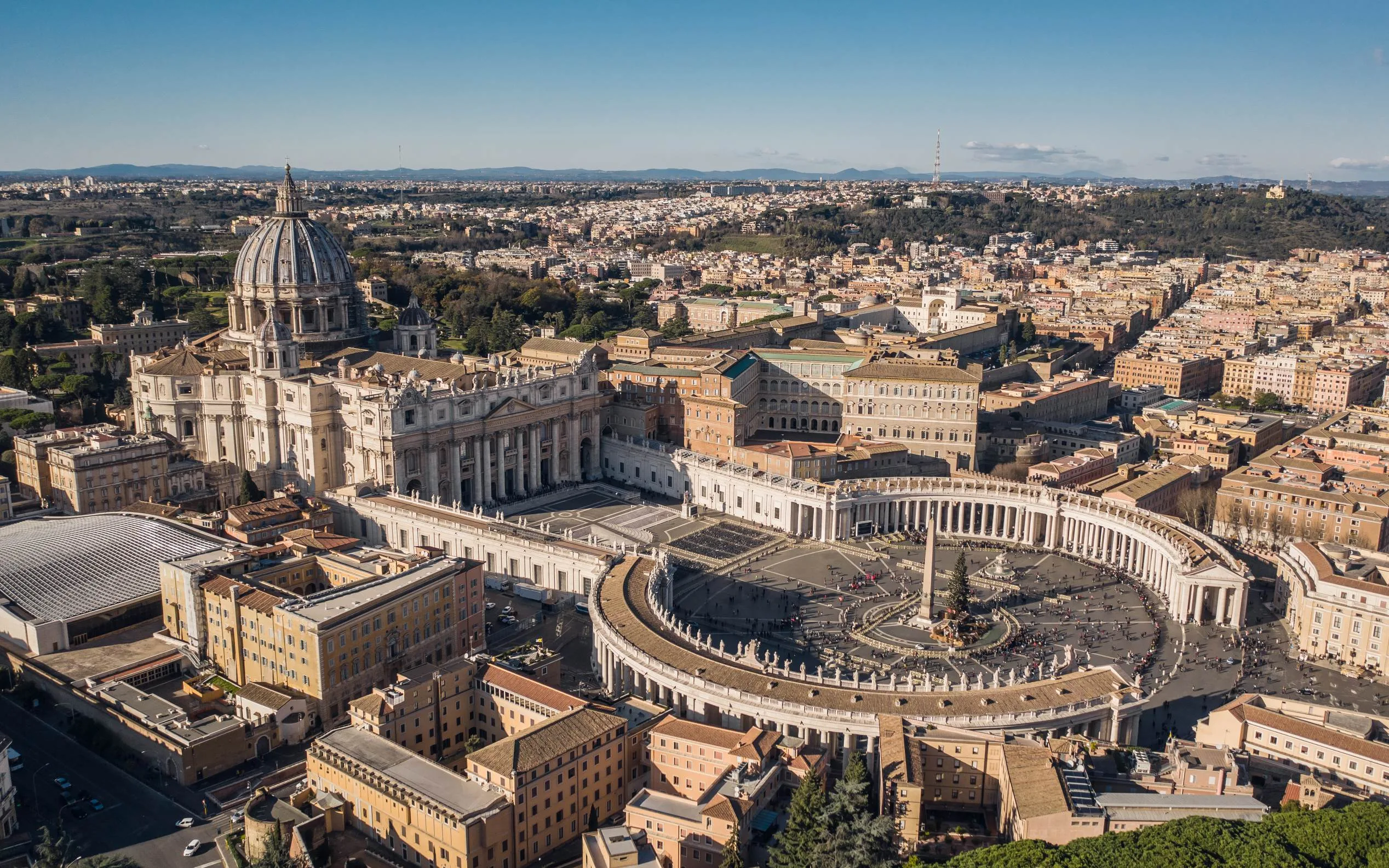
Six Million Tickets
Vatican City levies no income tax, exports almost nothing and houses fewer than a thousand people, and its public revenue rests on a museum turnstile and the rent from Roman property. The one time it tried to make money a different way it put something in the region of €350 million into a building in Chelsea and ended up trying a cardinal in its own criminal court.
By half past seven on a Tuesday in April the queue on the Viale Vaticano has already turned the corner. It is a particular kind of queue: nobody in it is local, almost everyone has a phone out, and men are working the line offering to sell entries that these people have mostly already bought. By nine it will run several hundred metres along the base of the wall, which is the only part of the boundary of this country that most visitors ever see. It looks like a tourist attraction managing its demand badly. It is closer to a national budget standing on a pavement.
Vatican City is forty-four hectares with a resident population in the hundreds and fewer than a thousand citizens, a good number of whom live abroad as papal diplomats. Citizenship here is functional rather than national — it is granted with a job and lapses when the job ends. There is no income tax, no VAT, no customs duty and no export industry beyond stamps and coins. Something under five thousand people work for the state and the Holy See between them, and almost all of them are Italians who come in through a gate in the morning and go home to Rome at night. A country arranged like that has to answer a question most countries never have to ask out loud: where does the money actually come from.
What 1929 paid
It came, in the first instance, from a settlement. The Roman Question had been open since Italian troops took Rome on 20 September 1870 and the popes withdrew into the Vatican as self-declared prisoners, refusing to recognise the loss of the Papal States. It closed on 11 February 1929, when Cardinal Pietro Gasparri and Benito Mussolini signed the Lateran Pacts: a treaty creating the sovereign state, a concordat governing the Church's position in Italy, and — the part that matters here — a financial convention. Italy paid 750 million lire in cash and a further billion lire in five per cent Italian state bonds, as compensation for the territory annexed in 1870. To manage it the Holy See hired Bernardino Nogara, a Lombard engineer and financier who is generally said to have accepted on the condition that he would not be constrained by religious considerations in choosing where to put the money. He ran the Special Administration until 1954, moved a great deal of it out of Italian paper into gold, foreign currency and equities in a long list of companies, and multiplied it. Everything the Holy See has since had to invest descends from that mandate.
Two sets of books, one turnstile
The Vatican keeps two budgets. The Governorate runs the territory — the museums, the post office, the shops, the gendarmerie — and usually posts a surplus. The Roman Curia runs the Church: a hundred-odd nunciatures carrying diplomatic relations with about a hundred and eighty states, dicasteries, seminaries, the media operation, and it has reported an operating deficit in the tens of millions of euros in most recent years. The museums are what stands between the two numbers. They took close to seven million visitors in 2019 and have been back near that level since 2023; admission is twenty euros plus a booking fee, and the museums are by a distance the largest single source of income the state has. On the Curia side the assets are property: APSA, which manages the Holy See's real estate and investments, published accounts for the first time in 2021 and disclosed a portfolio of roughly five thousand properties, the great majority in Italy and heavily concentrated in Rome, with a large share let at nominal or below-market rents to employees, religious orders and institutions. That is a policy rather than an oversight, and it caps what the portfolio can yield. Peter's Pence, the annual collection taken in parishes worldwide, runs in the tens of millions and has been falling for years. When the museums closed in March 2020 and stayed shut for most of the following twelve months, the income simply stopped while the costs did not, and in March 2021 Francis ordered a graduated cut to curial salaries — ten per cent for cardinals, less further down the scale — explicitly in order not to lay anybody off.
A state with no tax base has two ways to pay for itself: charge people to see what it inherited, or invest what it was handed in 1929. The Vatican has done both for nearly a century, and only one of them has ever been reliable.
The building in Chelsea
The Secretariat of State is the department closest to the pope, and until recently it held reserves of its own and invested them without much outside scrutiny. In 2013 and 2014 it put money into a fund run by the financier Raffaele Mincione which held a stake in 60 Sloane Avenue, a former Harrods depository in Chelsea earmarked for conversion into flats. By 2018 the Vatican wanted out of the fund and into direct ownership; the exit was brokered by another intermediary, Gianluigi Torzi, who ended up holding the thousand voting shares in the company that owned the building while the Vatican held the other thirty thousand non-voting ones. It paid him around €15 million to hand them over. By the time the affair closed the Holy See had put something in the region of €350 million into a single London property, part of it borrowed against and part of it drawn from funds fed by Peter's Pence. The building was sold in July 2022 for about £186 million. The Vatican's own reckoning of the loss was in the order of €140 million, which is more than the museums take at the door in a year.
A cardinal in the dock
What followed is the part that has no precedent. On 1 October 2019 Vatican gendarmes raided the Secretariat of State and the Financial Information Authority, the Holy See's own anti-money-laundering unit, and suspended five officials; the Egmont Group, the international network of financial intelligence units, cut the Vatican unit off from its secure system in November and restored access at the end of January. In September 2020 Cardinal Angelo Becciu, who had been the substitute at the Secretariat of State when the investment was made, resigned the rights of a cardinal. In December of the same year Francis stripped the Secretariat of State of its portfolio altogether and moved the assets to APSA, ending the arrangement that had made the deal possible. Then, by a rescript of 30 April 2021, he changed the judicial order so that cardinals and bishops could be tried by the ordinary tribunal of Vatican City State rather than by a panel of their peers. The trial opened on 27 July 2021, in a hall of the Vatican Museums converted into a courtroom, with ten defendants. It ran for eighty-odd hearings and delivered a verdict on 16 December 2023: Becciu convicted of embezzlement and sentenced to five years and six months, with convictions and sentences for most of the others. Everyone convicted appealed, and under Vatican law nothing is final until the appeal concludes.
The objection the trial could not answer
The defence made an argument that is worth taking seriously whatever one thinks of the individuals. In an absolute monarchy the same man authorises the prosecution, appoints the judges, and can alter the law while the investigation is running — and Francis did issue several rescripts during this one, including the one that made the trial of a cardinal possible in the first place. Vatican justice has no separation of powers to appeal to, because the state was not built with any. The reply the Holy See can make is procedural rather than constitutional: the hearings were public, the defendants had counsel, the judges were lay professionals, the reasoning was published, and an appeal exists. That is a great deal more than the Vatican offered anyone in living memory, and it is still a monarch trying his own officials. Both things are true, and the second is the reason the first was newsworthy.
What is left to pay for
The structural problem was never the London building; it was that the recurring costs of running a global church exceed what a museum and a Roman rent roll bring in. In November 2024 Francis wrote to the College of Cardinals appointing Cardinal Kevin Farrell sole administrator of the pension fund and warning of a serious prospective imbalance — the fund, on current arrangements, cannot meet its obligations in the medium term. He died on 21 April 2025, and the letter became somebody else's inheritance five months after he wrote it. The Jubilee that ran from Christmas Eve 2024 to 6 January 2026 brought Rome a year of crowds the city planned for in the tens of millions, and jubilee years end. Meanwhile the one reliable revenue line cannot be scaled: the galleries are already at their physical limit, and the Sistine Chapel will take only so many bodies an hour before the conservators object. The state's answer has been price and timing rather than volume — timed slots, extended evening openings, a booking fee on top of the ticket.
It is easy to write about the Vatican as a curiosity, a country the size of a golf course with an army of a hundred and thirty-five men in striped uniforms. The more accurate description is a very small government with a very large institution attached to it, no ability to tax, no ability to borrow much, and one inherited asset that happens to be among the most visited buildings on earth. Stand at the back of the queue on the Viale Vaticano at half past seven and you are not waiting to see art. You are standing in the revenue.