natatravel / stock.adobe.com
The Line Nobody Budgets For
The visitor levy is the one charge on a European trip that almost nobody budgets for and almost everybody pays. Three collection models, a long list of exemptions nobody advertises, and a tax whose payers have no vote in the council that sets it.
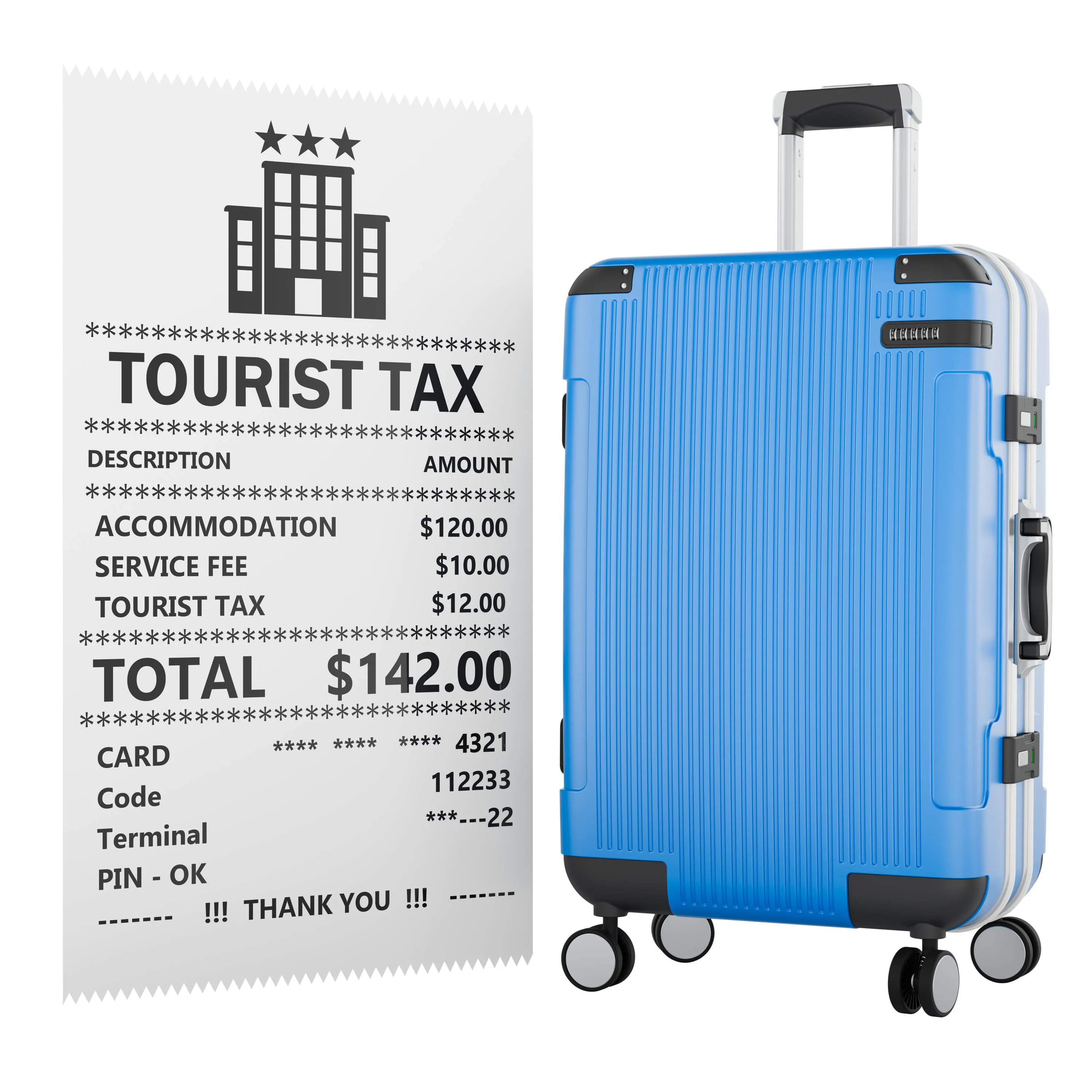
A tourist tax is the one line on a European holiday bill that almost nobody budgets for and almost everybody pays. It is not the VAT already inside the room rate, and it is not the resort fee that American hotels invented to keep their headline prices low. It is typically a per-person, per-night levy set by a city or a region — a few countries levy it nationally, and some per room rather than per head — collected by the accommodation on the municipality’s behalf, and in most places it is legally required to be shown separately — which is why it so often arrives at check-out as a surprise in cash.
It is also, quietly, one of the fastest-growing charges in travel. Cities that had no visitor levy a decade ago now have one; cities that had one have raised it, usually more than once, and usually by more than inflation. The reason is not mysterious. Municipal budgets are under pressure everywhere, the costs a visitor imposes are visible and local, and the constituency that pays the charge is by definition not the constituency that votes on it.
The shape of the charge
Three models dominate. The flat per-night fee is the commonest: a fixed amount per adult per night, usually stepped by hotel category, so a hostel bunk and a five-star suite are not taxed alike. The percentage model charges a share of the room rate instead, which is self-adjusting and therefore politically easier to raise, but it makes the yield swing violently with the season and produces the odd result that the same bed generates twice the tax in August. The third is the arrival levy — a single charge for entering a place at all, whether or not you sleep there — and it is the model that has grown fastest, because it is the only one that reaches the day-tripper.
The stepping by category deserves a note, because it is where the design intent shows. A levy that charges the same amount at a campsite and at a grand hotel is regressive in a way that visibly discourages exactly the budget traveller a city usually says it wants. Most European schemes therefore band by star rating or by room rate, and a few exempt hostels, campsites and youth accommodation entirely.
Many per-person schemes carry the same exemptions, and they are worth knowing because they are rarely advertised: children below an age threshold that varies from around ten to eighteen, people travelling for medical treatment or to accompany a patient, and in many Italian and Spanish municipalities a cap after a fixed number of consecutive nights — the tax stops at night seven or night ten, on the reasoning that beyond that you are not a tourist but a temporary resident. Percentage-based and per-room schemes, by contrast, typically exempt no one: they tax the room, not the person. And business travellers are rarely exempt any longer — the German cities that once excluded business stays have mostly stopped since a court ruling allowed taxing them.
What the money is for
The pitch is always the same: the visitor uses the pavement, the waste collection, the public toilets and the emergency services, and the resident should not carry the whole cost of that. Where the revenue is ring-fenced, it tends to go to street cleaning, heritage maintenance, visitor infrastructure and destination marketing — that last item being the one residents object to most, since it funds the campaign that brings more of the people the tax is meant to offset.
The better-designed schemes publish an account of what the money did, and a few have moved further: revenue directed at housing in the centre, at maintaining a service the visitor economy has priced out, or at a specific conservation programme with a named budget. Those are the schemes that survive local politics, because a resident can see the connection. The schemes that generate resentment are the ones where the levy rises annually and nothing visibly changes.
Where it is not ring-fenced, it simply enters the municipal budget, and the honest description is that it is a tax on people who cannot vote in the election that sets it. That is not automatically wrong — every excise works that way, and a hotel guest is arguably an easier target than a resident precisely because the burden is spread across many people paying a small amount each. But it does explain why the rates have risen so much faster than local property taxes over the last decade.
A visitor levy is the rare tax whose payers have no vote in the council that sets it. That is exactly why it keeps going up.
The day-tripper problem
Every accommodation-based levy has the same structural hole: it collects nothing from the visitor who does not sleep. In a city where day visitors substantially outnumber overnight ones — which describes most famous small cities, every cruise port and a great many alpine and coastal towns — the levy therefore charges the lower-impact visitor and misses the higher-impact one entirely.
That is the argument behind the arrival levies now appearing, and it is a good one. It is also much harder to implement: an accommodation levy has a collection agent with a legal relationship to the guest, and an arrival levy has to be enforced against people arriving on foot, by train, by coach and by ship, at every entrance. The schemes that have worked have all narrowed the problem, usually to a handful of controlled arrival points on defined peak days.
The practical part
Assume the tax is not in the price you booked. Platforms differ: some quote it, some show it as a separate line at the payment step, and some mention it only in a paragraph of property notes. If the accommodation asks for it in cash at check-in, that is normal in Italy, Greece and much of central Europe — it is not a scam, though it is also the easiest charge in travel to invent, so ask for the receipt the municipality requires them to issue. A property that cannot produce one is worth a second look.
Where the levy is stepped by nights, book consecutive nights at one property rather than splitting a stay, since a cap that resets on moving costs you the whole schedule again. Where children are exempt below a threshold, check whether the threshold is the age at arrival or at booking. And where a city runs a card or pass that includes the levy, do the arithmetic rather than assuming — a levy folded into a bundle is not a levy waived.
The number to carry in your head is that for two people on a week-long city stay, the levy typically lands somewhere between the cost of one restaurant meal and one night of the accommodation itself. For a fortnight across three countries with children, it is a real line in the budget. And for a day-tripper arriving by cruise ship or coach, the arrival levy is increasingly the whole of what the destination will collect from the visit — which is precisely the argument its supporters make for it.
Sources
- The municipality where you stay
Visitor levies are set city by city — the binding rates, bands and exemptions are on the city administration’s own site, usually under “tourist tax” or “city tax”.
- Your booking confirmation
Where the platform collects the levy it appears as a line at the payment step; where it does not, the property notes collection at check-in.